
accounting software
Read post How to Read a Small Business Balance Sheet in UAE
Learn how to understand a small business balance sheet in the UAE, including assets, liabilities, equity, working capital and financial health.
Learn how to understand a small business balance sheet in the UAE, including assets, liabilities, equity, working capital and financial health.

Create professional GST-compliant invoices in under 30 seconds, send WhatsApp payment links, and track inventory effortlessly.
Learn how UAE restaurants and cafés can track daily sales, record supplier purchases, reconcile payments, manage food inventory and maintain accurate VAT.
Quick Answer: Restaurants and cafés in the UAE can maintain accurate daily sales and purchase records by recording every customer order, separating cash and digital payments, verifying supplier invoices, tracking ingredients and stock usage, documenting wastage, and reconciling transactions at the end of each day. A consistent bookkeeping process helps prevent missing sales, incorrect food costs, duplicate purchases, and unreliable VAT records.
Operating a restaurant or café in the United Arab Emirates involves managing numerous financial transactions every day. From small coffee shops in Dubai and neighbourhood restaurants in Sharjah to casual dining outlets in Abu Dhabi, businesses must monitor customer bills, takeaway orders, online delivery sales, supplier purchases, ingredient consumption, and operating expenses.
Unlike some other small businesses, restaurants work with perishable inventory, frequent low-value transactions, multiple payment channels, and fluctuating ingredient prices. Even small recording mistakes can affect profitability.
For example, a café may generate AED 7,000 in daily customer sales but struggle to identify actual profit because supplier purchases, ingredient wastage, online delivery charges, and employee meals are not recorded properly.
When purchase records are incomplete, the business may also overstate available inventory or underestimate food costs. Similarly, when cash and card collections are not reconciled, sales figures may differ from actual payments received.
Accurate daily bookkeeping allows restaurant owners to understand what they sell, what they purchase, how much inventory they consume, and whether the business is generating sustainable profits.
The following eight steps explain how UAE restaurants and cafés can maintain reliable sales, purchase, inventory, and financial records.
Every restaurant and café should establish a consistent process for recording customer sales, including dine-in orders, takeaway sales, catering transactions, and orders received through delivery platforms.
Sales should be recorded when they occur under the applicable accounting rules, rather than relying only on cash deposited into the bank.
A practical daily sales record should contain the transaction date, bill or invoice number, sales channel, sales amount, applicable VAT, discounts, refunds, and payment status.
For example, a Dubai café may receive payments from customers ordering coffee and snacks at the counter, while also accepting online delivery orders.
Each transaction should be included in the daily sales records without double-counting the same order.
Sales channel | Amount (AED) |
|---|---|
Dine-in Sales | 3,500 |
Takeaway Sales | 1,500 |
Online Delivery Sales | 2,000 |
Catering Sales | 1,000 |
Total Daily Sales | 8,000 |
These figures are illustrative and assume the amounts are measured on a consistent revenue basis.
The restaurant should also maintain separate records for discounts, cancelled orders, returned payments, and applicable VAT.
For example, if a customer order worth AED 150 is cancelled before completion, the business should not allow the cancelled bill to inflate its final sales records.
Similarly, complimentary meals and staff meals should be identified separately so that food consumption can be reconciled.
A point-of-sale (POS) system can help record customer transactions, but the accuracy of the records depends on correct item setup and consistent use by employees.
A complete daily sales register helps restaurant owners monitor turnover, compare sales channels, and identify unusual transaction differences.
Restaurants frequently collect payments through multiple channels, including cash, debit cards, credit cards, digital wallets, and third-party food delivery platforms.
These payment methods should be recorded separately because the total sales value may differ from the amount immediately received in cash or credited to the bank.
For example, a restaurant may generate AED 10,000 in daily sales.
Payment channel | Sales amount (AED) |
|---|---|
Cash | 2,500 |
Card | 4,500 |
Delivery Platform | 3,000 |
Total | 10,000 |
Although total sales are AED 10,000, the business should not assume that the entire amount has been deposited into its bank account.
Cash collections should be compared with the physical cash drawer.
Card payments should be reconciled with payment terminal records and subsequent bank settlements.
For online food delivery platforms, the restaurant should compare customer order values with platform settlement reports, commission charges, refunds, adjustments, and actual amounts transferred.
For instance, if a delivery platform collects AED 3,000 from customers and deducts AED 600 in commissions and other agreed charges, the settlement may be AED 2,400 before any further adjustments.
The restaurant should not automatically record only AED 2,400 as sales revenue. The accounting treatment depends on whether the restaurant is acting as principal or agent and the relevant contractual arrangements.
Daily reconciliation helps identify missing payments, duplicate entries, incorrect deductions, and unsettled customer transactions.
Separating sales from payment collections gives restaurant owners a more accurate understanding of revenue and cash flow.

Restaurants and cafés regularly purchase food ingredients, beverages, packaging materials, cleaning supplies, and other operational items.
Some purchases are made from regular suppliers on credit, while others are paid immediately in cash or through bank transfers.
To maintain accurate purchase records, every supplier transaction should be supported by an invoice, receipt, or other appropriate document.
Employees should verify the actual quantity delivered before recording purchases.
For example, a restaurant orders 25 kilograms of chicken from a supplier, but only 23 kilograms are delivered.
If the business records all 25 kilograms as received, its stock records will be overstated.
The supplier discrepancy should be documented and resolved before the final purchase quantity is confirmed.
Purchase category | Amount (AED) |
|---|---|
Vegetables and Fruits | 450 |
Meat and Poultry | 800 |
Dairy Products | 300 |
Beverages | 250 |
Packaging Materials | 200 |
Total Purchases | 2,000 |
Purchases of ingredients held for future use should generally be reflected in inventory or cost accounting according to the business's accounting policies, rather than automatically treated as the cost of food sold that day.
Businesses should also separate purchases from supplier payments.
For example, a restaurant may receive ingredients worth AED 2,000 on credit and pay the supplier a week later.
The purchase and subsequent payment are two distinct accounting events.
Recording both correctly helps maintain reliable supplier balances and prevents duplicate expenses.
Food inventory management is particularly important for restaurants because ingredients are frequently consumed, damaged, spoiled, or wasted during preparation.
Restaurants should maintain records of opening stock, ingredients purchased, stock transferred, ingredients consumed, and closing stock.
Inventory records should reflect the relevant measurement units, such as kilograms, litres, packets, bottles, or individual items.
For example, a café purchasing coffee beans should record quantities consistently to avoid confusion between kilograms and grams.
A practical food inventory reconciliation may be calculated using:
This simplified formula assumes relevant inventory movements and adjustments are appropriately included.
Particulars | Amount (AED) |
|---|---|
Opening Food Inventory | 12,000 |
Food Purchases | 45,000 |
Closing Food Inventory | 10,000 |
Cost of Food Used | 47,000 |
The resulting AED 47,000 represents the cost of inventory used or otherwise removed during the period under the simplified calculation. Businesses should distinguish normal food consumption, abnormal wastage, staff meals, and other relevant movements where necessary.
Expiry-related losses should also be recorded separately.
For example, if vegetables worth AED 250 spoil before preparation, the restaurant should document the wastage and adjust inventory accordingly.
Restaurants should use suitable stock rotation methods, including First-Expire, First-Out (FEFO), for products with limited shelf lives.
Regular physical stock counts help reveal differences between recorded inventory and actual ingredients available.
Accurate food inventory records help restaurants reduce wastage, monitor ingredient costs, and improve purchasing decisions.
Food cost is one of the most important performance indicators for restaurants and cafés.
Even when sales increase, profits may decline if ingredient costs rise or excessive quantities are wasted.
Restaurants should compare their cost of food sold with the food sales revenue generated during the same period.
A commonly used financial measure is the food cost percentage:
For example, a restaurant generates AED 80,000 in food sales excluding VAT and has AED 28,000 in corresponding food cost of sales.
Its food cost percentage is 35%.
Restaurant Food Cost Calculator
Food Cost Percentage
Food Gross Contribution
A higher food cost percentage may indicate increased ingredient prices, inefficient portion control, excessive wastage, incorrect menu pricing, or inventory discrepancies.
However, there is no single ideal percentage suitable for every restaurant.
A fine-dining restaurant, fast-food outlet, bakery, and coffee shop may have different cost structures and pricing strategies.
Owners should compare performance across similar periods and review individual menu items where practical.
Daily purchase and sales records provide the foundation for these calculations.
Besides ingredient purchases, restaurants incur many other operating expenses, including rent, employee salaries, electricity, maintenance, cleaning, delivery charges, and equipment servicing.
These expenses should be recorded separately from food purchases to ensure financial reports show the correct cost categories.
Restaurants should also maintain supplier-wise accounts that show invoices received, amounts paid, outstanding balances, and any purchase returns or credits.
For example, a restaurant receives a supplier invoice of AED 5,000 and pays AED 3,000.
The remaining AED 2,000 should continue to appear as payable until settled or otherwise adjusted.
If the restaurant returns damaged ingredients worth AED 500 and the supplier accepts the return, the relevant payable and stock or expense records should be adjusted using the appropriate documentation.
Customer refunds, supplier returns, and supplier discounts should not be recorded as unrelated new sales or ordinary expenses.
Restaurants should also establish procedures for staff spending and petty cash.
If a kitchen employee purchases emergency supplies worth AED 80, the transaction should be supported by a receipt and recorded under the correct category.
Regular supplier reconciliation can help identify invoices that were missed, recorded twice, or paid incorrectly.
Separating supplier payments, purchases, returns, and operating expenses improves cash flow management and the accuracy of financial reports.
VAT-registered restaurants and cafés in the UAE must maintain appropriate financial and tax records.
The UAE generally applies a standard 5% VAT rate to taxable domestic restaurant and café supplies, subject to the applicable tax rules.
Businesses should record the value of taxable sales, output VAT, eligible input VAT on purchases, and relevant adjustments.
The UAE Ministry of Finance explains that businesses must maintain accurate, up-to-date financial transaction records, and VAT-registered businesses must account for relevant VAT charged and recoverable.
For example, if a restaurant makes taxable sales worth AED 10,000 excluding VAT, the output VAT at 5% would be AED 500.
If it purchases eligible business supplies with AED 150 of recoverable input VAT, the net difference may be AED 350 before other applicable transactions or adjustments.
Restaurants should not assume that all VAT on employee benefits, entertainment, or other expenses is automatically recoverable.
The tax treatment depends on the relevant conditions and restrictions.
VAT-registered restaurants should maintain relevant sales records, purchase invoices, tax invoices, credit notes, adjustments, and inventory documentation.
The Federal Tax Authority confirms that taxable persons generally must retain VAT invoices issued and received for a minimum of five years, subject to applicable exceptions and extended periods.
Businesses subject to UAE Corporate Tax should also consider the separate seven-year recordkeeping requirement applicable to relevant Corporate Tax documents.
Restaurants should retain sufficiently detailed records to trace transactions from source documents through their accounting entries and tax reporting.
Accurate tax records reduce the risk of missing transactions and make periodic reconciliations more manageable.
Restaurant accounting software can help organise daily sales, supplier purchases, payments, expenses, and inventory-related transactions.
A suitable system may support the entry of restaurant sales, customer receipts, supplier invoices, ingredient purchases, and financial reports.
For example, a café owner may want to review daily revenue alongside ingredient purchases, staff expenses, and outstanding supplier balances.
If these transactions are maintained in separate spreadsheets, preparing reliable reports can become time-consuming.
An integrated process can help reduce duplicate manual entries and provide clearer financial information.
Restaurants should assess whether their software supports their actual operations, including dine-in and takeaway transactions, POS integration, cash and card reconciliation, delivery-platform settlements, ingredient tracking, supplier accounts, and relevant VAT records.
Specialised restaurant functions such as kitchen order tickets, recipes, ingredient consumption, menu costing, and expiry management should be verified individually.
UAE restaurants and cafés exploring digital bookkeeping may evaluate Vinimay Accounting Software as part of their accounting software comparison.
Vinimay includes accounting workflows related to sales, purchases, receipts, payments, inventory, parties, and ledgers, with a restaurant and café industry category.
These types of functions are relevant to maintaining structured financial transaction records.
However, restaurant owners should verify currently available features before relying on the software for POS billing, automatic ingredient deductions, delivery-platform integration, detailed food costing, AED currency handling, and UAE VAT reporting.
The business should test representative transactions, from recording a customer sale and supplier purchase through to checking stock and financial reports.
The purpose of restaurant accounting software should be to improve transaction accuracy, reduce administrative work, and provide useful financial information for daily decisions.
Our editorial and compliance specialists create practical guides, tax calculation rules, and operational strategies to empower Indian small business owners and accountants.
Learn how to track daily business expenses in the UAE, organise receipts, manage petty cash, monitor spending, and maintain accurate VAT and tax records.
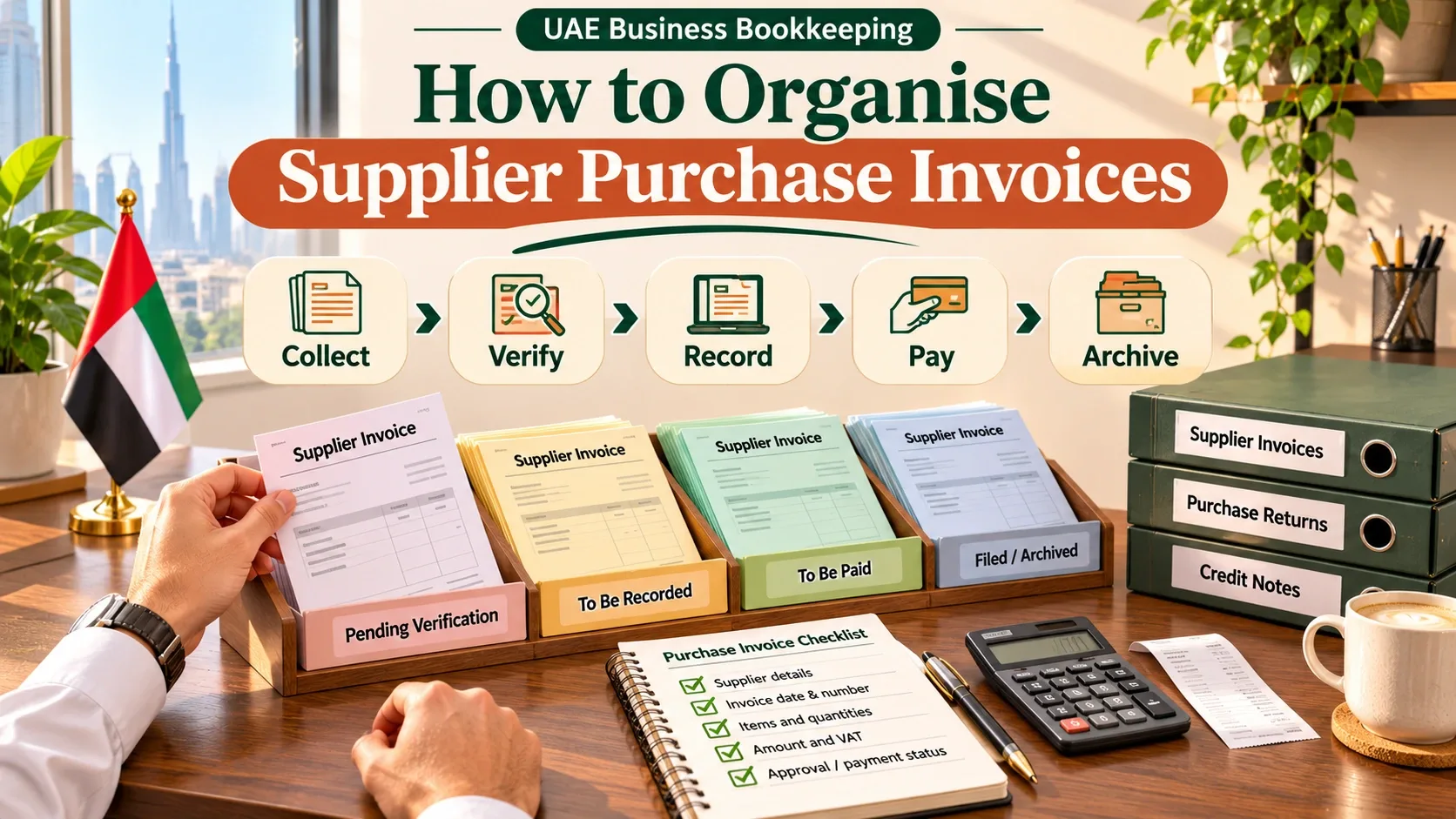
Learn how UAE small businesses can organise supplier purchase invoices, verify VAT details, track payments, prevent duplicates and maintain accurate records.
Create and download professional, GST-compliant tax invoices in under 30 seconds.
Create Free Invoice Now →