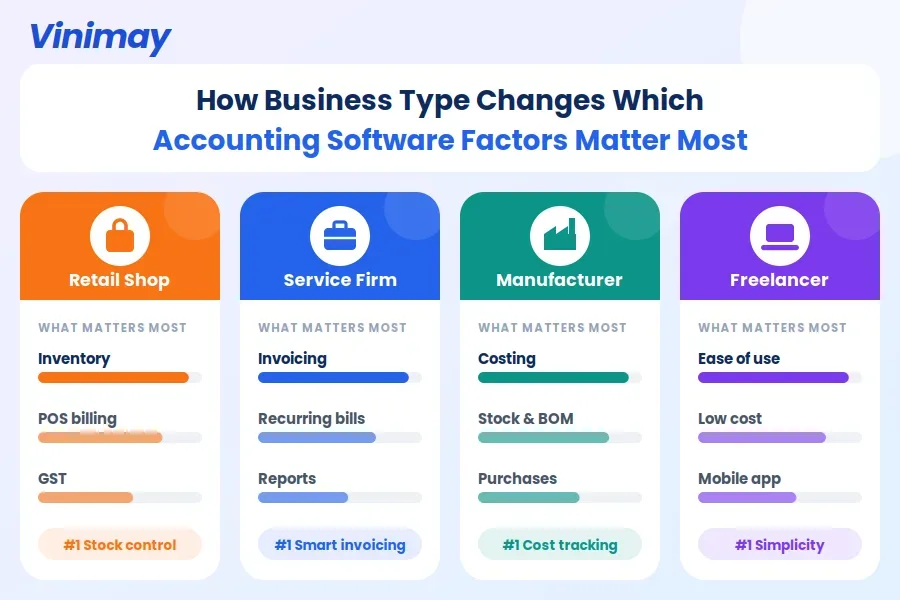
How Business Type Changes Which Accounting Software Factors Matter Most
Most accounting software checklists assume every business weighs the same factors equally — cost, features, ease of use. In practice, what actually matters shifts a lot depending on what your business does. A retail shop billing walk-in customers all day has a completely different priority list than a consultant billing five clients a month, even though both are technically "small businesses" comparing accounting software.
Treating every business type the same when evaluating software leads to a common mistake: picking a tool based on generic strengths (good reviews, low price) rather than the specific factor that actually matters for your operation. A retailer choosing software with no inventory link, or a wholesaler choosing one with weak outstanding tracking, ends up with software that "works" on paper but doesn't solve their actual daily friction.
Retail: Speed and Stock Come First
For a retail shop with daily walk-in customers, the priority is fast invoice creation tied directly to stock. If billing a sale doesn't reduce inventory automatically, stock counts drift from actual shelf reality within weeks, and reordering decisions get made on guesswork.
Fast, simple invoice creation matters more than deep reporting.
Inventory sync with billing is non-negotiable—this is where most manual retail systems break down.
Thermal or A5 print formats often matter more than PDF export, since counter receipts are the norm.
Service Providers: Recurring Billing and Client History
A consultant, agency, or repair service typically bills the same clients repeatedly, so the priority shifts toward customer history and consistency rather than speed or stock.
Saved client records matter more than inventory features, which are often irrelevant.
Clean, professional invoice formatting matters since these invoices usually go to clients by email, not handed over at a counter.
GST accuracy on services (correct SAC codes) is easy to overlook compared to product-based HSN codes, but matters just as much.
Wholesalers: Outstanding Tracking Above Everything
A wholesaler managing credit sales across many buyers has a fundamentally different pain point — knowing exactly who owes what, and when.
Outstanding tracking connected to Free Invoice matters more than almost any other factor.
Interstate GST handling (IGST vs CGST/SGST) becomes more relevant, since wholesalers often ship beyond their home state.
Purchase-side tracking matters too, since wholesalers are managing both what they sell and what they buy from suppliers.
Where Vinimay Fits Depending on Your Type
Vinimay's confirmed capabilities map differently depending on which category you fall into. For retail and wholesale businesses, inventory adjusts automatically as invoices are created, and GST (CGST, SGST, or IGST) is applied correctly based on the transaction — relevant to both stock accuracy and interstate billing. For all three types, sales, purchases, receipts, and payments are recorded against shared customer/vendor accounts, so outstanding balances stay accurate through the payment ledger regardless of whether you're a wholesaler managing many credit buyers or a service provider billing five regular clients.
[Create Your First Invoice Free with Vinimay]
Conclusion
There's no single accounting software checklist that fits every business—what matters most depends heavily on whether you're moving fast at a retail counter, billing recurring clients as a service provider, or tracking credit across dozens of wholesale buyers. Identifying your type first, then weighing factors against that specific need, gets you to the right software faster than a generic checklist ever will.
FAQs
Does a service business need inventory management in accounting software?
Generally not — inventory features matter mainly for businesses handling physical stock, so a service provider can usually skip this when comparing software.
Why does outstanding tracking matter more for wholesalers than retailers?
Because wholesalers typically sell on credit to many buyers, making it harder to track who owes what without a connected system, while retail is often cash-and-carry at the point of sale.
Should a retailer prioritize invoice speed or reporting depth?
Speed and stock sync generally matter more day to day—detailed reportingbecomes more valuable as the business scales, but isn't the first priority.
Do service providers need to worry about GST the same way product sellers do?
Yes — services use SAC codes instead of HSN codes, and getting these right matters just as much for compliance, even though it's less commonly discussed.
Does Vinimay handle both product (HSN) and service (SAC) based invoicing?
Vinimay applies GST correctly based on the transaction; confirm current SAC/HSN code support directly if your business needs both.
Related Topics
Published by Team Vinimay
Our editorial and compliance specialists create practical guides, tax calculation rules, and operational strategies to empower Indian small business owners and accountants.