Making the right business decisions requires accurate information about sales, expenses, cash flow, inventory, and overall financial performance. When data is maintained manually through different files or records, it can be difficult to get a clear picture of business operations and identify areas that need attention. Accounting software helps organize financial data and provides useful reports and insights that support better decision-making. By tracking transactions, payments, expenses, and business performance in one system, it enables business owners to understand their financial position more clearly.
Vinimay helps businesses manage accounting records, billing, inventory, and reports together, making important financial information easier to access. This guide explains how accounting software supports business decisions and how businesses can use financial data to plan, control costs, and improve operations.
Decision 1: Should I Restock This Product?
Without records: you restock based on a rough feeling of "this seems to be selling," possibly influenced by whichever product you happened to notice running low.
With records: sales records show exactly how much of this product has sold over recent weeks, and stock tracking shows current levels—so the restocking decision is based on actual sales pace rather than impression.
Decision 2: Should I Extend Credit to This Customer?
Without records: you decide based on how the relationship feels or how confident the customer sounds when asking.
With records: a customer-wise transaction history shows their actual payment pattern—how promptly they've paid in the past, whether anything is currently overdue—giving you something concrete to base the decision on, beyond how the conversation went.
Decision 3: Can I Afford to Hire Right Now?
Without records: this decision often comes down to a gut sense of whether business "feels" busy enough to justify the cost.
With records: reviewing expense records alongside sales trends over recent months shows whether revenue has genuinely grown enough to support additional costs, rather than reacting to a temporarily busy week.
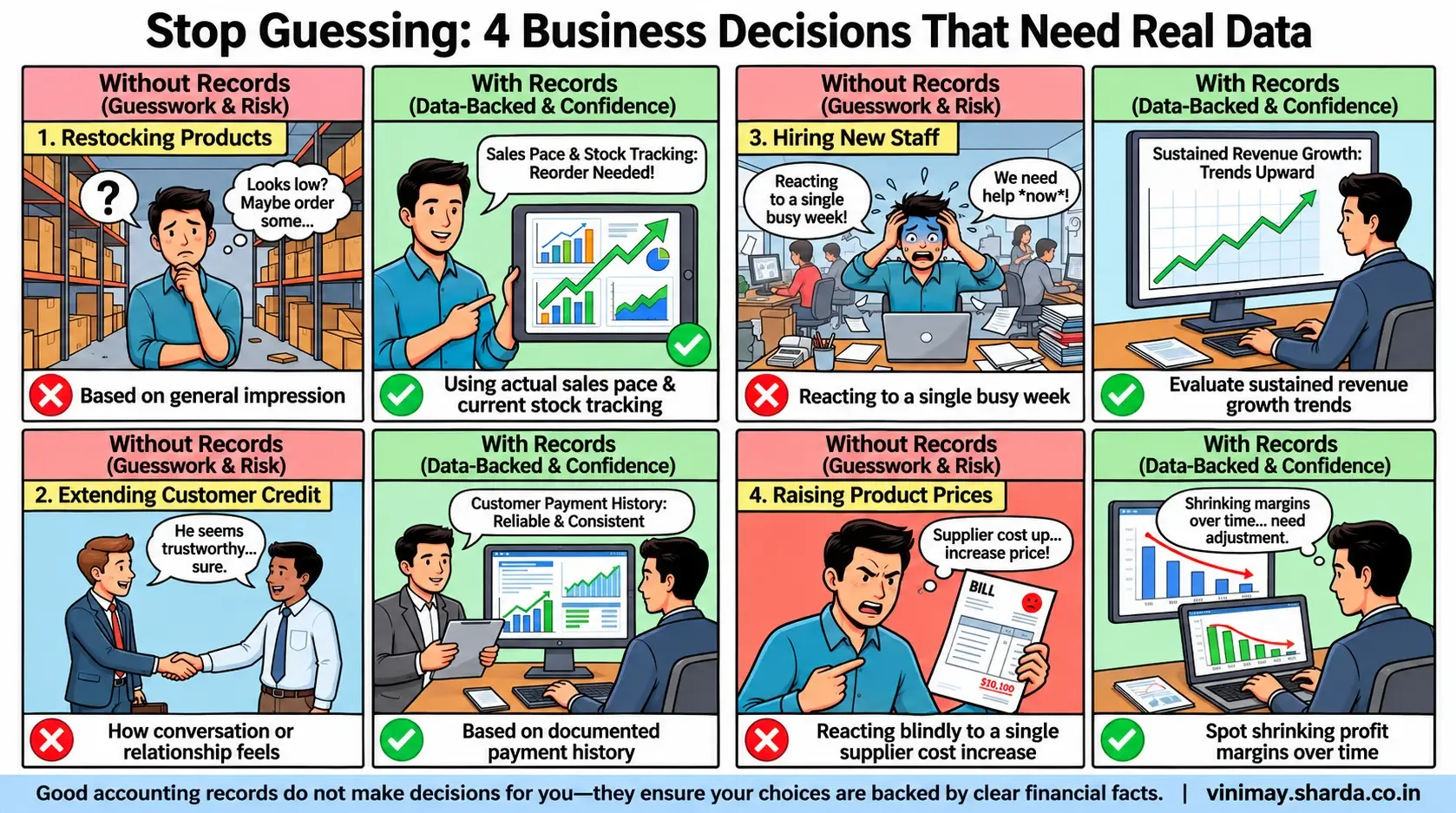
Decision 4: Is It Time to Raise Prices?
Without records: price changes often happen reactively, prompted by a supplier price increase you happened to notice, without a full picture of margins.
With records: comparing purchase records (what you're paying suppliers) against sales records (what you're charging customers) over time reveals whether your margin has been quietly shrinking, giving you evidence for a price adjustment rather than a hunch.
Decision 5: Which Customer Relationship Is Actually Worth Prioritising?
Without records: you might assume your most talkative or frequently contacted customer is your most valuable one.
With records: a customer-wise report showing total business done over time sometimes reveals a quieter customer is actually worth significantly more—a genuinely useful, occasionally surprising insight that only comes from looking at the numbers.
What All Five Decisions Have in Common
None of these decisions require complex analysis—they require the underlying data to already exist in an organized, reviewable form. The decision itself is still made by the business owner; what changes is whether that decision is backed by something checkable or just a feeling that could easily be wrong.
What This Requires From Your Records
For decisions like these to actually be possible, a few things need to be true of how records are kept:
Sales records and purchase records need to be accurate and current, not reconstructed from memory later
Customer and vendor management needs to keep each relationship's history organized and reviewable on its own
Ledger management needs to show running balances clearly, not just individual transactions
Reports need to summarize this data in a way that's actually usable, without requiring manual recalculation each time
In Vinimay, these areas are connected specifically so that decisions like the five above can be made from real, current data rather than memory—sales records feed restocking decisions, ledger management supports credit decisions, and reports bring purchase and sales data together for pricing and margin reviews. The decisions themselves still belong to the business owner; the records just make sure those decisions are informed ones.
Frequently Asked Questions
1. Does accounting software make business decisions for me? No—it provides accurate, organized data so decisions are informed rather than guessed, but the decision itself is still made by the business owner.
2. How does accounting software help with restocking decisions? By showing actual sales pace for a product alongside current stock levels, rather than relying on a general impression of what's selling.
3. Can records help decide whether to extend credit to a customer? Yes—a customer's documented payment history and current outstanding balance give a concrete basis for that decision.
4. How can expense records support a hiring decision? By showing whether revenue growth is sustained over time, rather than reacting to a single busy period.
5. Can accounting data reveal if prices need to change? Yes—comparing purchase costs against sales prices over time can reveal a shrinking margin that might not be obvious otherwise.
6. How do businesses identify their most valuable customers using records? By reviewing total business done per customer over time, which sometimes differs from who seems most engaged day to day.
7. What's the risk of making these decisions without good records? Decisions end up based on impressions or memory, which can be inaccurate or influenced by whichever recent event stands out most.
8. Does this require advanced financial analysis skills? No—most of these decisions rely on straightforward records like sales history, payment tracking, and expense records, reviewed directly.
9. How often should business records be reviewed for decision-making? Regularly enough that trends are caught early—monthly reviews are common, with more frequent checks for fast-moving decisions like restocking.
10. What's the biggest difference good records make to decision-making? They turn decisions from a feeling into something checkable, reducing the chance of a decision based on inaccurate impressions.
Related Topics
Published by Team Vinimay
Our editorial and compliance specialists create practical guides, tax calculation rules, and operational strategies to empower Indian small business owners and accountants.