The honest answer to this question isn't a list of specific industries—it's a set of conditions that, once true for any business regardless of what it sells, make accounting software genuinely necessary rather than optional.
Nearly every business that issues invoices needs to track what customers owe or must comply with GST and eventually needs accounting software—the type of business matters less than three underlying factors: transaction volume, need for record accuracy over time, and compliance requirements. A business hitting any of these thresholds benefits from software, regardless of industry label.
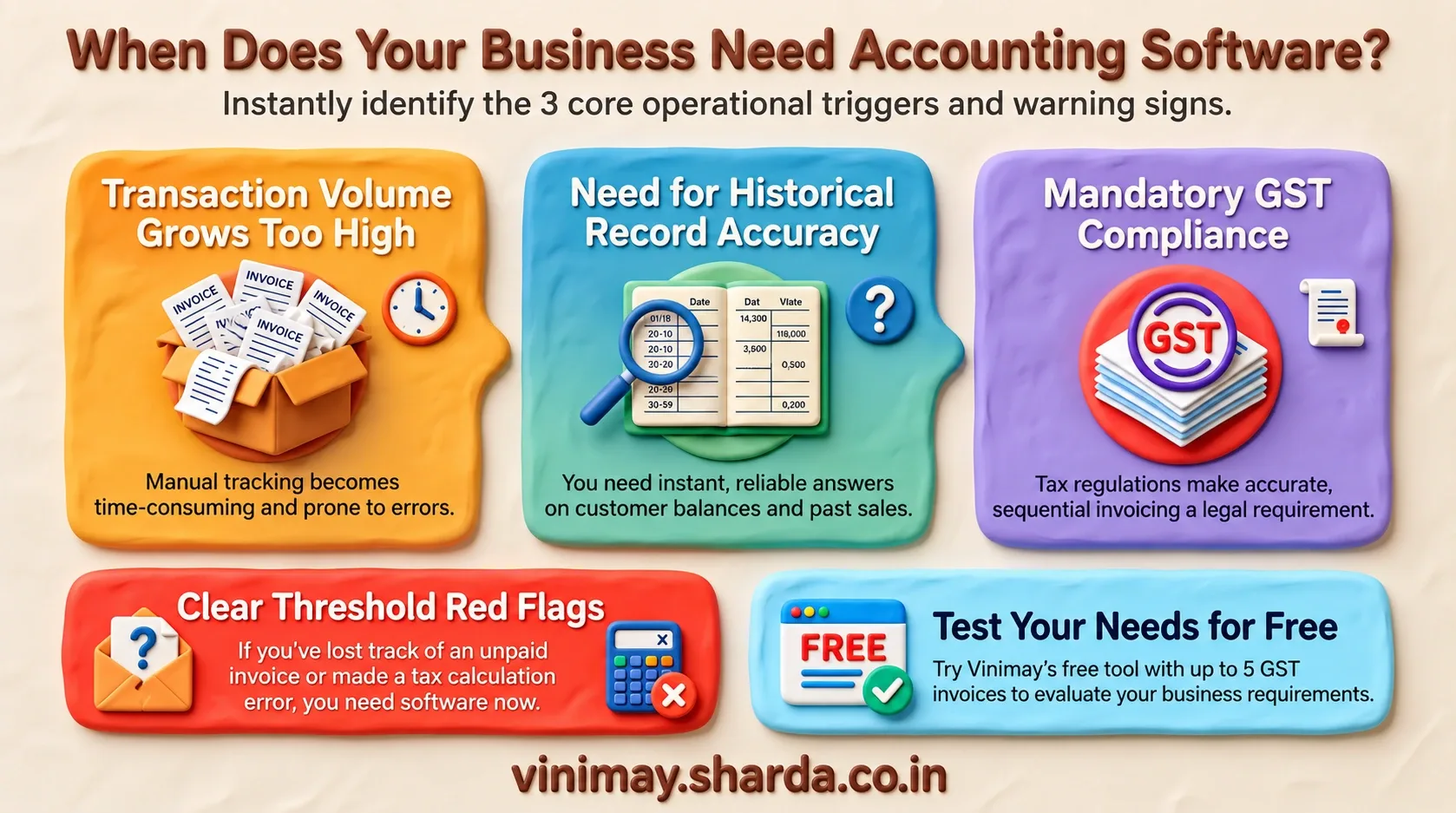
The Three Underlying Triggers, Not Industry Categories
Volume: Once transactions happen regularly enough that manual tracking becomes error-prone or time-consuming
Need for historical accuracy: Once a business needs to answer questions like "how much is owed" or "what sold last month" reliably
Compliance requirements: Once GST registration makes accurate, sequential, tax-correct invoicing a legal necessity, not just good practice
How This Plays Out Across Different Business Types
The Businesses That Genuinely Don't Need It Yet
A business issuing one or two invoices a month, with no inventory, no GST registration requirement, and no complexity in tracking who's paid, can reasonably continue with manual methods a while longer—needing accounting software isn't universal from day one; it's a threshold that most businesses eventually cross, just at different speeds.
Signs You've Crossed the Threshold, Regardless of Industry
You've lost track of whether a specific invoice was paid
Manual tax calculation has produced an error at least once
You've spent more than an hour reconstructing a month's sales figures
A customer or vendor has questioned a bill's accuracy
Where Vinimay Fits Across Business Types
Vinimay's core structure—GST invoicing, sales and purchase records, inventory, and payment tracking—is built to serve the underlying triggers described above rather than one specific industry, which is why it applies across retail, wholesale, service, and other business types covered in this discussion. The free invoice tool, offering up to 5 GST invoices, is a practical way for any business type to test whether these underlying needs are actually present for them right now.
Frequently Asked Questions
Q1. Is accounting software only necessary for large businesses?
No, the need is driven by transaction volume, record accuracy needs, and compliance requirements—not business size alone.
Q2. What are the three main reasons a business needs accounting software?
Growing transaction volume, the need for reliable historical records, and GST compliance requirements.
Q3. Can a very small business reasonably delay adopting accounting software?
Yes, if transaction volume is genuinely low and compliance needs are minimal, manual methods can work temporarily.
Q4. What's a clear sign a business needs to adopt accounting software now?
Losing track of a specific invoice's payment status or a manual tax calculation error are both strong signals.
Q5. Does Vinimay serve a specific industry only?
No, its core features address underlying needs common across retail, wholesale, service, and other business types.
Q6. How can any business type test if these needs apply to them?
Vinimay's free invoice tool, up to 5 GST invoices, offers a practical, no-cost way to test this directly.
Q7. Can accounting software help a business monitor cash flow?
Yes, organized records of sales, expenses, payments, and outstanding amounts can help business owners understand cash inflows and outflows more clearly.
Q8. Can small businesses use accounting software for GST records?
Yes, GST-enabled accounting software can help businesses maintain invoices, tax details, sales records, and other information needed for GST-related record keeping.
Q9. Does accounting software reduce manual data entry for businesses?
Yes, features such as saved customer details, product information, automated calculations, and reusable invoice formats can reduce repetitive data entry.
Q10. Can accounting software help businesses prepare financial reports?
Yes, depending on the software, businesses can use recorded transactions to generate reports that help review sales, expenses, receivables, and overall financial activity.
Related Topics
Published by Team Vinimay
Our editorial and compliance specialists create practical guides, tax calculation rules, and operational strategies to empower Indian small business owners and accountants.