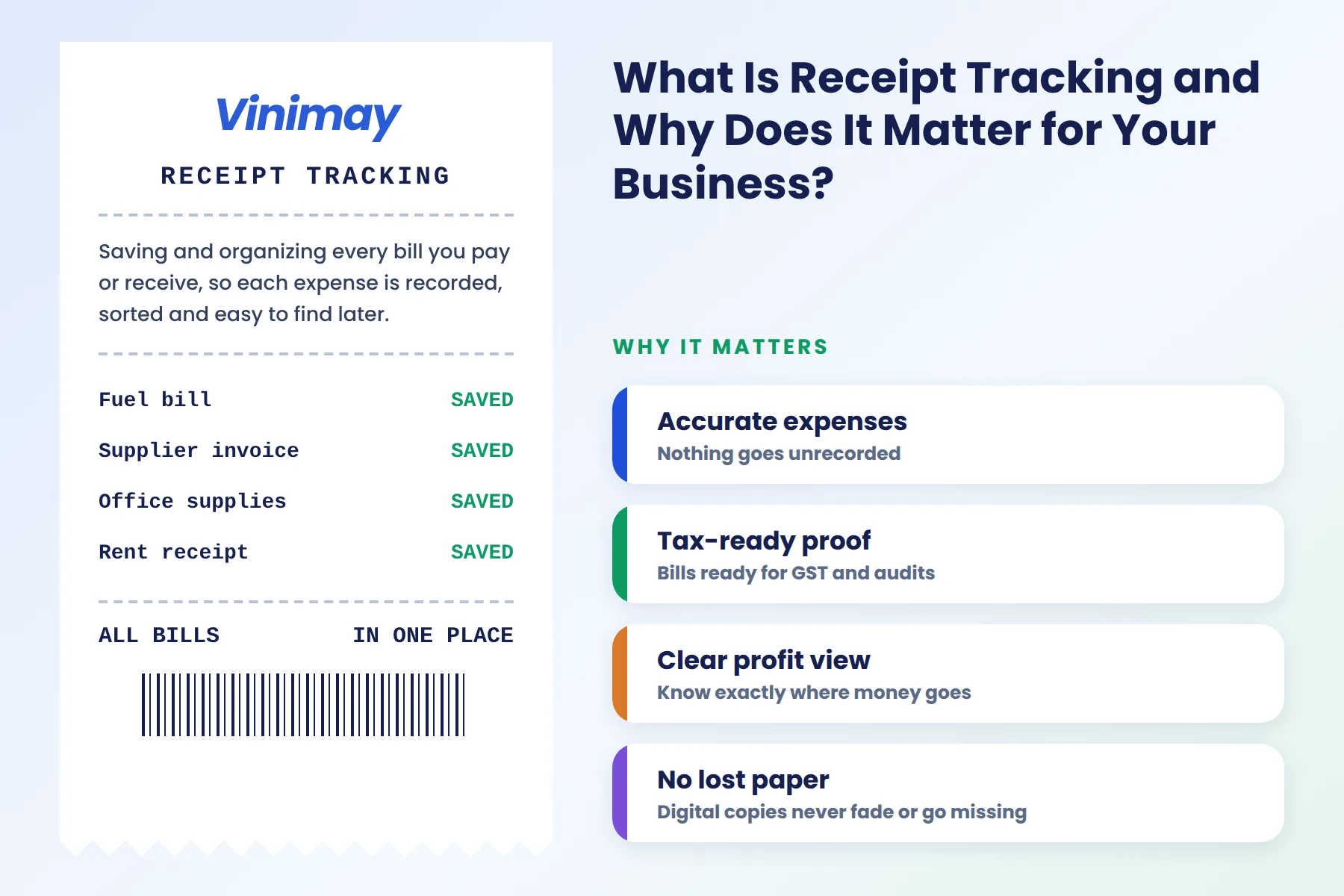
What Is Receipt Tracking, and Why Does It Matter for Your Business?
"Receipt tracking" can sound like it just means keeping copies of receipts, which undersells what it actually does in a billing or accounting system. In this context, it specifically refers to recording and confirming that a payment has actually been received—creating a clear, timestamped acknowledgment that ties back to a specific invoice or transaction, rather than simply hoping a payment status field gets updated correctly. Business
This distinction matters because "an invoice was paid" and "we have a confirmed, recorded acknowledgment that this specific payment was received, for this amount, on this date" are not quite the same level of certainty. Receipt tracking is what closes that gap—it's the accountability layer that makes a payment claim verifiable, not just assumed.
This guide explains what receipt tracking actually involves, how it differs from general payment tracking, and why it matters more than it might initially seem.
What Exactly Is Receipt Tracking?
Direct answer: Receipt tracking is the process of recording and confirming that a specific payment has been received — capturing details like the amount, date, and method — creating a clear, verifiable acknowledgment connected to therelevant invoice or transaction.
It's the confirmation layer on top of a payment being marked as "received."
It creates a specific, checkable record rather than a general status update
It supports both the business's own accuracy and the customer's need for proof of payment
Why Confirmation of Receipt Matters More Than It Seems
It's easy to assume that marking an invoice as "paid" is the same as having proper receipt tracking, but the difference becomes obvious the moment a dispute arises. If a customer insists they've paid an amount that doesn't match what's recorded or claims to have paid on a date that doesn't align with your records, a general "paid" status offers little to actually resolve the disagreement—there's no specific, dated confirmation to point to.Proper receipt tracking, by contrast, gives you something concrete: a record showing exactly what amount was received, through what method, and on what date, tied specifically to that transaction. This turns a "he said, she said" situation into something that can be checked and resolved quickly, which matters more the more customers and transactions a business handles.
Receipt Tracking vs Payment Tracking—Key Differences
What Good Receipt Tracking Should Capture
The exact amount received, matched against the invoice or partial amount it applies to
The date the payment was received, not just when it was recorded in the system
The payment method — cash, bank transfer, cheque, or other
A clear link to the relevant invoice or transaction, so it's easy to trace later
A record that's retrievable, so it can be checked or shared if a dispute arises
How Vinimay Tracks Your Receipts
Maintains receipt tracking connected to invoicing and payment tracking, creating a specific, verifiable record for each payment received
Links receipts to the relevant invoice, so confirming what was paid for a specific transaction is straightforward
Supports accurate receivables and payables by keeping receipt-level detail behind the broader outstanding balance
Provides reports that draw on receipt-level data, giving a more detailed, trustworthy view of payment history than a general status alone
Keeps this connected to customer management, so a customer's full payment history is easy to review if needed
Conclusion
Receipt tracking is a specific confirmation of an individual payment — amount, date, and method — not just a general "paid" status
This distinction matters most when a dispute arises and a specific, checkable record is needed to resolve it
Good receipt tracking captures enough detail to serve as proof, both for the business and the customer
Vinimay keeps receipt-level detail connected to invoicing and receivables, supporting accurate, verifiable payment records
FAQs
What is receipt tracking?
It's the process of recording a specific payment received — amount, date, and method — creating a verifiable confirmation tied to a particular invoice or transaction.
How is receipt tracking different from payment tracking?
Payment tracking shows a general status (paid, partially paid, outstanding), while receipt tracking captures the specific details of an individual payment received.
Why does receipt tracking matter if I already mark invoices as paid?
A general "paid" status doesn't provide the specific, dated confirmation needed to resolve a dispute about exactly what was paid and when.
Can receipt tracking help resolve payment disputes with customers?
Yes, a specific, recorded confirmation of the amount, date, and method received is far more useful in a dispute than a general payment status alone.
Does receipt tracking apply to partial payments?
Yes, each partial payment should be recorded individually with its own amount and date, building an accurate picture of how an invoice was paid over time.
Is a receipt the same as an invoice?
No, an invoice requests payment for goods or services, while a receipt confirms that a specific payment has actually been received.
Should receipts be shared with customers?
It's often good practice, especially for larger payments or when a customer specifically requests proof of payment for their own records.
Does receipt tracking help with cash payments specifically?
Yes, cash payments are particularly prone to disputes without a recorded confirmation, since there's no bank statement to independently verify them.
Can receipt tracking improve overall receivables accuracy?
Yes, since accurate receipt-level detail behind a receivables balance makes the overall figure more reliable and easier to verify if questioned.
Is receipt tracking only relevant for larger businesses?
No, it's useful at any scale—even a small business benefits from having a clear, specific record of payments received, not just a general status.
Related Topics
Published by Team Vinimay
Our editorial and compliance specialists create practical guides, tax calculation rules, and operational strategies to empower Indian small business owners and accountants.