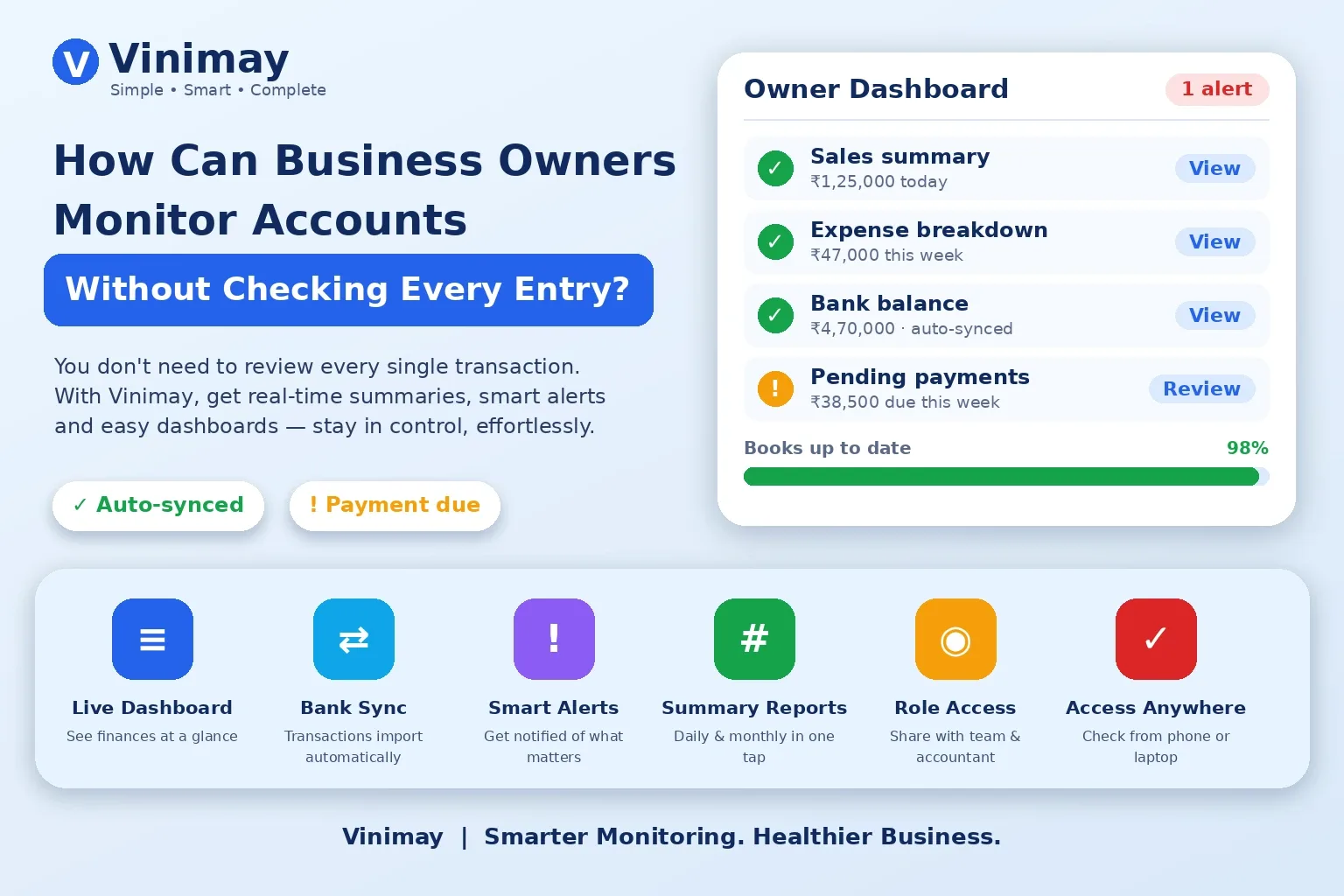
How Can Business Owners Monitor Accounts Without Checking Every Entry?
A business owner checking every single invoice, every payment, and every stock entry personally might feel thorough, but it's not actually sustainable once transaction volume grows past a certain point. There aren't enough hours in a day to manually verify fifty invoices one by one, and trying to do so usually means something else, like actually growing the business, gets less attention instead.
The realistic alternative isn't to stop checking accounts—it's to check them differently. Most healthy transactions don't need individual review; what actually needs attention are the exceptions, the unusual patterns, and a handful of key numbers that tell you whether things are broadly on track. This shifts monitoring from "review everything" to "review what's likely to matter."
This article lays out exactly what that looks like in practice—a daily snapshot, a weekly deeper check, and the specific warning signs worth watching for, so oversight stays genuinely manageable as the business grows.
Why Checking Every Entry Isn't Actually Sustainable
Reviewing every transaction line by line has a few real problems beyond just taking too long:
It doesn't scale — what takes 15 minutes at 10 transactions a day takes hours at 100
It creates review fatigue, where attention drops after the first dozen entries, ironically making the process less accurate over time
It focuses equal attention on routine, error-free entries and genuinely unusual ones, wasting effort where it isn't needed
The Exception-Based Approach to Monitoring
Direct answer: Exception-based monitoring means reviewing summary figures and specifically flagged unusual transactions, rather than every individual entry, trusting that consistent, routine transactions don't each need separate verification.
This works because most transactions in a well-set-up system follow the same predictable pattern—a normal sale, a normal payment, and a normal stock reduction. What actually deserves a closer look is anything that deviates from that pattern.
What a Daily Snapshot Should Include
A short daily check, ideally taking just a few minutes, should cover:
What a Weekly Check Should Cover
Beyond the daily snapshot, a slightly deeper weekly review should look at:
Outstanding receivables — has anything moved into a more overdue category since last week?
Stock levels for fast-moving items — is anything close to running out unexpectedly?
Any invoices still marked as drafts or unfinished, which might indicate something got missed
A quick comparison of this week's totals against the previous week's, to catch any significant, unexplained swing
Warning Signs That Need Immediate Attention
Some patterns shouldn't wait for the next scheduled check — they deserve a look as soon as they're noticed:
A single transaction significantly larger than anything typical for the business
A customer balance that's grown unusually fast compared to their normal pattern
Stock showing as available in the system but reported as out-of-stock at the counter, or vice versa
Repeated edits to the same past invoice, which could indicate either a recurring genuine issue or something worth investigating further
A noticeable gap between expected cash and actual cash on hand at day's end
Setting Up This Routine Without It Becoming Another Chore
Pick one fixed time each day for the daily snapshot — same time works better than "whenever there's a moment"
Keep the daily check under 5 minutes; if it's taking longer, it's turning back into full entry review
Reserve a slightly longer 15-20 minute slot once a week for the deeper check
Only investigate further when something looks genuinely off — resist the urge to double-check things that already look normal
Write down (even briefly) what "normal" looks like for your business, so deviations are easier to spot at a glance
Where This Fits With Software vs Manual Tracking
This approach depends heavily on having reliable summary numbers to check in the first place. With manual registers or scattered spreadsheets, even a "quick daily check" requires manually adding things up, which defeats the purpose. Connected billing and stock software, where totals and balances update automatically as transactions happen, makes this kind of fast, exception-based review actually practical, since the summary figures are already sitting there accurately rather than needing to be compiled by hand first.
Conclusion
Monitoring business accounts effectively isn't about reviewing every entry — it's about knowing which few numbers and patterns actually indicate whether things are healthy and catching the exceptions that genuinely need attention. A short daily snapshot, a slightly deeper weekly check, and a clear sense of what "normal" looks like for your business together provide real oversight without demanding hours of manual review every day.
FAQs
1. Isn't it risky to not check every single transaction personally?
For most businesses, the risk is actually lower with a consistent exception-based check than with sporadic full reviews, since regular monitoring catches unusual patterns quickly, while occasional deep dives often miss issues that accumulated between checks.
2. How long should a daily account check realistically take?
A focused daily snapshot should take just a few minutes, covering total sales, payments received, and any unusually large transactions, rather than reviewing each entry individually.
3. What's the biggest sign that my current monitoring approach isn't working?
If you're regularly discovering discrepancies weeks after they happened, rather than within a few days, it usually means the check-in frequency or the specific things being checked need adjusting.
4. Can this exception-based approach work without any software at all?
It's much harder manually, since even a simple daily total requires adding up entries by hand, which takes far longer than glancing at an automatically updated summary — this approach works best when the underlying numbers are already tracked systematically.
5. What should I do the moment I spot a genuine warning sign?
Investigate that specific transaction or pattern immediately rather than waiting for the next scheduled check, tracing it back to its source, whether that's a data entry error, a misunderstanding, or something needing a direct conversation with a customer or staff member.
6. How do I know what counts as "unusual" for my specific business?
This comes from knowing your own typical patterns — average daily sales, common transaction sizes, usual payment timing — so it helps to briefly note these baseline figures once, making deviations easier to spot going forward.
Related Topics
Published by Team Vinimay
Our editorial and compliance specialists create practical guides, tax calculation rules, and operational strategies to empower Indian small business owners and accountants.