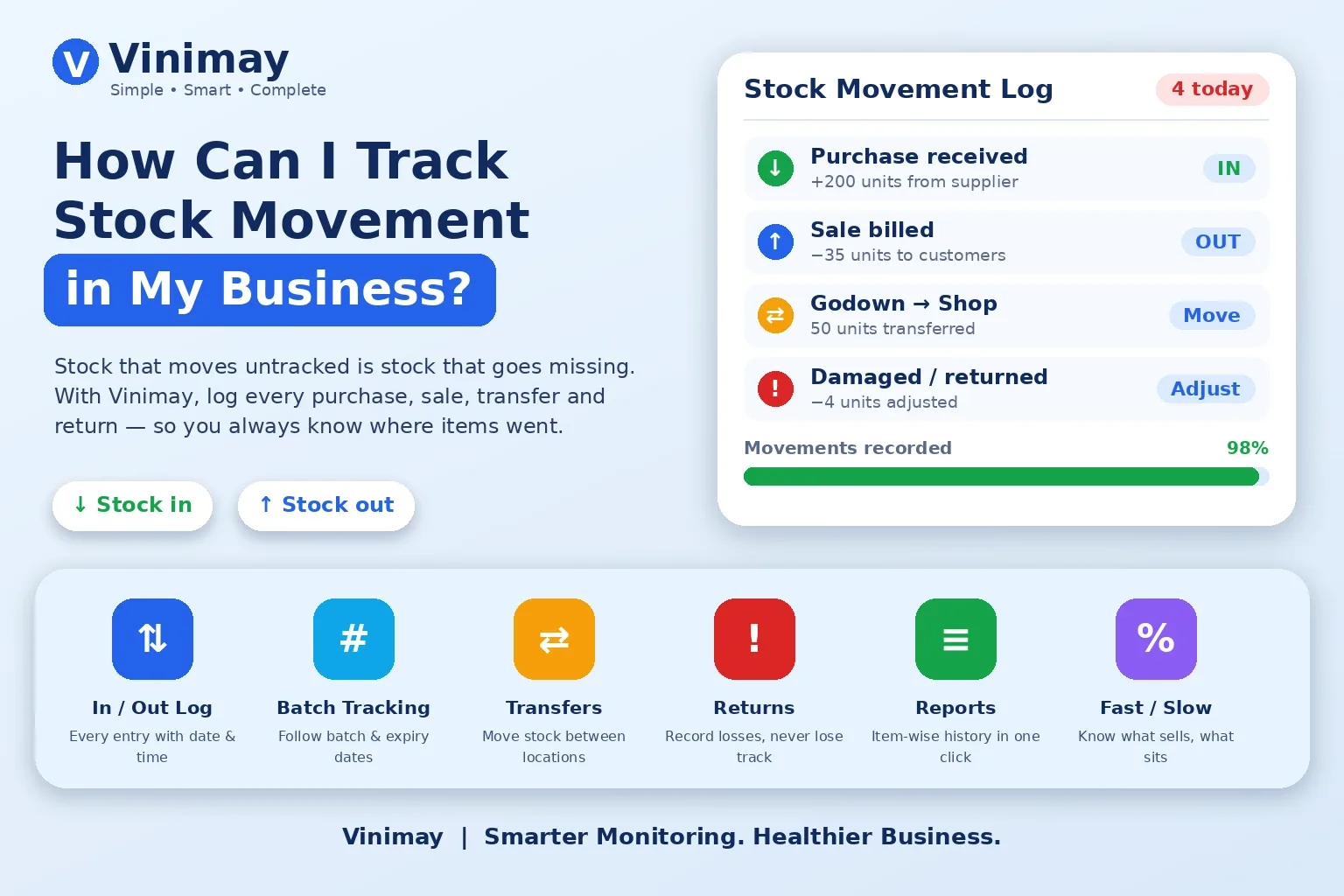
How Can I Track Stock Movement in My Business?
Knowing that a product currently has 40 units in stock answers one question, but it doesn't answer a more useful one: is that 40 units moving quickly and about to run out, or has it been sitting untouched for two months? Stock movement tracking is about understanding the second question, the flow of stock in and out over time, rather than just a single point-in-time count. Business
This distinction matters for very practical reasons. A business making purchasing decisions based only on current stock count, without understanding movement, ends up reordering slow items too often and fast items too late. Movement data reveals patterns that a static number simply can't.
This article covers what stock movement tracking actually involves, how to identify which products are moving fast versus sitting idle, and how to build a simple habit of reviewing this regularly.
What Stock Movement Tracking Actually Captures
Movement tracking looks at stock changes across a period, not a single snapshot:
Identifying Fast-Moving vs Slow-Moving Items
Direct answer: A fast-moving item is one that sells through its stock quickly and needs frequent reordering, while a slow-moving item sits in stock for an extended period relative to how much was purchased, tying up money without generating quick returns.
Comparing units sold over a period against units purchased or held reveals this directly. A product that sold 90 of the 100 units purchased in a month is clearly fast-moving; one that sold only 5 of 100 over the same period is clearly slow-moving, even if both show a similar current stock count in isolation.
Reading Movement Patterns to Guide Purchasing
Movement data becomes genuinely useful when it directly informs purchasing decisions:
Fast-moving items with tight margins between stock running out and reorder arrival should be reordered proactively, before hitting zero
Slow-moving items should prompt a review: is the pricing off, is demand simply seasonal, or should future purchase quantities be reduced?
A sudden, unexpected change in movement pattern, a normally fast item suddenly slowing, deserves investigation rather than being ignored as a one-off
Setting Up a Simple Movement Review Habit
Review movement for top-selling products weekly, since these carry the highest stockout risk
Review slow-moving products monthly to catch pricing or demand issues before too much capital gets tied up
Compare this month's movement against the same month last year, if seasonal patterns are relevant to the business
Flag any product with a sudden, unexplained shift in its usual movement pattern for a closer look
Conclusion
Tracking stock movementanswers a fundamentally different question than simply checking current stock levels, it reveals how quickly products actually sell and how stock flows in and out over time, information that's essential for smart purchasing decisions. Reviewing fast-moving items frequently and slower items periodically, while watching for sudden pattern changes, turns raw stock data into something genuinely useful for running the business.
FAQs
1. What's the difference between knowing stock quantity and tracking stock movement?
Stock quantity is a single point-in-time count of what's currently available, while stock movement tracks how that quantity has changed over a period through sales, purchases, and adjustments, revealing patterns a static number can't show.
2. How can I tell if a product is fast-moving or slow-moving?
Compare how many units were sold against how many were purchased or held over the same period, a high proportion sold indicates fast-moving, while a low proportion indicates slow-moving stock.
3. Why does understanding movement matter more than just checking current stock?
Because purchasing decisions based only on current stock count miss the trend entirely, a business might reorder a slow item too frequently or a fast item too late without understanding how quickly each is actually moving.
4. How often should stock movement actually be reviewed?
Fast-moving, high-risk products are worth reviewing weekly, while slower-moving items can generally be reviewed monthly, since their movement changes more gradually.
5. What should I do if a normally fast-moving product suddenly slows down?
This is worth investigating directly rather than ignoring, since it could indicate a pricing issue, a shift in demand, or a competing factor affecting that specific product's sales.
Related Topics
Published by Team Vinimay
Our editorial and compliance specialists create practical guides, tax calculation rules, and operational strategies to empower Indian small business owners and accountants.