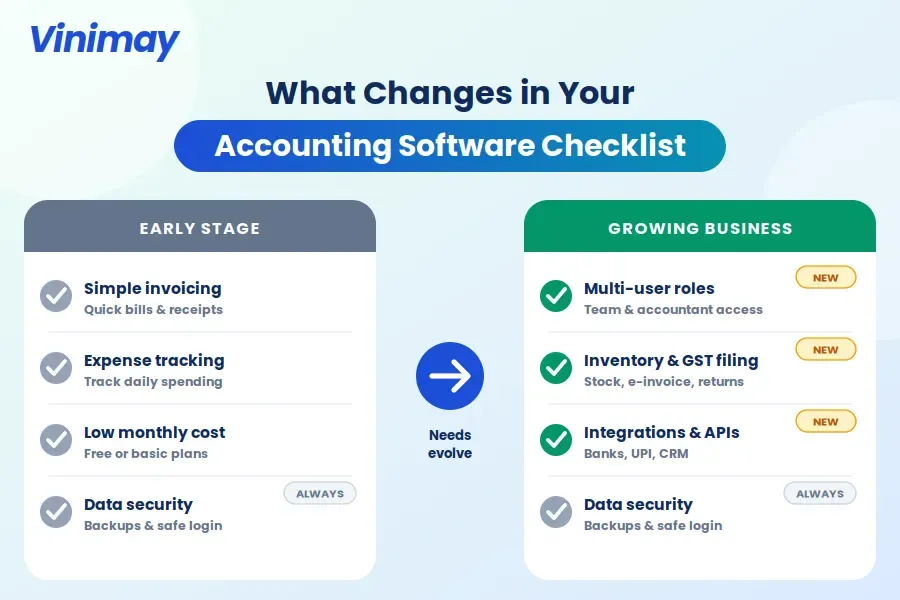
What Changes in Your Accounting Software Checklist as Your Business Grows
The accounting software that fits perfectly when you're a solo founder billing a handful of clients often stops fitting the moment you hire your first employee, and again when you open a second location or start selling across states. Most people pick software once and assume it'll simply "work" as they grow, without questioning that assumption until something actually breaks — a duplicate invoice number, a customer outstanding that no longer adds up, a GST split that was fine for local sales but wrong for the interstate order you just took.
The mistake isn't usually the original choice. Software picked for a solo founder with low invoice volume is often exactly right for that stage — cheap, simple, easy to learn. The problem shows up later, when the business has quietly moved past that stage without anyone revisiting whether the software moved with it. A checklist that made sense a year ago can become outdated without any single dramatic moment marking the change.
This article breaks down how the checklist actually shifts across three common growth stages — solo founder, first hire, and multiple locations or interstate sales — and looks at where Vinimay fits specifically at each one, rather than treating it as a single answer for every stage at once.
Stage 1: Solo Founder, Low Volume
At this stage, simplicity and low cost matter most. You're the only one billing, invoice volume is low, and you're still learning your own rhythm.
A free or low-cost plan is usually appropriate — no need to pay for capacity you're not using.
Single-user access is fine, since there's no one else to add yet.
Basic GST accuracy matters, but deep reporting doesn't yet.
Stage 2: First Hire, Growing Volume
Once a second person starts billing, or the invoice count climbs noticeably, the checklist shifts toward consistency and access control.
Multi-user support becomes relevant, even if you didn't need it a few months ago.
Consistent invoice numbering across users becomes important to avoid duplicates.
Basic reports (sales, outstanding) start being genuinely useful for decision-making, not just record-keeping.
Stage 3: Multiple Locations or Interstate Sales
At this stage, the checklist shifts again toward accuracy across complexity — different locations, different states, more moving parts.
Interstate GST handling (IGST vs CGST/SGST) becomes a daily concern rather than an occasional one.
Centralized customer/vendor records across locations prevent duplicate or conflicting entries.
Detailed reporting becomes necessary to track performance across different parts of the business.
Why Revisiting Your Checklist Periodically Matters
Software chosen at the solo-founder stage isn't wrong for that stage — it's just not built to be re-evaluated automatically as you grow. The mistake isn't the initial choice; it's not checking back in every six to twelve months to see whether the same software still fits, especially once you've crossed a growth milestone like a first hire or a second location.
Where Vinimay Fits Across These Stages
At the Solo Founder Stage
For a solo founder just starting out, the priority is testing whether GST-compliant invoicing fits your workflow at all, without committing to anything upfront.
Vinimay's free tool generates up to 5 GST-compliant invoices, with CGST, SGST, or IGST applied correctly.
No signup is required, so there's no cost or commitment risk at this stage.
This is enough to evaluate the invoicing experience itself before deciding whether to move further.
At the First-Hire Stage
Once a second person needs to bill customers or record transactions, the priority shifts toward consistency and shared access.
Sales, purchases, receipts, and payments recorded against shared customer/vendor accounts keep everyone working from the same data, rather than separate personal notes.
Outstanding balances stay accurate through the payment ledger, regardless of who recorded the original invoice or the payment against it.
Multi-user access specifically — separate logins per staff member — isn't currently confirmed for Vinimay, so if this matters at your first-hire stage, it's worth checking directly rather than assuming it's included.
At the Multiple-Location or Interstate Stage
As sales expand across states, the priority becomes GST accuracy under more complex conditions, alongside centralized records.
GST is applied correctly across CGST, SGST, and IGST based on the specific transaction, which matters more as a larger share of sales cross state lines.
Customer and vendor records stay centralized rather than duplicated per location, since transactions are recorded against the same shared accounts.
Detailed cross-location reporting and formal multi-branch management aren't part of what's currently confirmed for Vinimay — confirm this directly if your business has reached this stage.
[Create Your First Invoice Free with Vinimay]
Conclusion
The right accounting software checklist isn't fixed — it shifts as your business moves from solo operation to a growing team to multiple locations or interstate sales. Revisiting your priorities at each stage, rather than assuming your first choice will scale automatically, is what keeps the software working for you instead of quietly becoming a limitation you've outgrown.
FAQs
Does a solo founder need the same accounting software features as a growing business?
No — simplicity and low cost matter most early on; multi-user access and detailed reporting become relevant only as the team and volume grow.
When should I re-evaluate my accounting software choice?
At natural growth milestones — hiring your first employee, opening a second location, or starting to sell across states are good trigger points.
Why does interstate selling change what I need from accounting software?
Because IGST applies instead of CGST/SGST for interstate sales, and getting this right consistently becomes more important as more of your sales cross state lines.
Is it a mistake to start with free or low-cost accounting software?
Not at all — it's usually the right choice for a solo founder with low volume. The mistake is not revisiting that choice as your needs change.
What's the biggest sign that your current software has been outgrown?
Recurring issues like duplicate invoice numbers, customer outstanding that stops matching reality, or GST splits that were fine before but now need to handle interstate sales.
Should I switch software the moment I hire my first employee?
Not necessarily immediately, but it's the right time to check whether your current tool supports multiple users — if not, plan the switch before it becomes urgent.
Does invoice volume alone signal it's time to upgrade, or does team size matter too?
Both matter — rising volume with a single user is a different signal than needing more than one person to bill, and each points to a different kind of upgrade.
How often should a growing business revisit its accounting software checklist?
Roughly every six to twelve months, or immediately after a clear growth milestone like a new hire, a new location, or expanding sales into new states.
Does Vinimay support the multi-user needs of a growing team?
Not currently confirmed — check directly once you're at the stage of adding staff who need billing access.
Is Vinimay's free tool only useful for the solo-founder stage, or does it help later too?
It's primarily built for testing at an early stage — generating up to 5 GST-compliant invoices without signup. For ongoing needs at later stages, the fuller platform's transaction, customer, and GST-accuracy features become more relevant, though multi-user and multi-location specifics should be confirmed directly.
Related Topics
Published by Team Vinimay
Our editorial and compliance specialists create practical guides, tax calculation rules, and operational strategies to empower Indian small business owners and accountants.