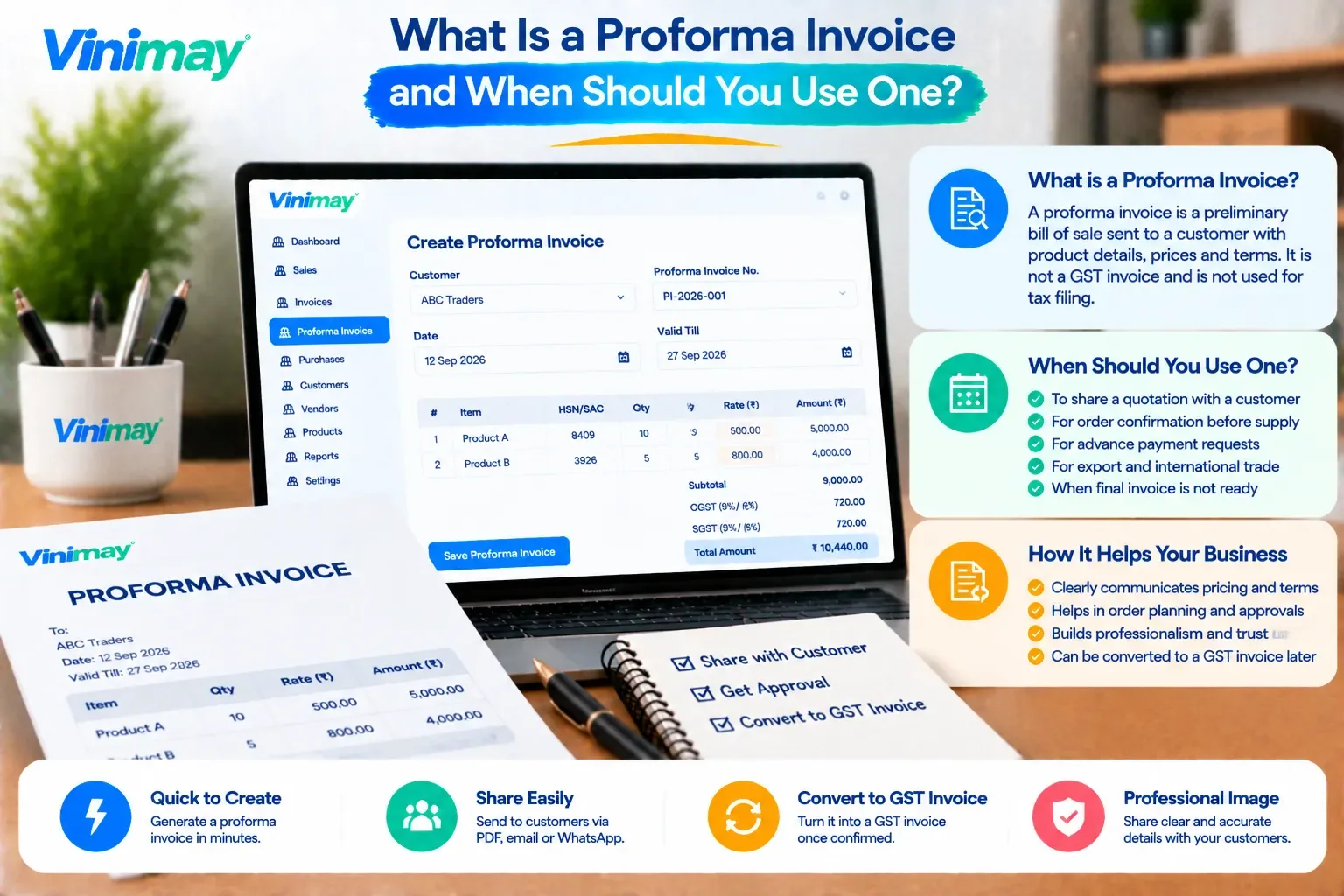
What Is a Proforma Invoice, and When Should You Use One?
What Is a Proforma Invoice and When Should a Proforma Invoice Look a Lot Like a Regular Invoice—Same layout, same line items, often the same numbers—which is exactly why it gets mistaken for one so often. The confusion isn't harmless: treating a proforma invoice as a final tax document or skipping the actual tax invoice because a proforma was already sent can create real gaps in GST records for both the buyer and seller.
The distinction is simple once it's clear: a proforma invoice is a preview, not a record. It communicates expected pricing and terms before a sale is confirmed, but it carries no GST liability and cannot be used for return filing or input tax credit. Once the actual supply happens, a proper tax invoice still needs to be issued—the proforma doesn't replace that step.
This guide explains exactly what a proforma invoice is, how it differs from a tax invoice, and when it's the right document to send.
What Exactly Is a Proforma Invoice?
Direct answer: A proforma invoice is a preliminary document sent to a buyer before a sale is finalised, showing expected pricing, quantities, and estimated tax — but it has no legal or tax validity, creates no GST liability, and cannot be used for GST return filing or Input Tax Credit claims.
It's essentially a formal quotation shaped like an invoice
It doesn't confirm a sale has happened — no goods have necessarily shipped, no service necessarily delivered
It's not uploaded to the GST e-invoicing portal and doesn't need an IRN or QR code
Why Confusing a Proforma Invoice With a Tax Invoice Creates Real Risk
The mix-up usually happens in one of two directions, and both create problems. A seller sends a proforma invoice, receives payment against it, and—assuming the paperwork is "done"—never issues the actual tax invoice; the supply is still taxable regardless, so this simply means the compliant document was never raised, not that the tax obligation disappeared. On the buyer's side, the risk is trying to use a proforma invoice to claim Input Tax Credit, which isn't possible under GST rules—ITC can only be claimed against a valid tax invoice that appears correctly in the buyer's GSTR-2B. Since a proforma invoice can be revised freely and a tax invoice generally cannot (only through a credit or debit note once issued), treating the two as interchangeable also creates confusion about which version of the numbers is actually final.
Proforma Invoice vs Tax Invoice — Key Differences
When Should You Actually Use a Proforma Invoice?
Before a sale is confirmed, to share pricing and terms with a buyer for approval
When a buyer needs a formal document to secure internal purchase approval or financing
For international transactions, before a commercial invoice is issued
When quantities or final terms may still change before the order is locked in
As a basis for requesting an advance payment, before the final tax invoice is raised
Once the sale is actually confirmed and goods are delivered or services rendered, a proper tax invoice needs to follow—the proforma invoice's job ends there.
How Vinimay Handles Proforma Invoices
Generates proforma invoices as a distinct, clearly labelled document, separate from GST tax invoices
Keeps proforma invoices connected to the customer record, so converting one into a final tax invoice references accurate, existing details
Applies GST tax calculation automatically once a proper tax invoice is generated for the same transaction
Maintains sales records and customer management so the transition from proforma to tax invoice stays traceable
Supports delivery challans alongside proforma invoices for businesses that need both documents for a single transaction
Conclusion
A proforma invoice is a preview document with no GST liability—it's not a substitute for a tax invoice
Confusing the two creates real risk: unfiled GST liability for the seller and a blocked ITC claim for the buyer
Use a proforma invoice for pre-sale quotations and approvals; issue a tax invoice once the sale is actually confirmed
Vinimay keeps proforma invoices and tax invoices as clearly separate, connected documents
FAQs
What is a proforma invoice?
A proforma invoice is a preliminary document showing expected pricing and terms before a sale is finalized—it has noGST liability and cannot be used for tax filing or ITC claims.
Is GST applicable on a proforma invoice?
No, GST does not apply to a proforma invoice itself; GST is only charged when the actual tax invoice is issued for a confirmed supply.
Can I claim an input tax credit using a proforma invoice?
No, ITC can only be claimed against a valid tax invoice or other prescribed GST documents, not a proforma invoice.
Do I still need to issue a tax invoice if I've already sent a proforma invoice?
Yes, once the sale is confirmed, a proper tax invoice must be issued—the proforma invoice does not replace this requirement.
Can a proforma invoice be changed after it's sent?
Yes, since it has no legal or tax standing, a proforma invoice can be revised freely before the final sale is confirmed.
Does a proforma invoice need an e-invoice IRN?
No, proforma invoices are exempt from e-invoicing requirements since they aren't GST-compliant tax documents.
What should a proforma invoice include?
While there's no fixed GST format, it typically includes buyer and seller details, itemised goods or services, estimated pricing, tax estimates, and validity period.
Is a proforma invoice the same as a quotation?
They're similar in purpose, but a proforma invoice is generally more formal and detailed, often used specifically to secure approval or an advance payment.
What happens if a customer pays based on a proforma invoice?
The supply is still taxable, and a tax invoice must be issued for that transaction—receiving payment doesn't remove this requirement.
Are pro forma invoices reported in GST returns?
No, proforma invoices are not reported in GSTR-1, GSTR-3B, or other GST returns, since they carry no GST liability.
Related Topics
Published by Team Vinimay
Our editorial and compliance specialists create practical guides, tax calculation rules, and operational strategies to empower Indian small business owners and accountants.