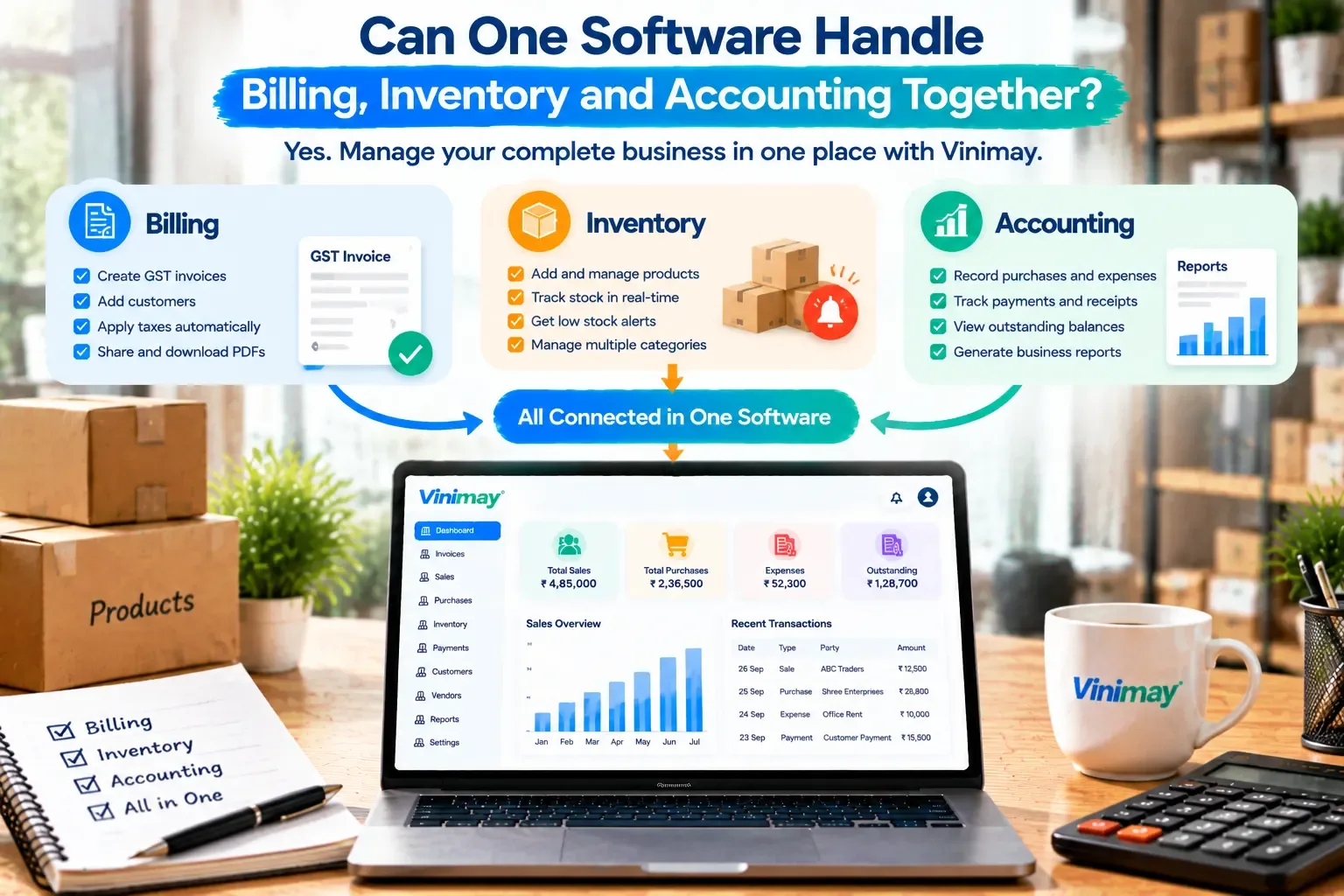
Running more than one registered business is common among MSME owners—a retail shop alongside a wholesale supply business, or separate entities for tax or operational reasons—but most billing software isn't automatically built to handle this cleanly, especially at the free tier. Billing and accounting software helps organize invoices, payments, stock, and customer records in one system, and when a person manages multiple businesses, the real question becomes whether that organization stays cleanly separated by entity or whether records start blending together in ways that create compliance headaches later. Vinimay includes multiple company management as one of its confirmed features, which is directly relevant to this specific need. This guide explains what managing multiple businesses in Free GST software actually requires and where free tools typically stand on this.
Why Do Business Owners Need to Manage More Than One Entity?
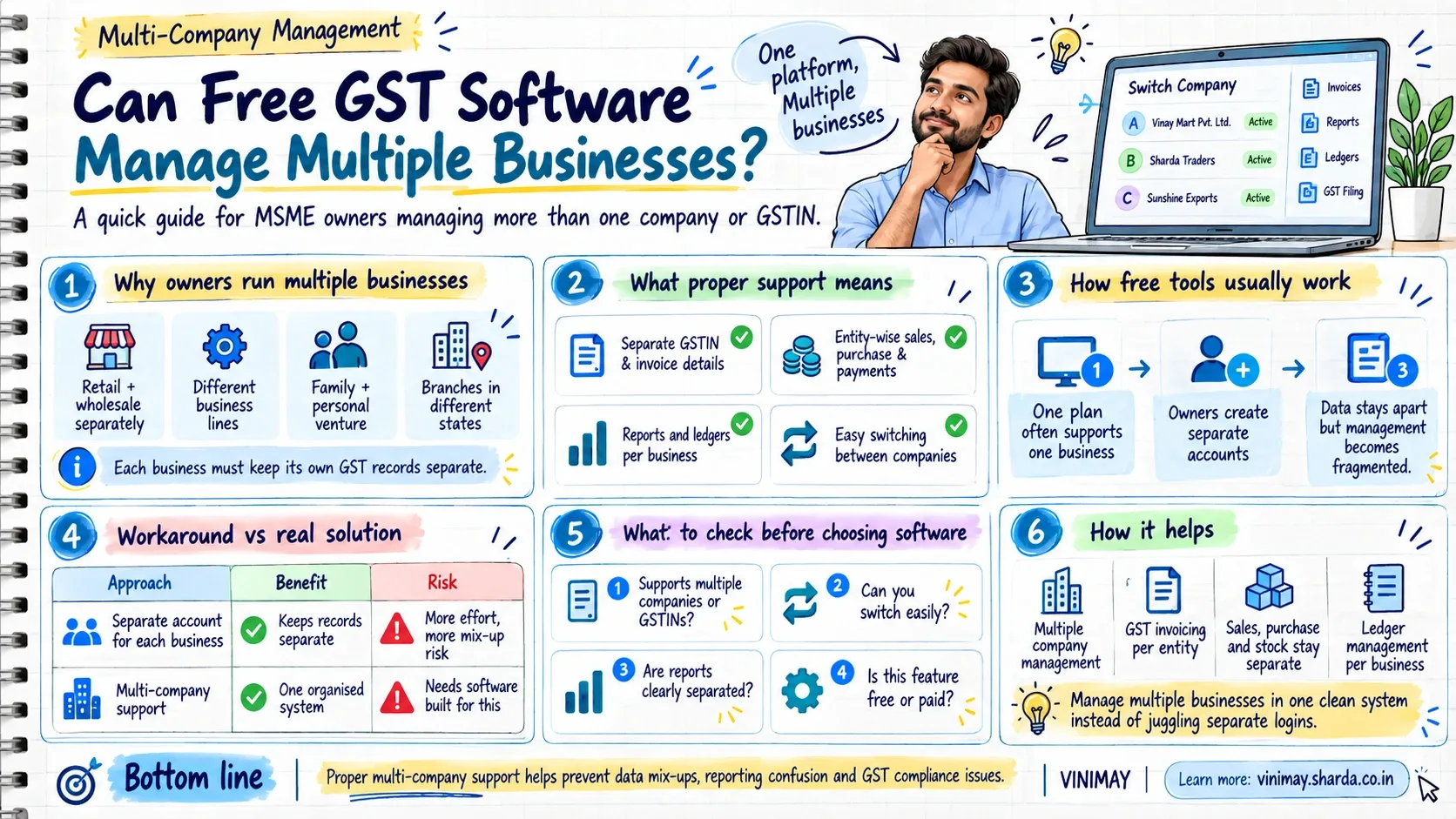
There are several common reasons an MSME owner ends up with more than one registered business:
Operating in more than one industry or line of business under separate registrations
Splitting a retail and wholesale operation for tax or liability reasons
Managing a family business alongside a personal venture
Running a business with multiple branches registered as separate entities in different states
In each case, GST records, invoices, and financial data need to stay distinctly separate per business—mixing them isn't just messy, it can create real compliance problems.
What "Managing Multiple Businesses" Actually Requires
Proper multi-business support in software means:
Each business has its own separate GSTIN and business details on invoices
Sales, purchase, and payment records don't mix between businesses
Reports and ledgers can be viewed per business, not combined by default
Switching between businesses is straightforward, without re-entering shared data incorrectly
How Free GST Software Typically Handles This
Many free GST plans are built around supporting a single business or GSTIN per account. This means managing multiple businesses often isn't supported at all or requires:
Creating entirely separate free accounts for each business
Manually ensuring no data gets mixed between the separate logins
Losing the convenience of viewing consolidated information, since each business lives in its own isolated account
The Common Workaround and Why It's Risky
Faced with a single-business free plan, many owners simply create multiple free accounts—one per business—using different email addresses or logins. While this technically keeps data separate, it introduces its own risks:
No shared customer or vendor records across accounts, even if some overlap exists
Increased chance of confusion about which account holds which business's data
More manual effort required to check anything across businesses, since there's no single place to do so
A higher risk of accidentally entering a transaction into the wrong business's account
What to Check If You Run More Than One Business
Does the software explicitly support multiple companies or GSTINs within one account?
Can you switch between businesses without re-entering shared setup details each time?
Are records and reports clearly separated by business, avoiding accidental mixing?
Is this multi-company support available on the free tier, or does it require a paid plan?
What Proper Multi-Company Support Looks Like
Genuine multi-company support means a business owner can maintain distinct GST invoicing, sales records, purchase records, and stock for each entity while still working within a single, organized system rather than juggling separate logins. This reduces both the manual effort and the risk of cross-business errors that come with the multiple-free-accounts workaround.
How Vinimay Supports Multiple Companies
Vinimay includes multiple company management as one of its confirmed feature areas, which is specifically relevant to business owners managing more than one entity:
Multiple company management keeps each business's records organized separately within one system
GST invoicing and billing apply the correct business details per entity when generating invoices
Sales records, purchase records, and stock tracking stay specific to each business rather than blending together
Ledger management can be reviewed per business, giving a clear picture of each entity's own receivables and payables
This structure is built to address exactly the workaround problem described above—rather than requiring separate accounts per business, with all the fragmentation and mix-up risk that comes with it.
Frequently Asked Questions
1. Can free GST software handle more than one business by default?
Many free plans are built around a single business or GSTIN, so multi-business support isn't always available without a workaround.
2. What's the common workaround for managing multiple businesses on free software?
Creating separate free accounts for each business is common, though it comes with fragmentation and mix-up risks.
3. Is it risky to use separate free accounts for different businesses?
Yes—it increases the chance of confusion, duplicated setup effort, and accidentally entering data into the wrong account.
4. Does GST compliance require separate records per business entity?
Yes—each registered business generally needs its own GSTIN, invoicing, and records kept distinctly separate.
5. What should I check before assuming software supports multiple businesses?
Confirm explicitly whether multi-company or multi-GSTIN support exists and whether it's included on the free tier or requires upgrading.
6. Can reports be viewed separately for each business in proper multi-company software?
Yes—genuine multi-company support keeps reports and ledgers specific to each business rather than combining them by default.
7. Is multiple company management a common free-tier feature?
It varies by provider; some tools include it even on free plans, while others require a paid upgrade.
8. What happens if business records get mixed between entities?
This can create real GST compliance issues, since each entity's filings need to reflect only its own transactions.
9. Does switching between businesses in proper multi-company software require re-entering data?
No—well-built multi-company support allows switching without needing to duplicate shared setup work.
10. Who benefits most from multi-company support in GST software?
Business owners managing more than one registered entity, branch, or GSTIN benefit directly from this kind of support.
Related Topics
Published by Team Vinimay
Our editorial and compliance specialists create practical guides, tax calculation rules, and operational strategies to empower Indian small business owners and accountants.