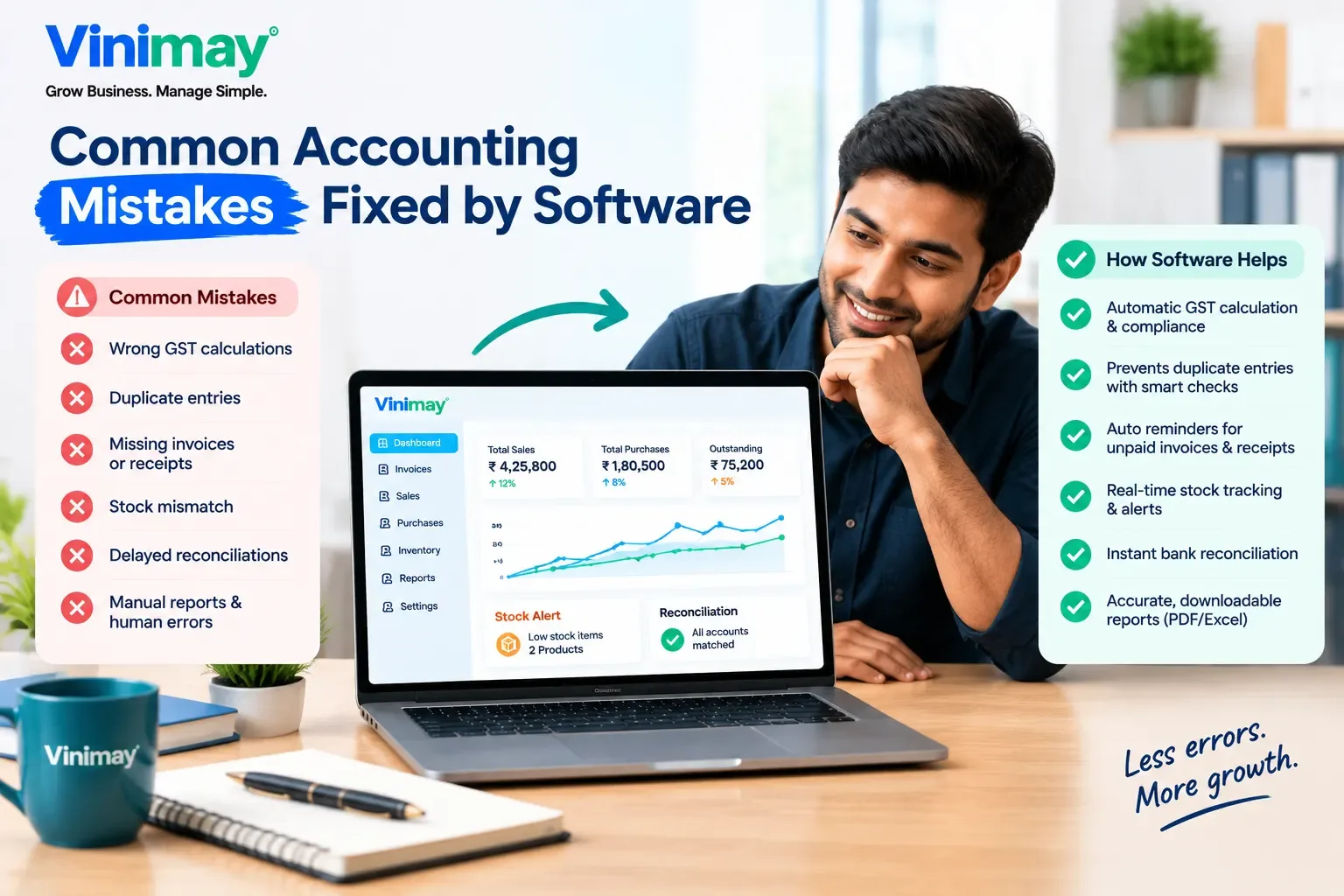
Common Accounting Mistakes Fixed by Software
Every small business eventually collects the same handful of accounting mistakes, almost regardless of what industry they're in. A wrong tax rateFree Accounting and Billing Software here, a duplicate invoice number there, a customer balance that quietly stops adding up. None of these happen because someone is careless—they happen because manual processes repeat the same calculation dozens or hundreds of times a month, and repetition is exactly where humans slip.
Software doesn't fix every mistake a business can make. It fixes a specific, well-defined set of them — the ones rooted in repeated manual calculation rather than missing information. Knowing which is which changes how you evaluate whether switching to software will actually solve your problem, or just move it somewhere else.
Below are the five mistakes that show up most often in manual or disconnected billing, why each one happens, and exactly what changes once the recording process is connected.
1. Charging the Wrong GST Rate
Why it happens: GST requires a different tax treatment depending on where the buyer is located—CGST plus SGST for a sale within the same state, IGST for a sale across state lines. Calculating this correctly on every single invoice, by hand, means checking the customer's state every time and applying the right formula without fail. Over enough invoices, someone eventually applies the wrong one, especially during a busy day.
What changes with software: The tax split gets applied automatically based on the transaction, removing the manual decision entirely. This doesn't mean GST becomes simpler as a rule—it means the same correct logic runs every time instead of depending on someone remembering it correctly under pressure.
2. Duplicate or Inconsistent Invoice Numbers
Why it happens: When more than one person is billing, or invoices are recorded across a mix of a physical book and occasional digital entries, numbering drifts. Two invoices end up with the same number, or numbers skip and double back, which becomes a real problem the moment those records need to be reconciled or checked during a GST audit.
What changes with software: Numbering runs sequentially from one shared system, regardless of who's creating the invoice. There's no manual tracking involved, so the collision simply can't happen the way it does with parallel paper or file-based systems.
3. Customer Outstanding That Doesn't Match Reality
Why it happens: Invoices get recorded in one place, and payments get noted somewhere else — a diary, a different spreadsheet, a mental note. Reconciling the two by hand means someone has to remember or dig up every transaction for a given customer, and it's easy to miss a payment or double-count one.
What changes with software: Payments get recorded directly against the invoice or customer they belong to, so the outstanding balance updates automatically the moment a payment is logged. There's nothing left to reconcile separately, because the invoice and the payment were never separate in the first place.
4. Stock Figures That Drift From Actual Sales
Why it happens: A sale gets billed, but the stock count gets updated separately—often at the end of the day, by hand, from memory or a rough tally. Over time, small gaps accumulate, and eventually the recorded stock and the actual shelf count disagree meaningfully.
What changes with software: Inventory adjusts the moment an invoice is created, tying the stock movement directly to the sale rather than to a separate counting step. This doesn't eliminate the need for physical stock checks entirely, but it removes the drift that comes purely from disconnected recording.
5. Records That Contradict Each Other Across Staff
Why it happens: When multiple people are involved in billing, purchasing, or recording payments, and each keeps their own notes or spreadsheet, the same customer or transaction can end up described differently in two places—different totals, different dates, sometimes different outcomes entirely.
What changes with software: Everyone works from the same shared record instead of separate personal files, so there's only one version of each transaction to begin with. Disagreement between records becomes structurally impossible rather than something that needs to be caught and corrected after the fact.
What Software Genuinely Can't Fix
It's worth being direct about the limits here, since overselling this point does more harm than good. Software can't catch a cash sale that was never entered into the system at all or correct a customer's GSTIN that was typed wrong on day one. It can't stop someone from skipping an entry because things were busy and promising to "add it later."
These are recording-discipline problems, not calculation problems—and no software, however well built, replaces the habit of entering every transaction accurately and promptly. What good software does is make that habit worth building, because once a transaction is in, the calculations built on top of it stop being a source of error.
How Vinimay Handles the First Category
Vinimay addresses the calculation-based mistakes described above directly. GST is applied automatically based on the transaction, invoice numbering runs consistently across the system, and payments are recorded against the same customer and vendor accounts as the invoices they belong to — so outstanding balances stay accurate without manual reconciliation. Inventory adjusts as invoices are created, tying stock movement to actual sales rather than a separate count.
What it doesn't do is catch a transaction that was never entered, or fix a customer's details if they were wrong from the start — that responsibility stays with whoever is recording the transaction, the same as with any system. If you want to see the GST calculation and invoice numbering in practice, Vinimay's free tool lets you generate up to 5 GST-compliant invoices without needing to sign up.
[Create Your First Invoice Free with Vinimay]
Conclusion
The mistakes that actually cost small businesses time and money are rarely dramatic — they're small, repeated calculation errors that compound quietly until aGST Billing Software for Small Businesses in 2026 or a customer dispute forces someone to untangle them. Software genuinely fixes this category, by applying the same correct rule every time instead of leaving it to memory and manual effort. What it can't do is replace the discipline of entering every transaction as it happens — that part stays a human responsibility no matter how good the software is. The businesses that see the biggest improvement are the ones that treat software and good recording habits as two parts of the same fix, not a substitute for one another.
Ready to connect billing and stock? Try Vinimay free: create up to 5 GST invoices, track inventory in real time, and download professional PDFs in seconds. Have questions? Chat with us on WhatsApp.
Frequently Asked Questions
- Does accounting software eliminate all accounting mistakes?
No — it eliminates calculation-based mistakes like wrong Accounting Software for Self-Employed Professionals: What Actually Fits Your Work, but it can't catch a transaction that was never entered or data typed in incorrectly from the start.
2. What's the most common mistake software fixes for Indian businesses specifically?
Incorrect GST tax splits—charging CGST/SGST instead of IGST, or the reverse—since this is a manual calculation repeated on every invoice and easy to get wrong under time pressure.
3. Why do customer outstanding often not match actual payments?
Because invoices and payments are frequently tracked in separate places. When both are recorded in the same system, outstanding balances update automatically instead of needing manual reconciliation.
4.Can software prevent stock mismatches after a sale?
It reduces the drift caused by disconnected recording, since inventory can update automatically as invoices are created. It doesn't remove the need for occasional physical stock checks entirely.
5. Do duplicate invoice numbers actually cause real problems?
Yes—beyond looking disorganized, duplicate or inconsistent numbering can create real difficulties during GST reconciliation or audits, where invoice traceability matters.
6. Why do businesses still make mistakes after adopting accounting software?
Usually because a transaction was skipped entirely or entered with wrong details. Software can only calculate correctly based on what's actually recorded—it can't add missing data on its own.
7. Is a wrong GST rate a data-entry mistake or a calculation mistake?
It's typically a calculation mistake—the customer and transaction details might be correct, but the wrong tax formula was applied. This is exactly the category software handles well.
8. Does Vinimay apply GST automatically on every invoice?
Yes—CGST, SGST, or IGST is applied based on the transaction, removing the need to calculate the split manually each time.
9. Can software fix inconsistent records when multiple staff are billing?
Yes, if everyone works from the same shared system rather than individual notes or spreadsheets — this removes the possibility of the same transaction being recorded differently in two places.
10. What should a business still check manually even after using accounting software?
Whether every transaction—especially cash sales or informal purchases — was actually entered into the system, since software can't catch what it was never given.
Related Topics
Published by Team Vinimay
Our editorial and compliance specialists create practical guides, tax calculation rules, and operational strategies to empower Indian small business owners and accountants.