What Is the Best Software for Tracking Business Transactions
Business Tracking a transaction sounds like it just means writing it down somewhere, but the real value comes from what happens after that—whether it's connected to the customer or vendor it belongs to, whether it updates your outstanding balance automatically, and whether you can find it again months later without digging through old files. A transaction recorded in isolation is barely more useful than one written on a scrap of paper; a transaction connected to the rest of your records is what actually gives you a usable picture of your business.
This distinction is exactly where most manual systems, and even some software, fall short. Recording a sale is easy. Recording it in a way that also updates the customer's outstanding balance, reflects in your stock count, and stays retrievable alongside every other transaction from that customer—that's what separates genuinely useful transaction tracking from a glorified list.
This article covers what good transaction tracking actually requires, the four transaction types every business generates, and how Vinimay handles them specifically.
The Four Transaction Types Every Business Generates
Tracking software is only doing its job if it handles all four consistently — a tool that only tracks sales while leaving purchases and payments to a separate spreadsheet isn't really tracking your transactions, just part of them.
Tracking software is only doing its job if it handles all four consistently — a tool that only tracks sales while leaving purchases and payments to a separate spreadsheet isn't really tracking your transactions, just part of them.
What Good Transaction Tracking Actually Requires
Every transaction tied to a customer or vendor, not floating as an unlinked entry.
Automatic balance updates, so outstanding amounts reflect the latest transaction without manual recalculation.
Consistent numbering and dating, so records stay traceable later, including during GST reconciliation.
Retrievable history, so you can pull up every transaction for a specific customer or vendor in one place.
Correct GST application on sales and purchase entries where relevant.
Every transaction tied to a customer or vendor, not floating as an unlinked entry.
Automatic balance updates, so outstanding amounts reflect the latest transaction without manual recalculation.
Consistent numbering and dating, so records stay traceable later, including during GST reconciliation.
Retrievable history, so you can pull up every transaction for a specific customer or vendor in one place.
Correct GST application on sales and purchase entries where relevant.
Why Disconnected Tracking Causes Real Problems
When sales are tracked in one place and purchases in another, or payments are noted separately from the invoices they settle, the same problems show up repeatedly: outstanding balances that don't match reality, duplicate entries from staff working off different files, and time lost reconstructing a transaction history that should have already been complete. None of these are dramatic failures individually, but together they erode confidence in your own numbers.
When sales are tracked in one place and purchases in another, or payments are noted separately from the invoices they settle, the same problems show up repeatedly: outstanding balances that don't match reality, duplicate entries from staff working off different files, and time lost reconstructing a transaction history that should have already been complete. None of these are dramatic failures individually, but together they erode confidence in your own numbers.
How Vinimay Tracks All Four Transaction Types
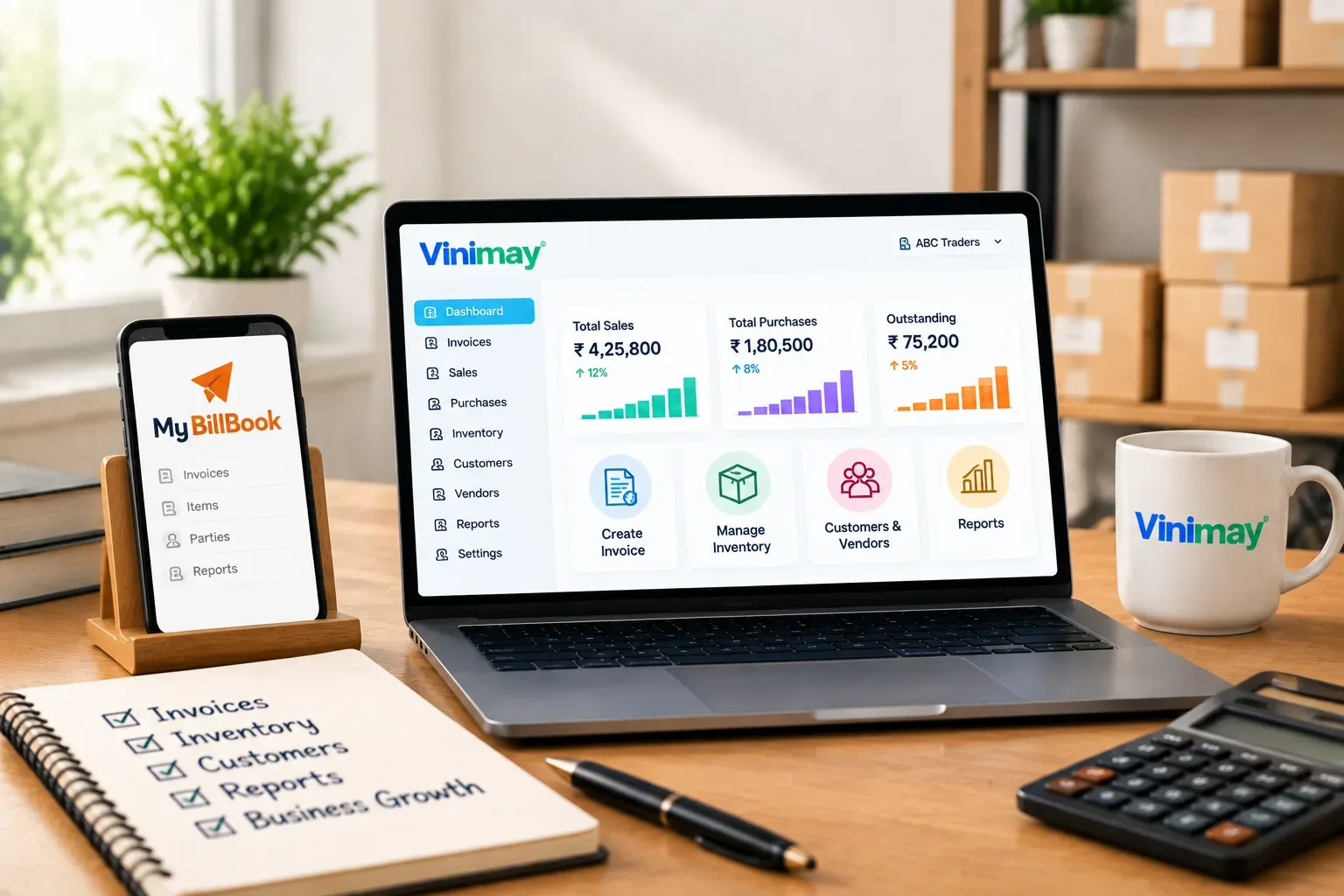
Vinimay records sales, purchases, receipts, and payments against shared customer and vendor accounts, so each transaction is automatically connected to who it belongs to rather than existing as an isolated entry. GST is applied correctly on sales and purchase invoices based on the transaction, and because receipts and payments are logged against the same accounts as the sales and purchases they settle, outstanding balances update automatically through Vinimay's payment ledger rather than needing manual reconciliation.
This covers the practical core of transaction tracking described above. If you want to see this directly, Vinimay's free tool lets you generate up to 5 GST-compliant invoices without signing up, giving a sense of how a transaction flows into a connected record.
[Create Your First Invoice Free with Vinimay]
Vinimay records sales, purchases, receipts, and payments against shared customer and vendor accounts, so each transaction is automatically connected to who it belongs to rather than existing as an isolated entry. GST is applied correctly on sales and purchase invoices based on the transaction, and because receipts and payments are logged against the same accounts as the sales and purchases they settle, outstanding balances update automatically through Vinimay's payment ledger rather than needing manual reconciliation.
This covers the practical core of transaction tracking described above. If you want to see this directly, Vinimay's free tool lets you generate up to 5 GST-compliant invoices without signing up, giving a sense of how a transaction flows into a connected record.
[Create Your First Invoice Free with Vinimay]
Conclusion
Good transaction tracking isn't about recording more — it's about recording in a way that connects each entry to the customer, vendor, and balance it affects. Software that handles all four transaction types (sales, purchases, receipts, payments) consistently, tied to the right accounts, gives you a genuinely usable picture of your business rather than a disconnected list of entries you have to reconcile by hand.
Good transaction tracking isn't about recording more — it's about recording in a way that connects each entry to the customer, vendor, and balance it affects. Software that handles all four transaction types (sales, purchases, receipts, payments) consistently, tied to the right accounts, gives you a genuinely usable picture of your business rather than a disconnected list of entries you have to reconcile by hand.
FAQs
What are the four main types of business transactions to track?
Sales, purchases, receipts (payments received), and payments (payments made) — good tracking software handles all four consistently.
Why isn't recording a sale by itself enough?
Because a sale recorded in isolation doesn't update outstanding balances or connect to the customer's full history — real usefulness comes from that connection, not the record alone.
What causes outstanding balances to be wrong even when transactions are tracked?
Usually because sales and payments are tracked in separate places rather than against the same customer record, requiring manual reconciliation that's easy to get wrong.
Does transaction tracking software need to handle GST as well?
For Indian businesses, yes — sales and purchase transactions typically need correct GST application (CGST, SGST, or IGST) to stay compliant and audit-ready.
Can I track purchases and sales in the same system?
Ideally yes — tracking them separately in different tools or files is exactly what causes disconnected records and reconciliation problems.
Does Vinimay track all four transaction types?
Yes — sales, purchases, receipts, and payments are all recorded against shared customer and vendor accounts, with outstanding balances updating automatically through the payment ledger.
What are the four main types of business transactions to track?
Sales, purchases, receipts (payments received), and payments (payments made) — good tracking software handles all four consistently.
Why isn't recording a sale by itself enough?
Because a sale recorded in isolation doesn't update outstanding balances or connect to the customer's full history — real usefulness comes from that connection, not the record alone.
What causes outstanding balances to be wrong even when transactions are tracked?
Usually because sales and payments are tracked in separate places rather than against the same customer record, requiring manual reconciliation that's easy to get wrong.
Does transaction tracking software need to handle GST as well?
For Indian businesses, yes — sales and purchase transactions typically need correct GST application (CGST, SGST, or IGST) to stay compliant and audit-ready.
Can I track purchases and sales in the same system?
Ideally yes — tracking them separately in different tools or files is exactly what causes disconnected records and reconciliation problems.
Does Vinimay track all four transaction types?
Yes — sales, purchases, receipts, and payments are all recorded against shared customer and vendor accounts, with outstanding balances updating automatically through the payment ledger.
Related Topics
Published by Team Vinimay
Our editorial and compliance specialists create practical guides, tax calculation rules, and operational strategies to empower Indian small business owners and accountants.