Choosing GST software often starts with the wrong question. Many MSME owners begin by asking "which software is best?" when the more useful question is "which software fits how my business actually operates?" Two MSMEs can be the same size on paper and need completely different tools, because the right fit depends on transaction volume, team structure, and GST complexity — not size or industry alone. Billing and accounting software helps organise invoices, payments, stock and customer records in one system, and choosing well means matching that system to your actual operations rather than picking based on price or popularity.
Vinimay supports GST invoicing, billing, sales and purchase records, and stock tracking as a connected system, which is useful to keep in mind as a reference point while working through the selection process below. This guide walks through a practical, step-by-step approach MSMEs can use.
Why This Decision Is Harder Than It Looks
GST software selection feels straightforward until you realise how differently two seemingly similar businesses operate. A service-based MSME billing five clients a month has almost nothing in common, operationally, with a retail MSME issuing forty GST invoices a day and tracking hundreds of stock-keeping units. A generic recommendation rarely fits both.
Step 1: Map Your Actual Transaction Pattern
Before looking at any software, get specific about your own numbers:
How many invoices do you generate in an average month?
Does that number spike during certain seasons or periods?
Are most transactions simple, single-rate sales, or do they involve varied products and tax rates?
This single step rules out a surprising number of options immediately — some plans simply won't fit your volume.
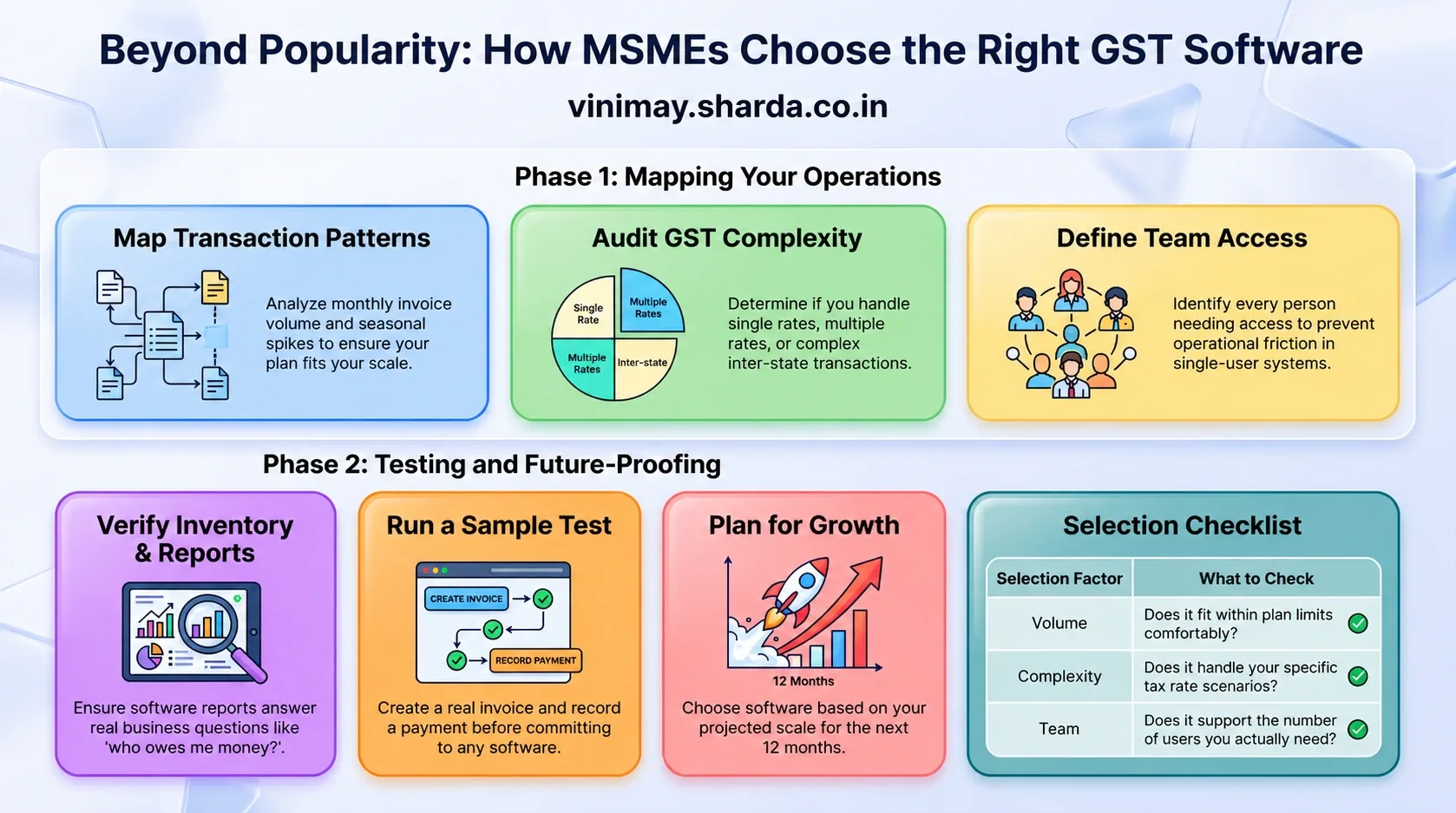
Step 2: Identify Your GST Complexity
Not all GST billing is equally complex:
A single flat GST rate across all products is the simplest scenario
Multiple GST rates across different product categories add complexity
Inter-state transactions or GST reconciliation needs to add further complexity
The more complex your GST situation, the more seriously you should weigh software with deeper filing and reconciliation support, rather than relying on basic invoicing alone.
Step 3: Count How Many People Need Access
Be specific here too — not just "how many staff do I have," but "how many people actually need to create invoices, record payments, or review accounts." If the answer is more than one, single-user software will create friction regardless of how good its other features are.
Step 4: Check Inventory and Reporting Needs
If your business carries stock, ask whether basic stock entry is enough, or whether you need to track products across categories, locations, or in batches. Similarly, list the actual questions you ask about your business monthly — "who owes me money," "what's my best-selling product" — and check whether a software's standard reports actually answer them.
Step 5: Test Before Committing
Before fully committing to any software, free or paid:
Create a sample invoice using your real products and tax rates
Record a sample payment and confirm it reflects correctly
If relevant, test a stock update from a sample sale or purchase
Try finding a past transaction to see how easy the search actually is
Step 6: Plan for Growth, Not Just Today
Choose based on where your business is now, but keep half an eye on where it's likely headed in the next year. If you're already close to a free plan's invoice cap, or you know you'll be hiring soon, factor that into the decision now rather than switching software again shortly after settling in.
Putting the Steps Together
Once you've mapped your transaction volume, GST complexity, team size, and inventory needs, the right choice usually becomes clearer on its own — rather than needing to be picked from a list of "top" options. What matters is whether a system keeps your GST invoicing accurate, connects your sales and purchase records, tracks stock alongside actual transactions, and gives you a clear view of what's owed and by whom. Vinimay is structured around exactly these confirmed areas — GST invoicing, billing, sales and purchase records, stock tracking, and ledger management — which MSMEs can weigh against the specific factors mapped out above to judge fit for their own operations.
Frequently Asked Questions
1. What's the first step MSMEs should take when choosing GST software?
Mapping actual monthly transaction volume and GST complexity is the most useful starting point before comparing any specific tools.
2. Should MSMEs choose software based on business size alone?
No — transaction volume, team structure, and GST complexity matter more than a general size label.
3. How important is testing software before committing?
Very important — creating a sample invoice with real products and rates reveals issues that feature lists alone won't show.
4. What role does team size play in choosing GST software?
If more than one person needs billing or account access, single-user software will create operational friction.
5. Should inventory needs affect the software choice?
Yes — businesses with more complex stock needs should confirm the software's inventory features match their actual product range.
6. Is it a mistake to choose the cheapest option automatically?
It can be, if the cheapest option doesn't fit your actual transaction volume, GST complexity, or team needs.
7. How should MSMEs think about future growth when choosing software?
Factor in known upcoming changes, like hiring plans or growing sales volume, rather than only considering current needs.
8. What reports should MSMEs check for before choosing software?
Reports that answer real, recurring business questions — like outstanding receivables or best-selling products — matter most.
9. Does GST complexity change which software is suitable?
Yes — businesses with multiple tax rates or inter-state transactions benefit more from deeper GST filing support.
10. Is there a single "right" GST software for all MSMEs?
No — the right choice depends on each MSME's specific transaction pattern, team size, and GST complexity.
Related Topics
Published by admin
Our editorial and compliance specialists create practical guides, tax calculation rules, and operational strategies to empower Indian small business owners and accountants.