Can One Software Handle Billing, Inventory, and Accounting Together?
Billing, inventory, and accounting sound like three separate jobs — and historically, they often were three separate tools, each requiring its own manual updates to stay in sync with the others. The question of whether one software can genuinely handle all three isn't really about whether the features exist side by side; it's about whether they're actually connected underneath.
Yes, one software can handle billing, inventory and accounting together, but the practical value depends entirely on whether the integration is real—meaning a single entry updates all three — or superficial, meaning the three modules simply sit in the same app without talking to each other. This distinction matters more than most feature lists let on.
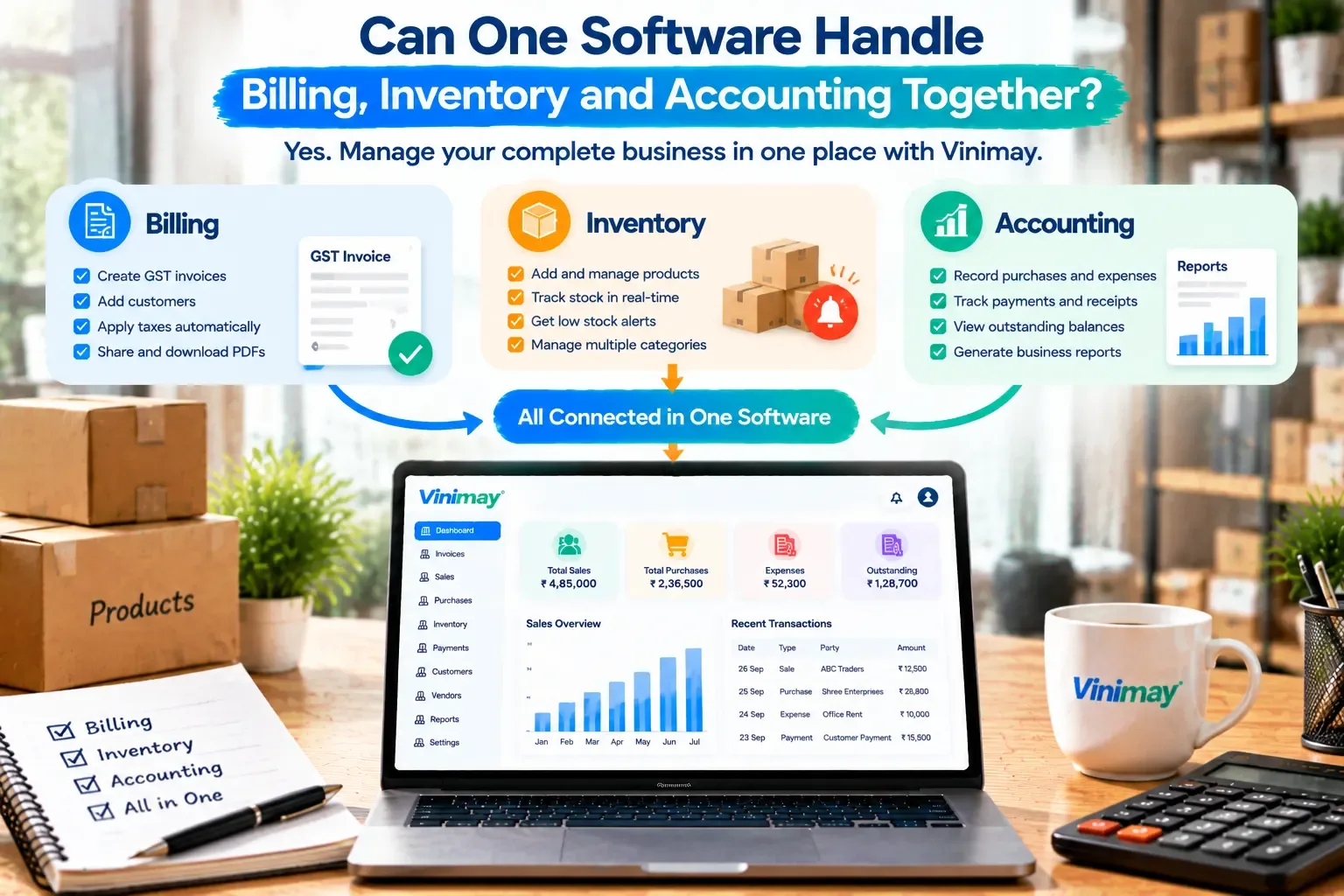
Vinimay brings GST invoicing, sales and purchase records, inventory tracking and payment records together as one connected system. This guide explains exactly how that kind of integration works mechanically, where it commonly breaks down even in tools that claim to offer it, and how to tell the difference before relying on any single system.
How the Integration Actually Works
Genuine integration means a transaction recorded once for one purpose automatically updates every other record it affects. This isn't a single feature — it's a chain of connected updates:
An invoice created for billing purposes also reduces the relevant product's stock count
The same invoice contributes to that customer's outstanding balance in the payment ledger
The sale amount feeds into sales reports and, where relevant, purchase-versus-sale comparisons
A purchase entry similarly updates stock upward and adds to vendor payment records
When this chain works end to end, "billing, inventory and accounting together" stops being three separate tasks and becomes one action with three visible effects.
What Happens at the Moment of a Sale
It helps to walk through a single transaction concretely. A customer buys three units of a product. The moment that sale is billed:
A GST-compliant invoice is generated with tax applied correctly
The product's stock count drops by three units automatically
The sale amount is added to that day's and month's sales figures
If the payment isn't made immediately, the amount appears as outstanding against that customer
In a genuinely integrated system, this entire sequence happens from one entry. In a loosely connected system, some of these steps might require a second, manual action—updating stock separately, or checking a different screen for the outstanding balance.
Where This Integration Typically Breaks Down
Even tools that market themselves as "all-in-one" sometimes fall short in specific, checkable ways. Stock might update only after a manual sync step rather than instantly. Inventory and billing might exist as separate modules that require switching screens and re-entering product details. Payment tracking might record that money came in without linking it back to which invoice it settled. And reports might pull from only one of the three areas — sales, say — without reflecting stock or payment status alongside it.
None of these gaps make a tool useless, but they mean the "together" claim is partially true rather than fully integrated—worth knowing before assuming everything updates automatically.
Signs a Tool Is Genuinely Integrated vs Loosely Connected
A quick way to test this yourself: create one sale in the system and immediately check whether stock, payment status and reports all reflect it without any extra step on your part.
How Vinimay Connects These Three
In Vinimay, billing, inventory, and payment records work from the same underlying data rather than as separate modules. Creating a GST invoice reduces stock for the relevant product automatically, adds the sale to your purchase-and-sales records, and updates the customer's outstanding balance if the payment isn't immediate. Reports are generated from this same connected data, reflecting sales, purchases and payment status together rather than from isolated silos.
This reflects the exact integration pattern described above — one entry, multiple automatic effects — rather than billing, inventory and payment tracking existing as separately maintained sections that happen to share an interface.
To see this directly, Vinimay's free invoice tool lets you generate up to 5 GST invoices free and observe how a single entry feeds into your records.
Conclusion
One software can genuinely handle billing, inventory and accounting together—but "together" only means something if a single entry updates all three automatically, rather than the three simply existing in the same interface.
The clearest way to judge this is to test it directly: make one sale and see what updates without extra effort. Vinimay is built around this exact chain—invoicing, stock, and paymentrecords responding to the same entry—so the "together" claim holds up under that test rather than requiring separate manual reconciliation
Frequently Asked Questions
1. Is it common for software to claim integration without actually delivering it?
Yes, some tools house billing, inventory and payments in one app without genuinely connecting the underlying data.
2. What's the simplest way to test if a tool is truly integrated?
Create one sale and check whether stock, payment status and reports all update automatically without a second manual step.
3. Does Vinimay update stock automatically after a sale?
Yes, a GST invoice reduces the relevant product's stock as part of the same entry.
4. Can billing and inventory work together without accounting features?
Yes, many small businesses connect billing and stock without needing full accounting-level financial statements.
5. Why does integration matter more than having all three features present?
Because features that don't share data still require manual cross-checking, which defeats the purpose of having them in one place.
6. Does an integrated system reduce reporting time?
Yes, since reports pull from connected sales, stock and payment data rather than requiring manual combination.
7. What happens if stock and billing fall out of sync in an integrated tool?
This shouldn't happen if the integration is genuine — recurring mismatches usually indicate the connection is only partial.
8. Is payment tracking linked to specific invoices important?
Yes, without this link, "outstanding balance" has to be calculated manually rather than shown directly.
9. Can I test Vinimay's integration before committing?
Yes, Vinimay's free invoice tool lets you generate up to 5 GST invoices free and see the connected effect on records.
10. Does full accounting (like balance sheets) come as part of this integration?
Typically not — billing-inventory-payment integration is distinct from full financial statement preparation, which often needs separate accounting support.
Published by Team Vinimay
Our editorial and compliance specialists create practical guides, tax calculation rules, and operational strategies to empower Indian small business owners and accountants.