AI has become attached to nearly every software category as a buzzword, and accounting is no exception—but underneath the marketing language, there are specific, genuine ways AI-related capability can help with everyday business accounting, distinct from the vaguer promise of "AI-powered" as a label.
Yes, AI can help with accounting in specific, practical ways—such as suggesting transaction categories based on patterns, flagging unusual entries that deviate from normal patterns, or answering questions about your own data in plain language—though it's worth being clear that these are assistive capabilities, not a replacement for accurate initial data entry or professional judgment on compliance matters.
What Can AI Do in Accounting?
AI can automate several repetitive accounting tasks and help businesses process financial information more efficiently. Depending on the software, AI can assist with:
Invoice processing: Extracting information from invoices and reducing manual data entry.
Expense categorization: Automatically classifying expenses into appropriate accounting categories.
Transaction matching: Matching bank transactions with invoices, payments, or accounting entries.
Error detection: Identifying possible duplicate entries, unusual transactions, or missing information.
GST and tax support: Helping organise tax-related transactions and identify inconsistencies, although important tax calculations should still be reviewed.
Financial reporting: Turning recorded financial data into summaries of sales, expenses, profits, receivables, and cash flow.
Payment tracking: Identifying pending or overdue invoices and helping businesses monitor receivables.
Cash-flow analysis: Analyzing transaction patterns to provide insights into incoming and outgoing funds.
Data entry automation: Reducing repetitive work involved in recording routine financial transactions.
Business insights: Highlighting trends and patterns that may help business owners understand their financial performance.
AI can make accounting faster and more automated, but it does not eliminate the need for human review. Businesses should verify important financial, GST, and tax-related information before relying on AI-generated results.
Where AI Genuinely Adds Value in Accounting
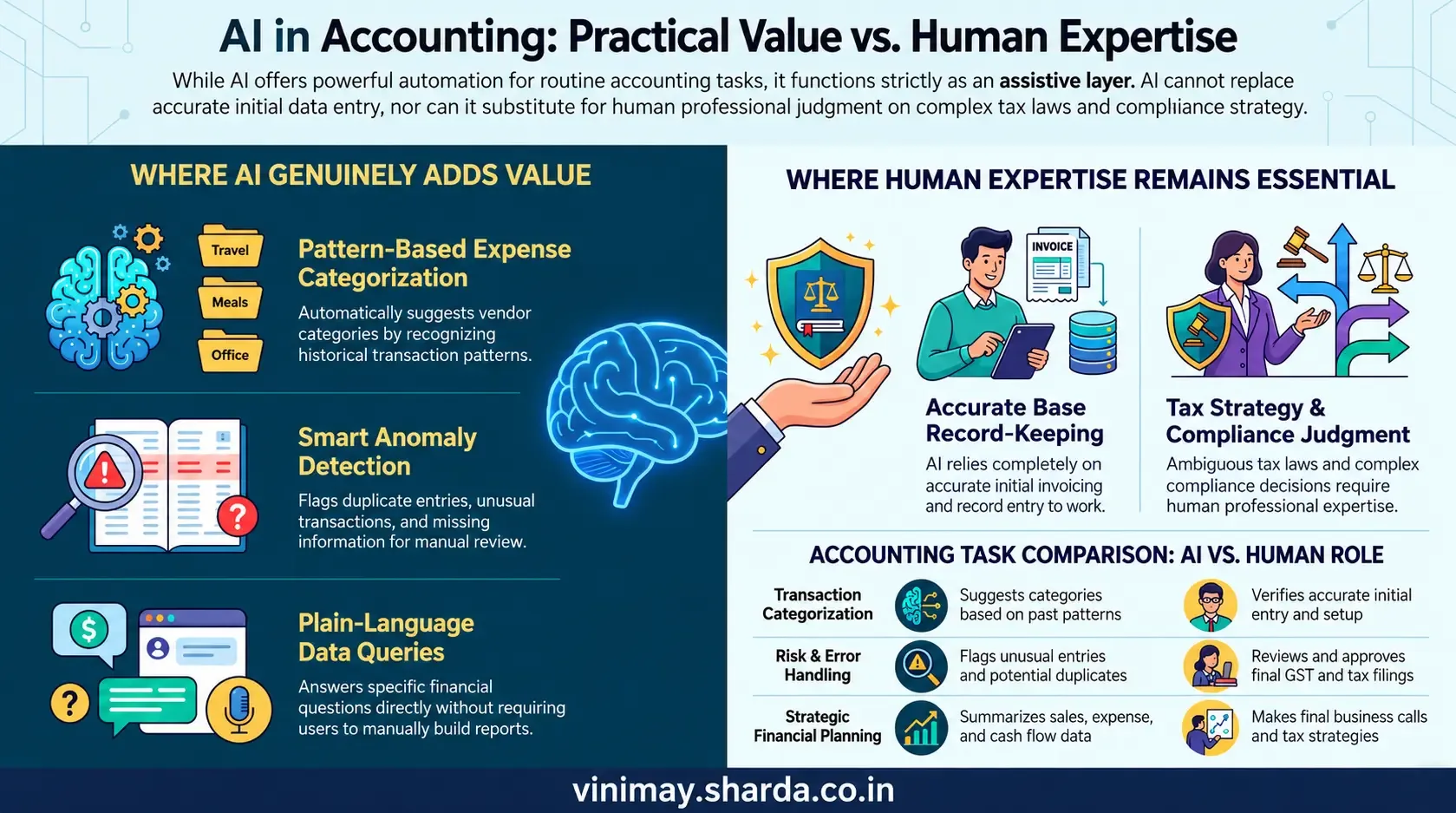
Pattern-based categorisation suggestions—recognising that a specific vendor is usually categorised as "office supplies" and suggesting that consistently
Anomaly detection—flagging a transaction that looks unusual compared to your typical pattern, worth a second look
Natural language queries—asking "What were my top expenses last month?" and getting an answer without manually building a report
Where AI Doesn't Replace What It Sounds Like It Might
AI-assisted categorization still depends on accurate initial data entry—it can't categorize a transaction it never received correctly in the first place. It also doesn't replace professional judgment on genuinely ambiguous compliance questions, where understanding current tax law matters more than pattern recognition.
A Realistic View of AI's Current Role
Why This Matters for How You Evaluate "AI-Powered" Claims
When a tool markets itself as AI-powered, it's worth asking specifically what that means—is it suggesting categories, answering questions about your data, or is "AI" attached more loosely as a marketing term without a concrete, checkable capability behind it?
The Practical Takeaway
AI-related features in accounting software are genuinely useful as assistance layered on top of solid, accurate record-keeping—they don't substitute for that foundation; they build on it, which is why accurate initial invoicing and record entry remain the more fundamental things to get right first.
Where This Fits Vinimay's Approach
Vinimay's core strength is accurate, connected record-keeping—GST invoicing, sales and purchase tracking, payment status—which forms exactly the foundation that any AI-assisted feature would need to work well upon. The free invoice tool demonstrates this core accuracy directly.
Frequently Asked Questions
1. What are the most practical AI applications in accounting software?
Suggesting transaction categories based on patterns, flagging unusual entries, and answering data questions in plain language.
2. Can AI replace accurate manual data entry?
No, AI-assisted features still depend on accurate initial entries—they enhance organized data, they don't create it from nothing.
3. Does AI in accounting software replace the need for a CA?
No, AI can assist with pattern recognition and data organization, but professional judgment on compliance and strategy still requires a person.
4. What should I ask before trusting an "AI-powered" accounting claim?
What specifically the AI does—suggesting categories, flagging anomalies, answering questions—rather than accepting the label alone.
5. Is anomaly detection reliable for catching all errors?
It's helpful for flagging unusual patterns worth reviewing, though it doesn't guarantee catching every possible mistake.
6. Does AI-assisted categorization work without any manual setup?
Generally it improves as it learns your specific patterns, though initial categories still need to be established.
7. Is AI in accounting software a completely new capability?
Pattern-based suggestions and automation have existed in various forms; what's changed is the sophistication and natural language interaction.
8. Should small businesses prioritize AI features when choosing software?
Accurate core record-keeping matters more as a foundation than AI features layered on top of an inconsistent base.
9. Can AI help answer questions about my sales data?
Yes, this is one of the more practical applications—asking a plain-language question instead of manually building a report.
10. Does Vinimay currently offer AI-assisted features?
Vinimay's core strength is accurate, connected record-keeping; specific AI-assisted features are worth confirming directly for current availability.
Related Topics
Published by Team Vinimay
Our editorial and compliance specialists create practical guides, tax calculation rules, and operational strategies to empower Indian small business owners and accountants.