An e-commerce seller processing orders through a website or marketplace faces a specific challenge: sales happen automatically, often in high volume, and frequently across different states—which puts real pressure on whatever free invoice cap andtax-handling capability the accounting software offers. Yes, e-commerce businesses can use free accounting software, but the fit depends heavily on transaction volume and whether the tool handles interstate tax correctly by default, since e-commerce sales frequently cross state lines in a way that many smaller, local businesses don't experience as often.
Why Ecommerce Puts Specific Pressure on Free Tiers
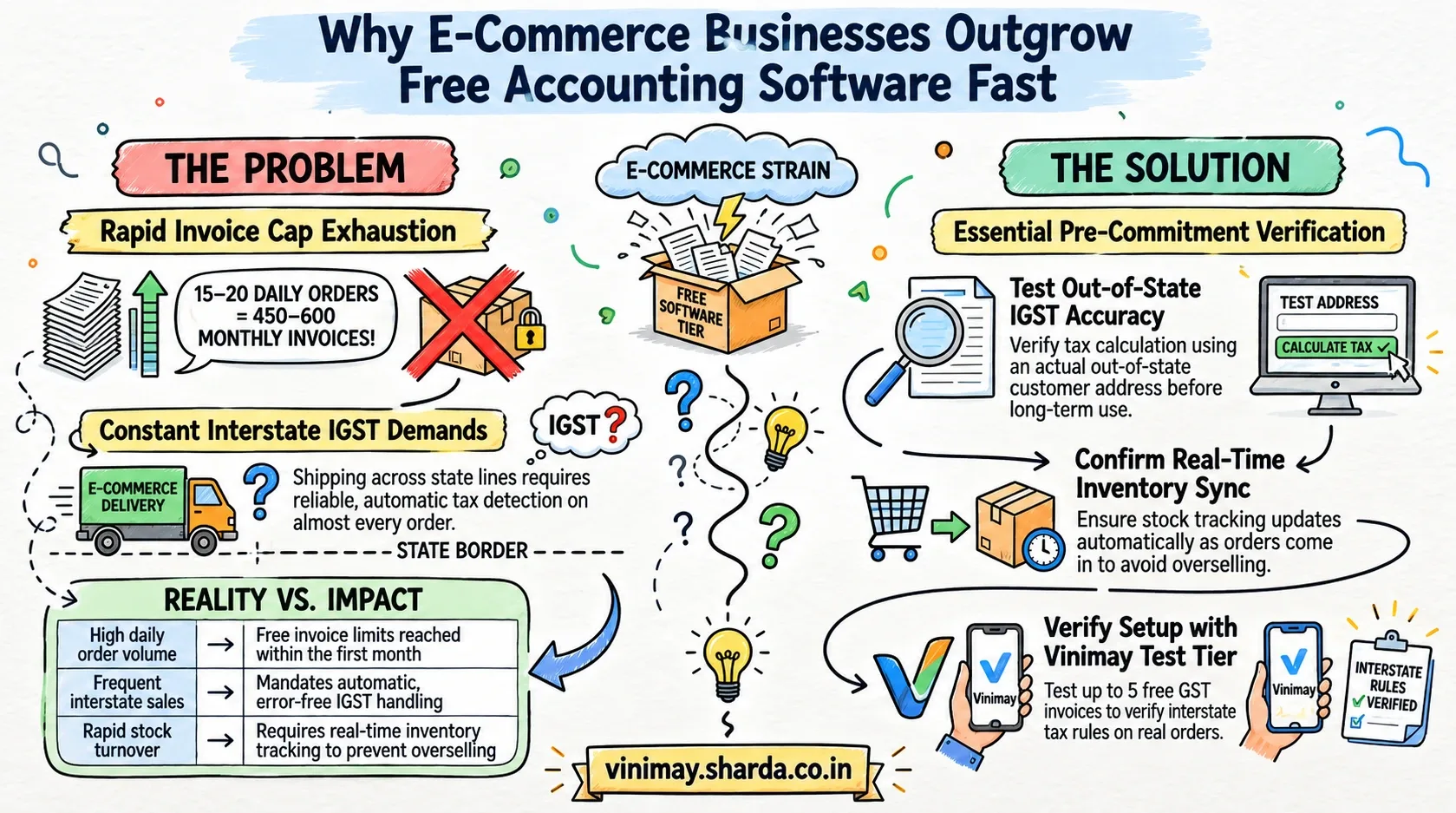
A physical shop might serve customers from the same city daily; an e-commerce businesses seller might ship to a different state with nearly every order. This means the IGST application isn't an occasional scenario—it's the everyday norm, making correct automatic tax-type detection genuinely essential rather than a nice-to-have.
What Ecommerce-Specific Billing Needs
Correct, automatic IGST application for interstate sales, since this happens constantly, not occasionally
Sufficient invoice volume capacity, since even a small e-commerce business operation can generate dozens of orders daily
Product catalogue management for potentially large numbers of SKUs
Stock tracking connected to sales to avoid overselling out-of-stock items
Where Free Tiers Often Get Tested Quickly
The Volume Reality Check
Even a modest e-commerce businesses operation—say, 15-20 orders a day—adds up to 450-600 invoices monthly, a volume that exceeds most free invoicing tiers relatively quickly. This isn't a flaw in free software; it simply means e-commerce businesses tend to graduate out of free tiers faster than lower-volume business types.
What Ecommerce Sellers Should Verify Specifically
Before relying on free software long-term, confirm the specific invoice volume cap against your realistic order numbers, verify that inter-state tax handling works correctly by testing with an actual out-of-state customer address, and check whether stock tracking updates in real time as orders come in.
Where Vinimay Fits This
Vinimay correctly applies IGST for interstatetransactions based on verified customer address setup andconnects inventory to sales automatically. For ecommerce sellers testing this fit, the free invoice tool allows up to 5 GST invoices free—usefulor verifying tax handling works correctly on an actual interstateorder before scaling further.
Frequently Asked Questions
Q1. Why does e-commerce billing put more pressure on free software than other businesses?
Because e-commerce sales frequently cross state lines,requiring reliable, automatic IGST handling far more often than typical local businesses experience.
Q2. How quickly does an e-commerce business typically hit free invoice limits?
Oftenwithin the first month, since even modest daily order volume adds up to several hundred invoices monthly.
Q3. Does Vinimay handle interstate GST automatically for e-commerce sellers?
Yes,IGST applies automatically based on verified customer address setup.
Q4. What should e-commerce sellers verify before relying on free software?
The specific invoice volume cap, interstate tax accuracy, and whether stock updates in real time with orders.
Q5. Is stock tracking especially important for e-commerce?
Yes, since rapid order volume increases the risk of overselling if stock isn't updated accurately and quickly.
Q6. How many free invoices can an e-commerce business test with Vinimay?
Up to 5 GST invoices free, useful for verifying interstate tax handling specifically.
Q7. Can e-commerce billing software generate GST-compliant invoices?
Yes, GST billing software can generate invoices with applicable tax details, helping e-commerce sellers maintain consistent billing records for their online orders.
Q8. Can e-commerce sellers track customer-wise sales through billing software?
Yes, customer-wise transaction records can help sellers review orders, invoice history, payments, and sales activity for individual customers.
Q9. Can billing software help e-commerce businesses manage returns and cancelled orders?
Depending on the software, features such as sales returns, cancelled invoices, and inventory adjustments can help keep billing and stock records updated.
Q10. Can e-commerce billing software help manage high-volume transactions?
Yes, software that combines billing, inventory, and reporting can reduce manual data entry and make it easier to manage a growing number of daily transactions.
Because e-commerce sales frequently cross state lines,requiring reliable, automatic IGST handling far more often than typical local businesses experience.
Oftenwithin the first month, since even modest daily order volume adds up to several hundred invoices monthly.
Yes,IGST applies automatically based on verified customer address setup.
The specific invoice volume cap, interstate tax accuracy, and whether stock updates in real time with orders.
Yes, since rapid order volume increases the risk of overselling if stock isn't updated accurately and quickly.
Up to 5 GST invoices free, useful for verifying interstate tax handling specifically.
Yes, GST billing software can generate invoices with applicable tax details, helping e-commerce sellers maintain consistent billing records for their online orders.
Yes, customer-wise transaction records can help sellers review orders, invoice history, payments, and sales activity for individual customers.
Depending on the software, features such as sales returns, cancelled invoices, and inventory adjustments can help keep billing and stock records updated.
Yes, software that combines billing, inventory, and reporting can reduce manual data entry and make it easier to manage a growing number of daily transactions.
Related Topics
Published by Team Vinimay
Our editorial and compliance specialists create practical guides, tax calculation rules, and operational strategies to empower Indian small business owners and accountants.