A manufacturer's accounting needs sit somewhere between a retailer and a full production operation—raw materials come in, get transformed into finished goods, and then get sold, with cost and stock tracking needed at every stage of that transformation, not just at the final sale. Yes, manufacturers can use accounting software, though the fit depends heavily on whether the tool tracks the full journey from raw material purchase through production to finished goods sale, rather than just handling the final sales invoice in isolation. This is a more layered requirement than typical retail or service billing.
What Makes Manufacturing Accounting Different
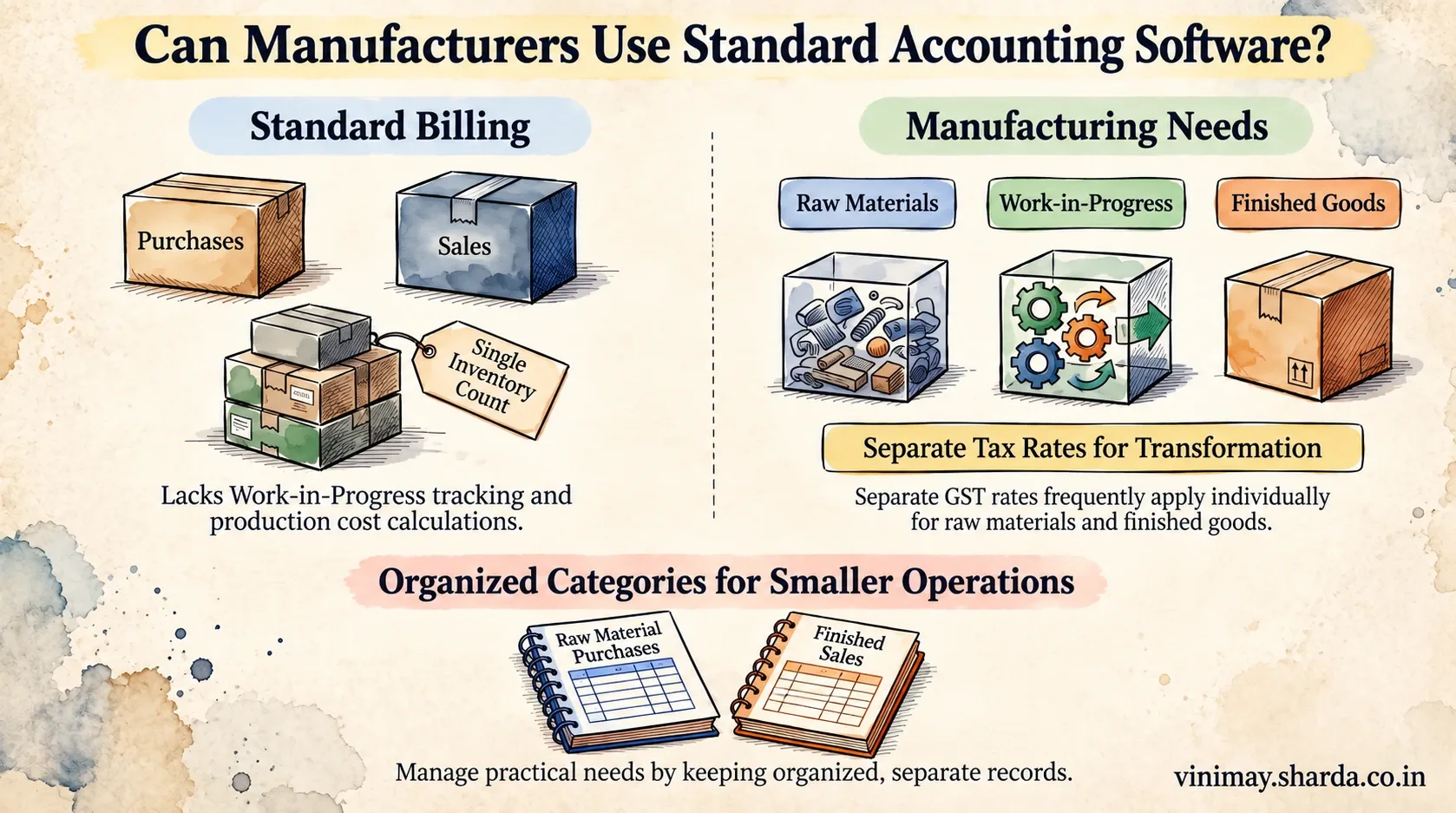
Unlike a retailer who buys finished products and resells them unchanged, a manufacturer buys raw materials, incurs production costs, and sells a transformed product—meaning stock tracking needs to account for materials, work in progress, and finished goods as three distinct states, not one simple inventory count.
What Manufacturing-Specific Accounting Should Handle
Purchase records for raw materials, separate from finished goods sales
Stock tracking that reflects materials consumed during production
GST correctly applied on both raw material purchases and finished goods sales, which may carry different rates
Vendor management for material suppliers, distinct from customer management for buyers
Where Standard Billing Software Falls Short for Manufacturers
A tool built purely around retail-style "buy finished goods, sell finished goods" tracking won't naturally account for the transformation step—it can track that materials came in and finished goods went out but won't automatically calculate production costs or work-in-progress value without dedicated manufacturing features.
What Smaller Manufacturers Often Do Instead
For a smaller manufacturing operation without complex, multi-stage production tracking needs, using solid purchase and sales record-keeping—tracking raw material costs and finished goods sales as separate, well-organized categories—often covers practical needs without requiring a specialized, more expensive manufacturing ERP system.
Where Vinimay Fits This
Vinimay supports purchase records, vendor management, and inventory tracking, which covers the raw material and finished goods sides of a manufacturer's business reasonably well for straightforward operations. Detailed work-in-progress tracking or automated production cost calculation isn't part of Vinimay's confirmed feature set, so manufacturers with complex, multi-stage production accounting needs should evaluate this specifically.
Frequently Asked Questions
Q1. Do manufacturers need different software than retailers?
Often yes, if they need to track work-in-progress or production costs specifically, though basic purchase-and-sales tracking can work for simpler operations.
Q2. Does Vinimay track work-in-progress inventory?
This isn't part of Vinimay's confirmed feature set; it supports raw material purchases and finished goods stock as separate records.
Q3. Can GST rates differ between raw materials and finished goods?
Yes, this is common, and a correct tax application needs to reflect the specific item being billed, not a single blanket rate.
Q4. What's a practical approach for a smaller manufacturer?
Using solid purchase and sales record-keeping, treating raw materials and finished goods as separate, organized categories.
Q5. Does Vinimay support vendor management for material suppliers?
Yes, vendor management is part of Vinimay's confirmed features, distinct from customer management for buyers.
Q6. How many free invoices can a manufacturer test with Vinimay?
Up to 5 GST invoices are free, useful for testing finished goods sales tracking specifically.
Q7. Can manufacturing software track raw material purchases separately?
Yes, software with inventory features can maintain separate records for raw materials, helping manufacturers monitor purchases, quantities, suppliers, and available stock.
Q8. Can manufacturers track finished goods inventory after production?
Yes, finished goods can be maintained as a separate inventory category, making it easier to monitor available stock and sales after production.
Q9. Can manufacturing businesses track supplier-wise purchases?
Yes, vendor records can help manufacturers review purchases by supplier, monitor transactions, and maintain organized material procurement records.
Q10. Can billing and inventory software help manufacturers maintain GST records?
Yes, GST-enabled billing and inventory software can help manufacturers maintain tax-related sales and purchase records while applying the relevant GST rates to individual products.
Often yes, if they need to track work-in-progress or production costs specifically, though basic purchase-and-sales tracking can work for simpler operations.
This isn't part of Vinimay's confirmed feature set; it supports raw material purchases and finished goods stock as separate records.
Yes, this is common, and a correct tax application needs to reflect the specific item being billed, not a single blanket rate.
Using solid purchase and sales record-keeping, treating raw materials and finished goods as separate, organized categories.
Yes, vendor management is part of Vinimay's confirmed features, distinct from customer management for buyers.
Up to 5 GST invoices are free, useful for testing finished goods sales tracking specifically.
Yes, software with inventory features can maintain separate records for raw materials, helping manufacturers monitor purchases, quantities, suppliers, and available stock.
Yes, finished goods can be maintained as a separate inventory category, making it easier to monitor available stock and sales after production.
Yes, vendor records can help manufacturers review purchases by supplier, monitor transactions, and maintain organized material procurement records.
Yes, GST-enabled billing and inventory software can help manufacturers maintain tax-related sales and purchase records while applying the relevant GST rates to individual products.
Related Topics
Published by Team Vinimay
Our editorial and compliance specialists create practical guides, tax calculation rules, and operational strategies to empower Indian small business owners and accountants.