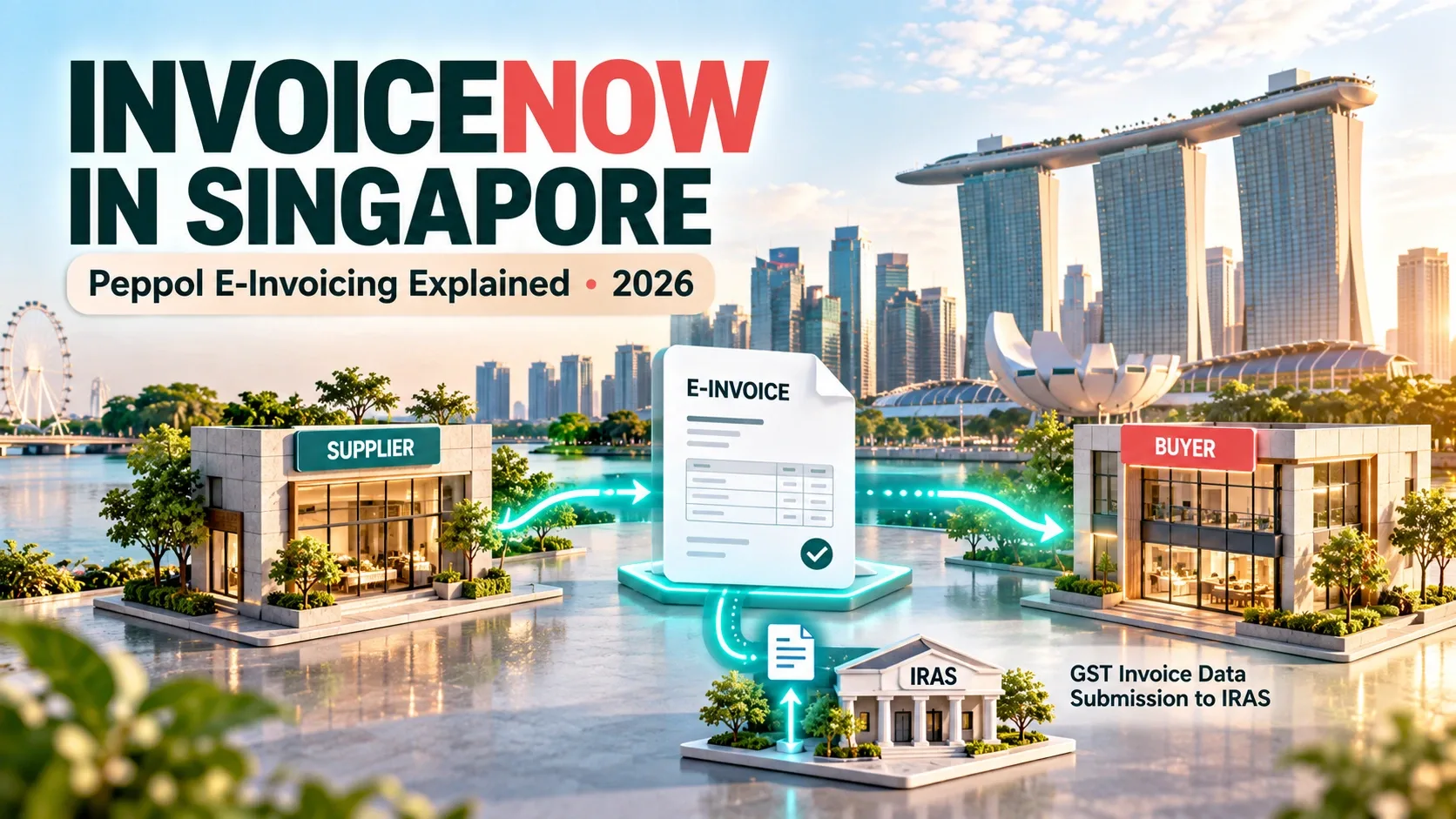
InvoiceNow is Singapore's nationwide electronic invoicing network based on the Peppol standard. Introduced by IMDA, it enables businesses to exchange structured invoices directly between accounting systems. GST-registered businesses must progressively submit invoice data to IRAS using InvoiceNow-Ready Solutions.
Singapore is transforming how businesses issue invoices, exchange payment information and maintain accounting records. InvoiceNow makes it possible to send invoice data electronically without relying entirely on paper documents, PDF attachments or manual data entry.
For small businesses, freelancers, retailers and service providers, InvoiceNow can simplify invoicing and reduce administrative work.
The Inland Revenue Authority of Singapore (IRAS) is also introducing mandatory GST invoice data submission through InvoiceNow in phases.
1. What Is InvoiceNow and Why Was It Introduced?
InvoiceNow is a nationwide e-invoicing initiative introduced by Singapore's Infocomm Media Development Authority (IMDA) in 2019.
It uses the international Peppol framework to connect businesses operating with different accounting and invoicing systems.
Instead of sending an invoice as an email attachment and requiring the recipient to enter the information manually, InvoiceNow enables structured invoice data to move between compatible business systems.
The main benefits include:
Faster invoice processing.
Reduced manual data entry.
Fewer transcription errors.
More efficient payment reconciliation.
Better financial recordkeeping.
Easier exchange between different accounting platforms.
InvoiceNow is not a single accounting software application. It is a network that compatible invoicing solutions can connect to.
2. How Does InvoiceNow Work in Singapore?
InvoiceNow operates through Peppol, an internationally recognised electronic document exchange framework.
The process generally involves four participants:
The supplier creates an invoice using compatible software.
The supplier's Access Point converts or transmits the invoice in the prescribed structured format.
The buyer's Access Point receives the electronic invoice.
The buyer receives the information in its connected accounting or finance system.
Because the network uses common standards, the supplier and buyer do not need identical accounting software.
For example, a Singapore wholesaler can send an invoice electronically to a retail business using a different InvoiceNow-compatible solution.
The receiving business can then process the information with less manual re-entry.
3. Is InvoiceNow Mandatory for Singapore Businesses?
InvoiceNow network participation is available to businesses generally, but the GST InvoiceNow Requirement introduces mandatory invoice data submission for GST-registered businesses.
The requirement began with selected voluntary GST registrants and is expanding in phases.
For existing GST registrants, the annual supply bands refer to specified 2025 accounting-period figures, not simply current-year turnover.
Certain overseas entities and businesses registered for GST solely because of the reverse-charge regime are excluded from the requirement.
4. What Is the Difference Between InvoiceNow and GST InvoiceNow?
Although the names are closely related, they describe different functions.
A business may use InvoiceNow to exchange invoices with trading partners before its mandatory GST reporting date.
Under GST InvoiceNow, qualifying invoice data must also be transmitted to IRAS for tax administration.
This requirement does not replace ordinary GST return filing responsibilities.
5. What Invoice Data Must Businesses Submit to IRAS?
The GST InvoiceNow Requirement generally covers relevant sales and purchase information reported in GST returns.
This includes information relating to:
Standard-rated supplies and purchases.
Zero-rated supplies and purchases.
Exempt supplies.
Relevant tax invoices and sales invoices.
Debit notes and credit notes.
Certain receipts and equivalent transaction records.
Specific aggregation arrangements are available for qualifying point-of-sale supplies, simplified tax invoices and petty cash purchases.
Businesses should review the official IRAS rules to understand which transactions must be submitted, how and by when.
Not every transaction requires an individually exchanged Peppol invoice between supplier and buyer.
6. How Can a Singapore Business Register for InvoiceNow?
Businesses can begin by checking whether their existing accounting software is InvoiceNow-Ready.
The usual onboarding process includes:
Choose an IMDA-accredited InvoiceNow-Ready Solution Provider or suitable Access Point.
Register the business on the InvoiceNow network.
Obtain or activate its Peppol ID using the business's Unique Entity Number (UEN).
Configure its accounting or invoicing system.
Enable GST InvoiceNow submission functionality where required.
Test electronic invoice exchange and reporting.
Businesses using an in-house enterprise system may work directly with an IMDA-accredited Access Point Provider.
Singapore-registered businesses should also complete the applicable Corppass verification requirements.
7. Is InvoiceNow Free for Small Businesses in Singapore?
Some InvoiceNow solutions provide free basic electronic invoicing functionality, while others charge subscription or integration fees.
IRAS and IMDA have introduced support measures to encourage adoption.
These include:
GST InvoiceNow Transition Grants of S$1,000 for eligible SMEs.
Transition Grants of S$5,000 for eligible larger businesses.
Free-of-charge basic solution packages available through 31 March 2031.
Other support programmes subject to eligibility criteria.
Free solutions may have limits on features, users or additional accounting functionality.
Businesses should confirm current grant eligibility, application conditions and software costs through official IMDA resources.
8. How Can Small Businesses Prepare for InvoiceNow?
Small businesses should review their existing invoicing process before choosing a solution.
A practical preparation checklist includes:
Verify company UEN and registration details.
Check whether existing software is InvoiceNow-Ready.
Review customer and supplier information.
Confirm invoice numbers, GST classifications and amounts.
Register for the appropriate Peppol connectivity.
Enable IRAS reporting where applicable.
Test invoice exchange and correction procedures.
Train employees responsible for billing.
Accounting software such as Vinimay provides general invoicing, customer records, payment tracking and transaction management features that can help organise business information.
However, Vinimay's Singapore GST InvoiceNow compliance, Peppol connectivity and IRAS submission capabilities have not been independently verified. Businesses should confirm these capabilities before relying on any software to satisfy mandatory requirements.
The priority is to choose software that supports everyday accounting needs and the applicable Singapore e-invoicing obligations.
Frequently Asked Questions About InvoiceNow Singapore
1. What is InvoiceNow in Singapore?
InvoiceNow is Singapore's nationwide Peppol-based electronic invoicing network, introduced by IMDA to help businesses exchange structured invoices between compatible accounting and finance systems.
2. Is InvoiceNow mandatory in Singapore?
The GST InvoiceNow Requirement is mandatory for GST-registered businesses according to a phased implementation schedule, while general electronic invoice exchange is available more broadly.
3. When did GST InvoiceNow become mandatory?
The first mandatory phase began on 1 November 2025 for qualifying newly incorporated voluntary GST registrants. Further phases began in April 2026 and continue through April 2031.
4. Is InvoiceNow free for Singapore SMEs?
Certain providers offer free basic InvoiceNow solutions. Eligible SMEs may also qualify for government transition grants, subject to the applicable conditions.
5. What is an InvoiceNow Peppol ID?
A Peppol ID is an electronic identifier used to identify a business on the InvoiceNow network. In Singapore, registration commonly uses the company's UEN.
Related Topics
Published by admin
Our editorial and compliance specialists create practical guides, tax calculation rules, and operational strategies to empower Indian small business owners and accountants.