The question itself contains an assumption worth checking first: that "good" means the same thing for every small business. A five-person clothing boutique and a solo consultant are both "small businesses", but what makes accounting software good for one won't necessarily make it good for the other.
Free accounting software is genuinely good for small businesses at a specific stage — low transaction volume, a single user, and straightforward billing needs — and becomes progressively less adequate as any of those three factors grow. It isn't a compromise or a lesser option by default; it's a tool matched to a particular set of circumstances, and the question worth asking isn't "Is free good?" But "Does my current situation match what free is built for?"
What Is Free Accounting Software?
Free accounting software is a digital tool that helps small businesses, startups, freelancers, and individuals manage basic financial activities without paying a regular software subscription fee. It can simplify tasks such as creating invoices, recording sales and expenses, tracking payments, maintaining customer records, and organising financial transactions.
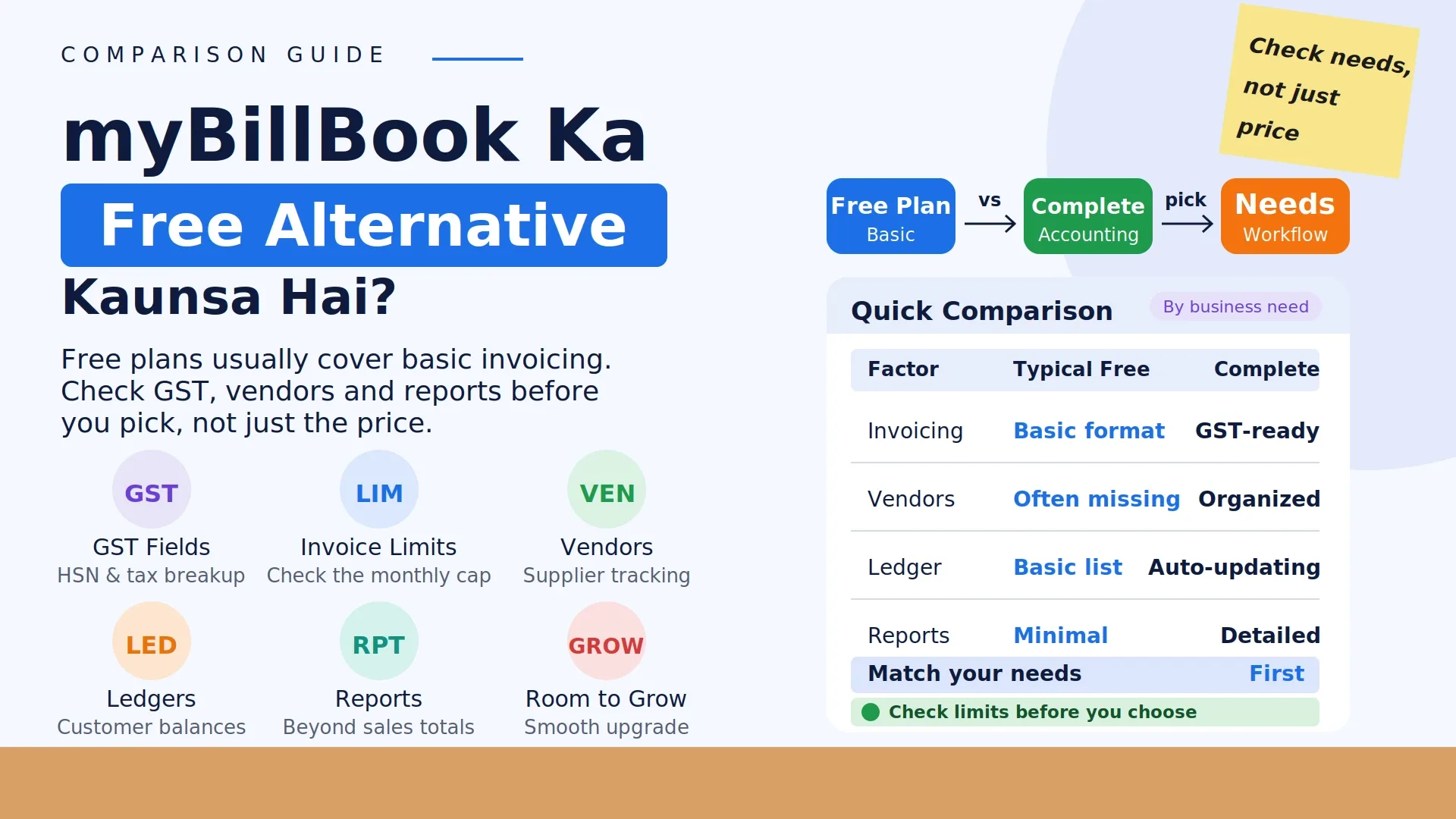
Depending on the provider, free accounting software may also support support GST invoicing, tax calculations, payment tracking, financial reports, and PDF invoice generation. However, the features and usage limits can vary between providers, so businesses should check what is included in the free plan before choosing one.
For a small business with straightforward accounting needs, free software can be useful for reducing manual work and keeping financial records organised. As the business grows, higher transaction volumes, additional users, advanced reporting, or inventory requirements may make a paid plan more suitable.
What Free Software Actually Does Well
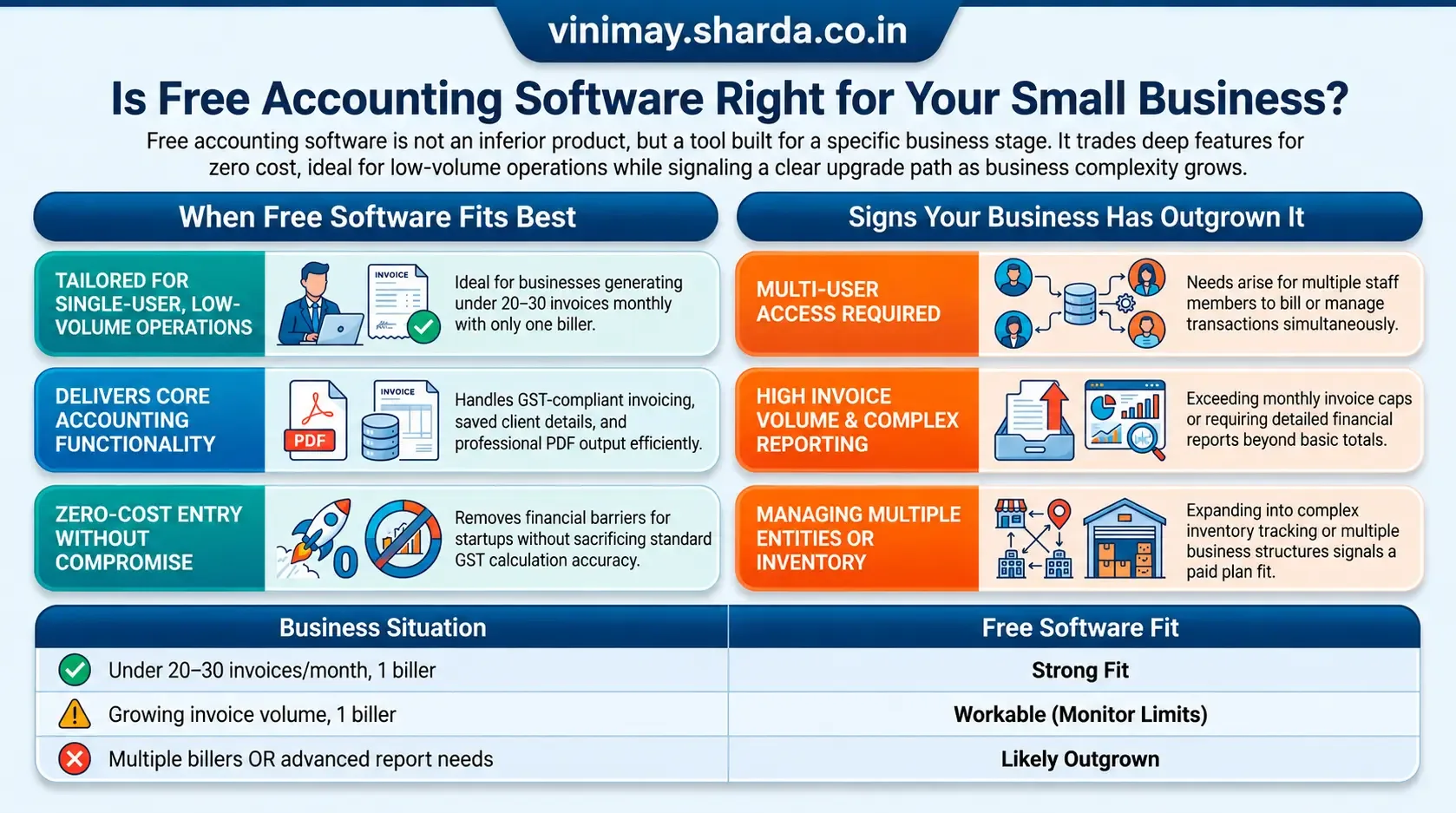
For the right-sized business, free accounting software genuinely delivers: GST-compliant invoicing without a subscription cost, saved customer and product details that speed up repeat billing, and a professional-looking document that replaces handwritten bills entirely. None of this is a stripped-down or inferior version of "real" accounting — it's the complete core functionality most small businesses actually use daily.
Where the Fit Starts to Strain
Invoice volume exceeding a free plan's monthly cap
More than one person needing to create bills
A need for detailed reports beyond basic totals
Managing more than one business entity
None of these represent free software failing — they represent a business outgrowing the specific scope free tiers are designed around.
A Practical Way to Judge Fit for Your Business
The Honest Trade-Off Nobody States Plainly
Free software trades depth for accessibility — it removes cost as a barrier to starting, in exchange for a narrower scope once your needs grow more complex. This isn't a hidden catch; it's simply how free tiers sustain themselves as a genuine entry point rather than a permanently limited product.
Where Vinimay Fits This Question
Vinimay's free invoice tool is built around exactly the small-business scenario where free software performs well — GST-compliant invoicing, saved customer details, and professional PDF output, available immediately without cost. For a business generating up to 5 invoices in this tier, it demonstrates the same underlying accuracy and quality found in Vinimay's fuller system, just at a smaller, no-cost scale.
Frequently Asked Questions
Q1. Is free accounting software reliable for GST compliance?
Yes, tax calculation accuracy depends on setup and implementation, not on price — free tools can be just as accurate for standard GST scenarios.
Q2. When does a small business typically outgrow free software?
Usually when invoice volume exceeds the free tier's limit, or more than one person needs billing access.
Q3. Does "free" mean fewer features permanently, or just at first?
This depends on the provider — some free tiers are a permanent entry-level option; others are a trial before upgrading.
Q4. Is free software good for a business with physical inventory?
It can be, if inventory tracking is included at that tier — this is worth confirming specifically rather than assuming.
Q5. How many free invoices can I create with Vinimay to test this fit?
Up to 5 GST invoices free, downloadable as PDF.
Q6. Should I choose free software just to avoid cost, even if my business has grown?
Not necessarily — matching the tool to your actual current volume and needs matters more than minimising cost alone.
Q7. Can free accounting software generate GST-compliant invoices?
Yes, free accounting software can generate GST-compliant invoices when GST details, tax rates, HSN/SAC codes, and business information are entered correctly.
Q8. Can I track GST sales and purchase records in free accounting software?
Yes, if the software includes GST transaction tracking, businesses can maintain sales, purchase, invoice, and tax-related records in one place.
Q9. Can free accounting software help reduce GST calculation errors?
Yes, automated tax calculations can reduce manual errors, provided the correct GST rates, customer details, HSN/SAC codes, and transaction information are configured.
Q10. Should I test free accounting software before using it for GST records?
Yes, creating sample invoices and checking GST calculations, invoice details, PDF output, and record management can help confirm whether the software suits your business.
.
Related Topics
Published by Team Vinimay
Our editorial and compliance specialists create practical guides, tax calculation rules, and operational strategies to empower Indian small business owners and accountants.