How Can I Reduce Manual Bookkeeping Work?
Bookkeeping rarely feels heavy because of any single task — it's the accumulation of small, repetitive actions that adds up: entering the same customer details on every invoice, manually checking whether a payment came in, updating a spreadsheet that should really update itself. None of it is complicated work, which is exactly why it's so easy to underestimate how much time it quietly consumes every week.
The most effective way to reduce this isn't working faster through the same manual steps — it's removing the steps that don't need a person doing them at all. Recording a transaction once and having it flow accurately into invoicing, payment tracking, and reports is what actually cuts hours off bookkeeping, rather than just doing the same manual process with slightly more discipline.
This guide breaks down where manual bookkeeping time actually goes, practical ways to reduce it accurately, and what still needs human oversight even after automating the repetitive parts.
Where Does Manual Bookkeeping Time Actually Go?
Direct answer: Most manual bookkeeping time goes into repetitive data entry — creating invoices from scratch, manually checking and updating payment status, and rebuilding reports by hand — rather than into complex financial decisions, which is exactly why this time is so reducible with the right connected system.
Re-entering the same customer or product details on every invoice
Manually checking bank statements or notebooks to confirm which invoices are paid
Recalculating GST tax manually or double-checking a formula
Rebuilding sales or expense reports from scratch each time one is needed
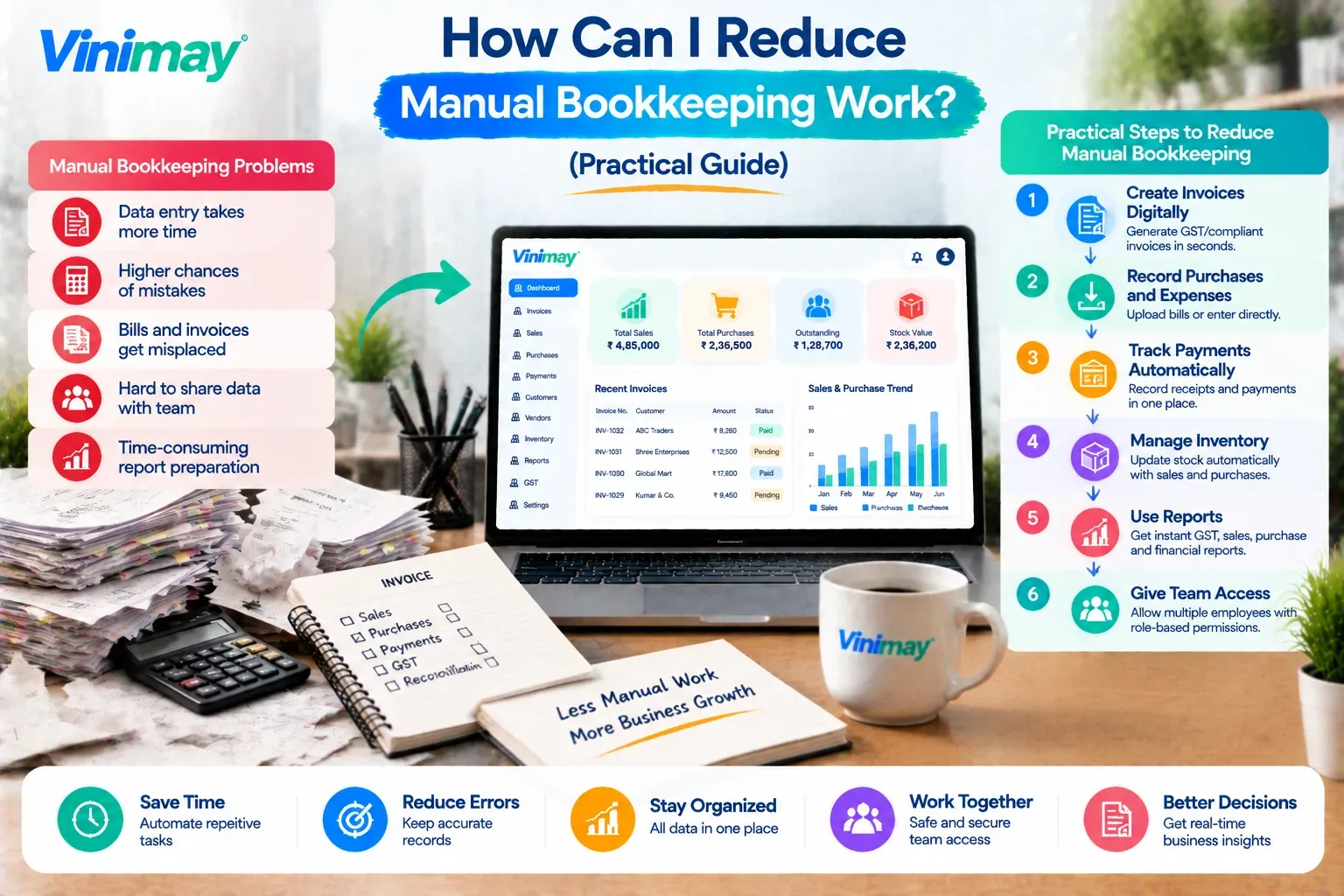
Why Manual Entry Is the Real Time Drain, Not Bookkeeping Itself
It's worth separating "bookkeeping" from "manual entry," because they're often blamed together when only one of them is actually the problem. Bookkeeping — deciding how to categorise a transaction, understanding what a report means, knowing when something needs a professional's judgment — is valuable work that genuinely benefits from a person's attention. Manual entry, on the other hand, is the repetitive act of typing the same information into a system by hand, checking it against another document, and doing it all over again for the next transaction — work that adds no real judgment, just time and a chance for a small error to slip through unnoticed. The businesses that reduce bookkeeping time most successfully aren't doing less bookkeeping; they're removing the manual entry that surrounds it, so the actual thinking part of bookkeeping gets the attention it deserves instead of getting rushed at the end of a long data-entry session.
Practical Ways to Cut Down Manual Bookkeeping Work
Use software that applies GST calculations automatically — removing the need to manually calculate or double-check tax on every invoice
Keep invoicing and payment tracking connected — so marking a payment updates the customer's balance automatically, instead of a separate manual check
Store customer and vendor details once, not on every new invoice — reusing saved records instead of retyping them
Generate reports directly from recorded transactions — rather than rebuilding a summary manually each time one is needed
Set a fixed weekly time for review, not entry — spend time checking accuracy, not typing in data that could flow in automatically
Standardise how transactions are recorded — a consistent process across the team reduces errors that come from everyone doing it slightly differently
What Not to Automate Without Oversight
Categorisation judgment calls — an unusual or ambiguous transaction still benefits from a person deciding how it should be recorded
Final review before tax filing — automated records still need a human check before submission, especially for anything unusual
Correction decisions — issuing a credit note, debit note, or handling a disputed payment still needs a person's judgment, not a fully automatic process
Large or one-off transactions — these are worth a manual double-check regardless of how automated the rest of the system is
How Vinimay Cuts Down Manual Work
Applies GST tax calculation automatically on every invoice, removing manual tax entry and double-checking
Keeps payment tracking connected to invoicing, so a recorded payment updates receivables automatically
Stores customer and vendor details through customer and vendor management, so they don't need retyping on every invoice
Connects sales records, purchase records, and stock through inventory and product management, reducing separate manual updates
Generates reports and ledger entries directly from recorded transactions, instead of being rebuilt manually each time
Conclusion
Most bookkeeping time is spent on repetitive manual entry, not on the actual judgment-based parts of bookkeeping
Reducing manual work means connecting invoicing, payments, and records — not just doing the same steps faster
Some tasks — categorisation judgment calls, final review, corrections — still need human oversight even with automation
Vinimay removes repetitive manual entry around GST invoicing, payments, and records, so time gets spent on review instead of data entry
FAQs
How can I reduce manual bookkeeping work?
By using connected software that applies GST calculations automatically, links payments to invoices, and generates reports directly from recorded transactions, rather than manually re-entering and checking each step.
Where does most manual bookkeeping time actually go?
Mostly into repetitive data entry — recreating invoices, manually checking payment status, and rebuilding reports — rather than into complex decisions.
Can bookkeeping be fully automated?
No, some tasks like categorisation judgment calls, corrections, and final review before filing still benefit from human oversight, even with automation in place.
Does reducing manual entry increase the risk of errors?
Generally no — manual entry is actually where most repetitive errors occur, so removing it and adding periodic review tends to improve accuracy.
What's the difference between automating bookkeeping and doing less bookkeeping?
Automating removes repetitive manual entry; it doesn't reduce the judgment-based parts of bookkeeping, which still benefit from a person's attention.
How much time can be saved by reducing manual bookkeeping tasks?
This varies by business, but time is typically freed up wherever repetitive re-entry (customer details, tax calculations, report building) is eliminated.
Is it worth automating bookkeeping for a very small business?
Yes, even at low volume, automatic GST calculation and connected payment tracking reduce the chance of small, repeated manual errors.
Should I still review my books manually after automating?
Yes, a periodic review — weekly or monthly — is still important to catch anything unusual that automation alone might not flag accurately.
Does connected software replace the need for a bookkeeper?
Not entirely — it removes repetitive manual entry, but a bookkeeper or CA still provides judgment and review that software doesn't replace.
What's the first bookkeeping task worth automating?
Invoicing and payment tracking are usually the highest-impact starting point, since they're the most frequent and repetitive manual tasks for most businesses.
Related Topics
Published by Team Vinimay
Our editorial and compliance specialists create practical guides, tax calculation rules, and operational strategies to empower Indian small business owners and accountants.