Staff bill customers without necessarily seeing the full financial picture, and whether that's actually possible depends on how granular the software's access system is. Yes, employees can access accounting information in most modern billing software, but critically, this access should be controllable rather than all-or-nothing—a well-designed system lets you decide specifically what each employees sees and does, rather than forcing a choice between full access or no access at all.
What "Access" Actually Covers
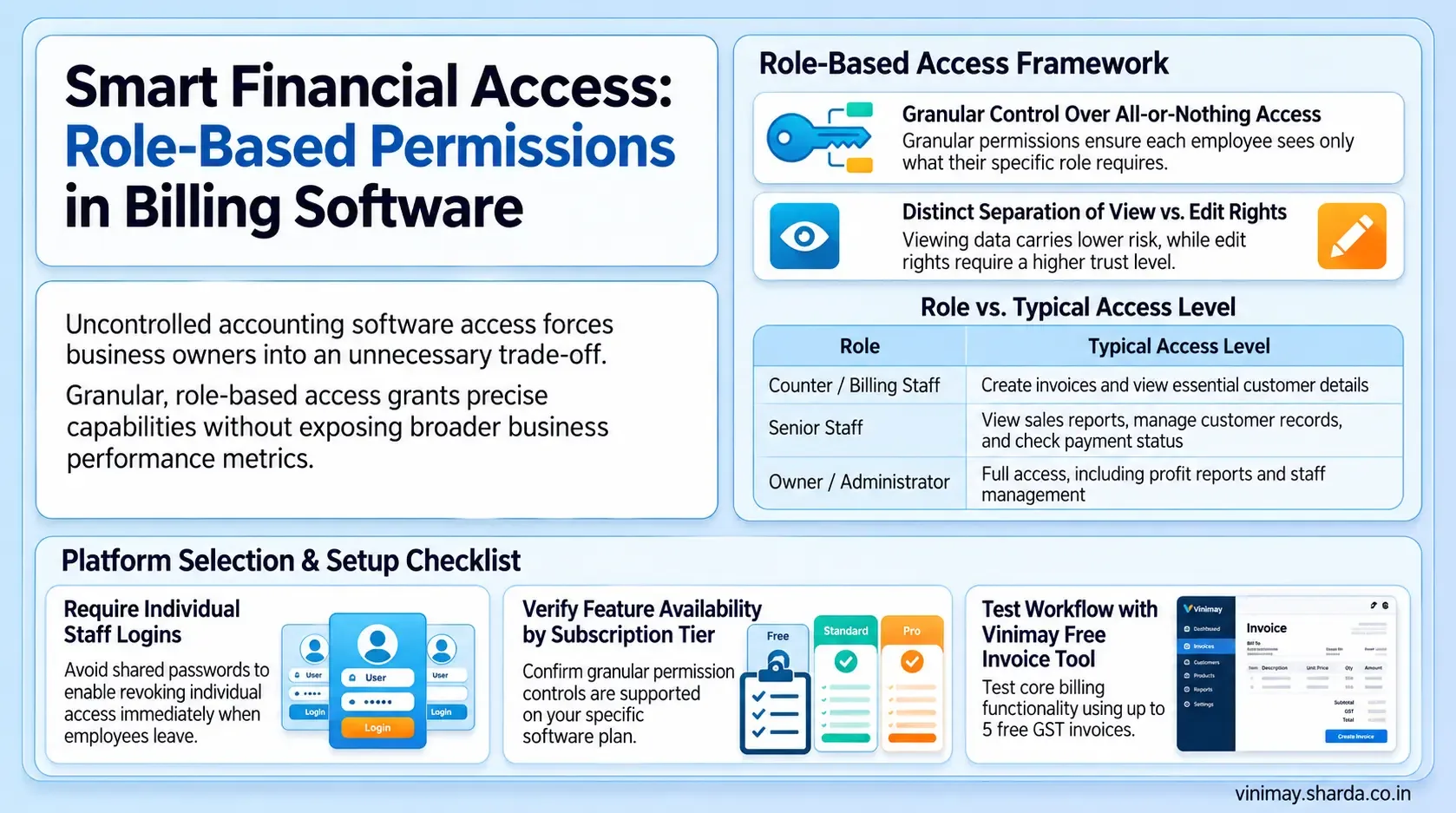
Employees access isn't a single switch—it typically spans several distinct capabilities: creating invoices, viewing customer records, seeing payment status, viewing overall sales reports, and modifying existing records. A counter staff member might need only the first two; a senior employees might reasonably need more.
Why Uncontrolled Access Creates Real Problems
Without the ability to limit access, businesses face an uncomfortable choice: either give every staff member full visibility into revenue figures, outstanding customer balances, and business performance, or restrict software use to only the owner, which defeats the purpose of having a team at all.
What Reasonable Access Levels Look Like
The Trust Question This Actually Answers
Controlled access isn't about assuming staff dishonesty—it's about giving each person exactly what their role requires, nothing more. A delivery staff member logging collections doesn't need visibility into monthly profit figures, and not giving them that access isn't distrust; it's appropriate scope.
What to Check Before Assuming This Is Supported
Confirm whether individual staff logins exist (versus one shared password), whether access levels can actually be customized per person, and whether this granular control is available on your specific plan, since it's sometimes reserved for higher tiers.
Where Vinimay Fits This
Vinimay's structure keeps billing, stock, and payment data connected under one business account, with the specific staff access and permission levels available depending on your plan—worth confirming directly for your team's exact needs. The free invoice tool lets you test the core billing experience any staff member would use.
Frequently Asked Questions
Q1. Should every employees have the same level of access?
No, access should generally match what each role actually requires—counter staff rarely need the same visibility as a senior manager.
Q2. What's the risk of giving all staff full access?
It exposes sensitive figures like revenue and customer balances unnecessarily and removes any meaningful distinction between roles.
Q3. Can employees access ever be too restrictive?
Yes, if staff can't perform their actual job (like creating invoices) because access is too limited, it creates unnecessary friction.
Q4. Does controlling access require complex setup?
Not typically—most systems that support this make it a matter of selecting a role or permission level per staff member.
Q5. What's the difference between viewing and editing access?
Viewing lets someone see information without changing it; editing allows modification, which is a meaningfully higher level of trust and risk.
Q6. Should delivery staff see overall business reports?
Usually not necessary—their role typically requires viewing specific customer or order details, not company-wide performance data.
Q7. Can access levels be changed after they're set?
Yes, in a properly built system, adjusting a staff member's access as their role changes should be straightforward.
Q8. Does Vinimay offer role-based employees access?
This varies by plan—confirm current staff access options directly for your specific business needs.
Q9. What happens to access when an employees leaves?
It should be revocable immediately, ideally without needing to change a shared password that affects other staff.
Q10. How many free invoices can I use to test the staff billing experience?
Vinimay's free invoice tool allows up to 5 GST invoices for free.
Related Topics
Published by Team Vinimay
Our editorial and compliance specialists create practical guides, tax calculation rules, and operational strategies to empower Indian small business owners and accountants.