Before any money changes hands, many transactions start with a conversation about price and scope—a quotation. Whether that quotations can smoothly become the final invoice, without retyping everything from scratch, is a genuinely useful workflow question.
Yes, many billing tools, including Vinimay, support creating a quotations (often called a proforma invoice) before the final sale, which can then serve as the basis for the actual GST invoice once the transaction is confirmed. This two-stage process reflects how many real sales actually happen—an estimate first, a final bill after.
What Is a Quotation in Accounting Software?
A quotation in accounting software is a document a business creates to show a customer the expected price, products or services, quantities, taxes, discounts, and payment terms before a sale is confirmed. It helps customers review the proposed transaction before placing an order.
Accounting software can make quotations creation easier by allowing businesses to save customer details, product or service information, GST rates, prices, and terms. Once the customer accepts the quotation, some software also allows the quotation to be converted into an invoice, reducing duplicate data entry.
A typical quotation may include:
Customer name and contact details
Product or service description
Quantity and unit price
GST or applicable taxes
Discounts
Total quotation value
Payment terms
Quotation validity period
Business name and contact details
Notes or terms and conditions
Quotation vs. Invoice: A quotation is generally a price proposal before the sale, while an invoice is issued to request payment for goods or services supplied or agreed for billing.
Why This Two-Stage Process Matters
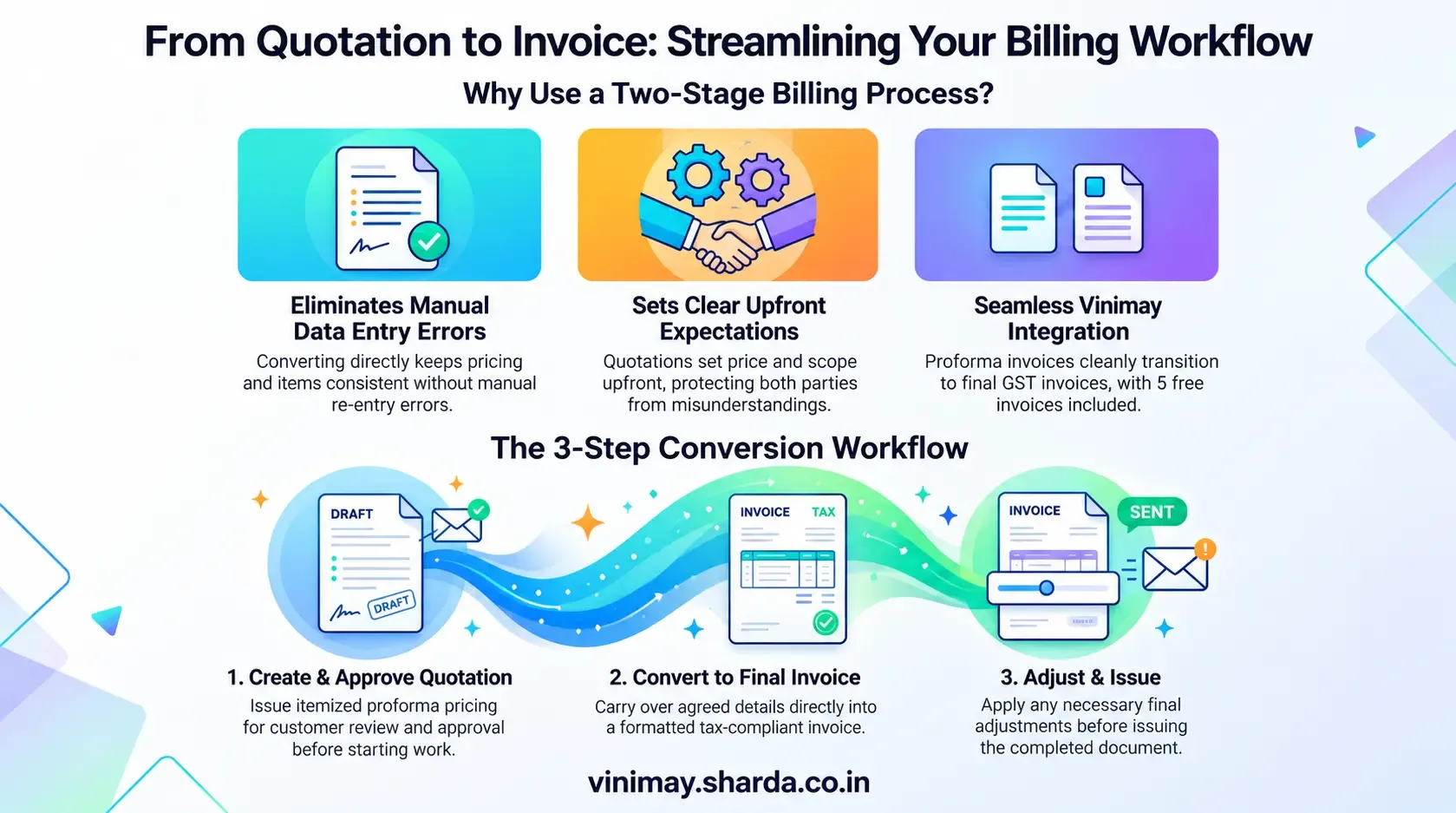
A quotation sets expectations on price and scope before committing to work or delivering goods, protecting both the business and the customer from misunderstandings later. Converting it into a final invoice, rather than creating an entirely separate document, keeps the details consistent between what was agreed and what was billed.
What a Quotation (Proforma Invoice) Typically Includes
Itemised pricing, similar to a final invoice
A note that it's an estimate, not a tax invoice
Validity period, if the pricing is time-sensitive
The same customer and product details that would appear on the eventual invoice
The Conversion Process, Step by Step
Why Converting Beats Is Recreating
Recreating an invoice from scratch after a quotation risks introducing inconsistencies—a slightly different price, a missed item—between what was agreed and what was billed. Converting directly from the quotation keeps this consistent by design, rather than depending on careful manual re-entry.
Where Vinimay Fits This
Vinimay supports proforma invoices for the quotation stage, letting you present pricing and scope before finalizing a sale. This groundwork can then inform the final GST invoice, keeping details consistent between what the customer agreed to and what's actually billed.
Frequently Asked Questions
1. What's the difference between a quotation and a proforma invoice?
They're often used interchangeably—both refer to an estimate document issued before the final, tax-compliant invoice.
2. Does a quotation require GST details?
Typically not in full, since it's not a legal tax document, though itemized pricing is usually included.
3. Can pricing change between a quotation and the final invoice?
Yes, if terms change before the final sale, though ideally this should be minimal to maintain customer trust.
4. Does Vinimay support creating quotations?
Yes, through proforma invoices, which can inform the final GST invoice once the sale is confirmed.
5. Why use a quotation instead of going straight to an invoice?
It sets clear expectations before committing to work or delivery, reducing the chance of a dispute later.
6. Is a quotation legally binding?
Generally not in the same way a tax invoice is, though it does represent an agreed estimate between both parties.
7. How long should a quotation typically remain valid?
This varies by business, though including a validity period on the document helps manage expectations around pricing changes.
8. Can I convert a quotation into an invoice without retyping everything?
This depends on the specific software's workflow, though ideally the same underlying details carry forward.
9. Does every business need to use quotations?
No, this is most useful for project-based or higher-value transactions where scope and price benefit from upfront agreement.
10. How many free invoices can I create with Vinimay after using a proforma invoice?
Up to 5 GST invoices are free, which can build on the details set out in an earlier proforma invoice.
Related Topics
Published by Team Vinimay
Our editorial and compliance specialists create practical guides, tax calculation rules, and operational strategies to empower Indian small business owners and accountants.