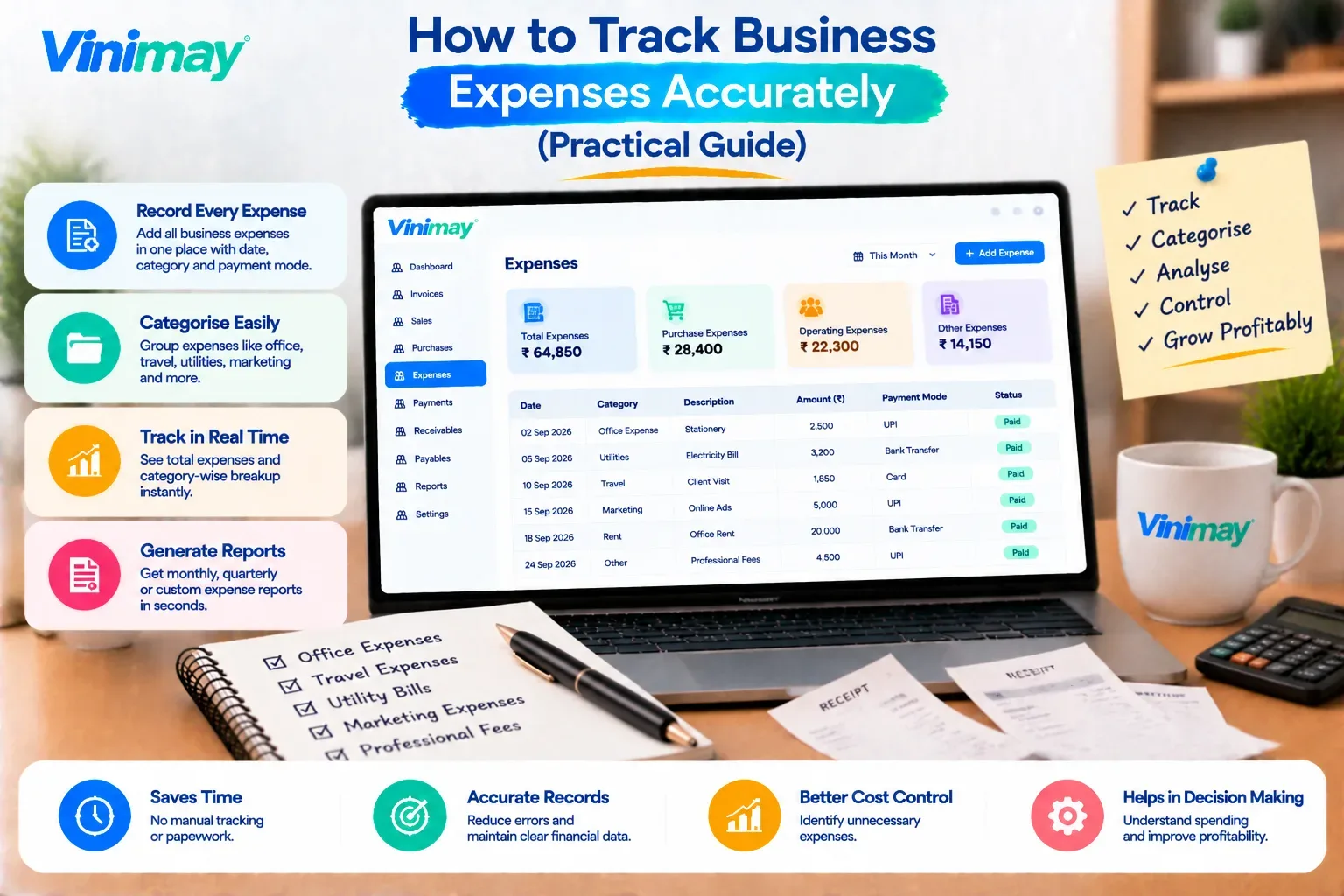
Keeping track of business expenses is important for understanding where money is being spent and identifying opportunities to control unnecessary costs. When expenses are recorded manually across notebooks or spreadsheets, analyzing spending patterns can become difficult, especially as the number of transactions increases.
Accounting software helps businesses record and categorize expenses systematically. It allows businesses to review expense details, compare spending across different categories, and generate reports that provide better visibility into financial activities. These insights help business owners understand their cost structure and make more informed decisions.
Vinimay helps businesses manage expense records, track transactions, and access financial reports in one integrated system. By maintaining organized expense data, businesses can monitor spending trends, improve cost management, and maintain better control over their financial operations.
Recording Expenses Is Not the Same as Analyzing Them
A list of expenses, however complete, is just a record until someone asks something of it. Analysis starts the moment you stop looking at expenses as a passive log and start using them to answer specific, practical questions about the business.
Question 1: Is This Expense Recurring or One-Off?
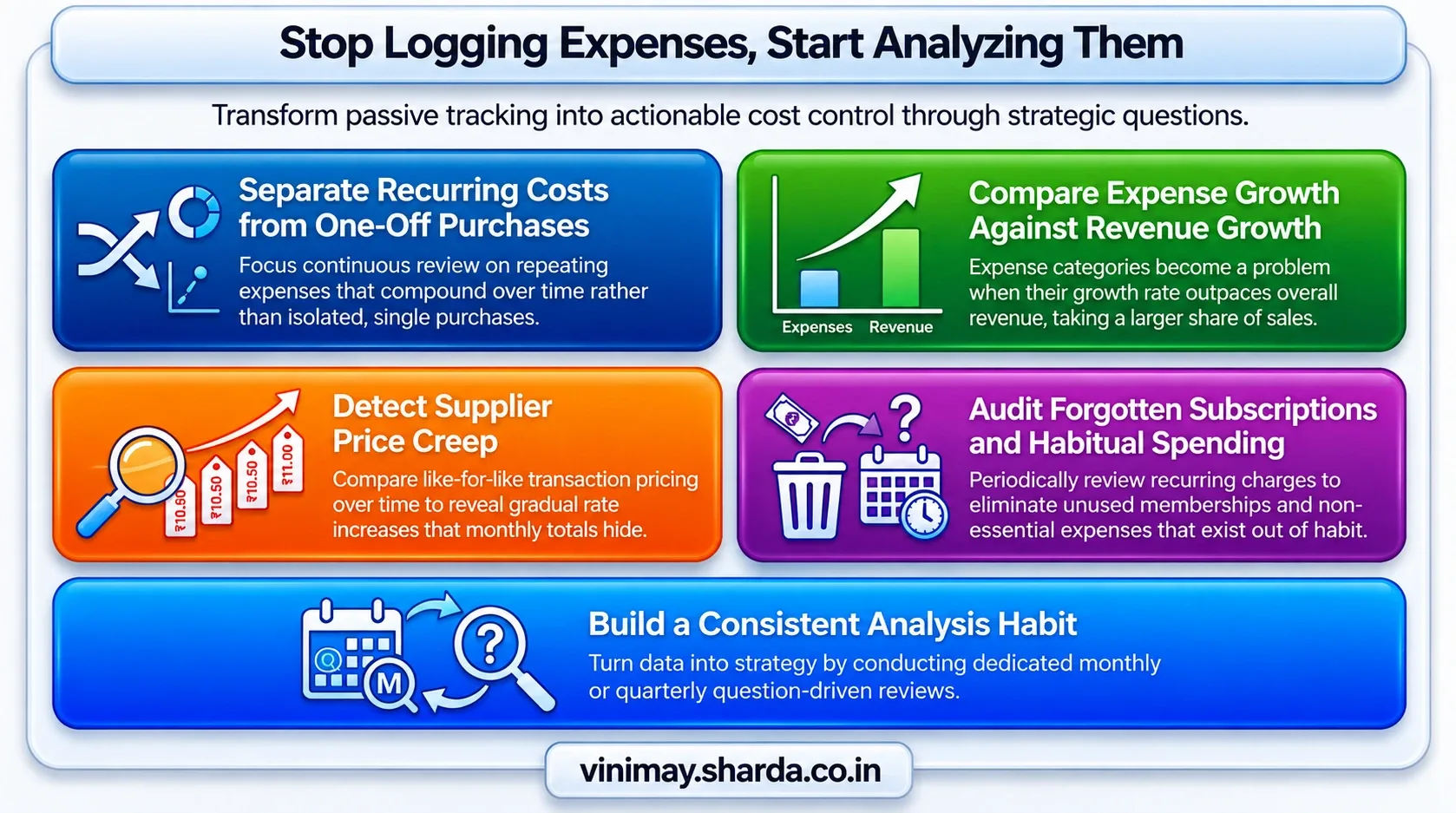
Not every expense deserves the same attention. A one-off equipment purchase behaves very differently from a monthly subscription or recurring supplier cost. Separating recurring expenses from one-off ones helps you focus ongoing review specifically on the costs that will keep repeating, rather than treating every line item equally.
Question 2: Is This Category Growing Faster Than My Revenue?
An expense category can be growing in absolute terms without actually being a problem if revenue is growing at a similar or faster pace. The more useful comparison is whether a specific category—say, raw materials or transport—is growing faster than your overall sales, which would mean it's eating a bigger share of every rupee earned.
Question 3: Which Expenses Could I Actually Reduce Without Hurting the Business?
This question separates "necessary" costs from ones that exist mostly out of habit. Reviewing expense categories with this question in mind—rather than just looking at totals—often surfaces small, low-impact costs that have simply never been reconsidered.
Question 4: Am I Paying More Than I Used To for the Same Thing?
Comparing what you paid for a specific product or service six months ago against what you're paying now for the same item reveals price creep that's easy to miss when looking only at monthly totals. A supplier raising prices gradually, a service quietly increasing its rate—these show up clearly when you compare like-for-like over time.
Question 5: Are There Expenses I've Simply Forgotten I'm Paying For?
Subscriptions, memberships, and small recurring charges have a way of continuing long after they stopped being useful. Periodically reviewing your full list of recurring expenses specifically to ask, "Do I still need this?" is a simple but often overlooked form of analysis.
Turning These Questions Into a Habit
None of these questions require sophisticated tools—they require setting aside time, on a consistent schedule, to actually ask them of your expense data rather than just glancing at a total. Monthly or quarterly reviews, treated as a genuine habit rather than an occasional exercise, are what turn expense records into expense analysis.
What Your Records Need to Support This
For these questions to be answerable in the first place, a few things need to be true of how expenses are recorded:
Expense records need to be categorized consistently so comparisons across time or categories are meaningful
Purchase records need to capture specific pricing per transaction so price creep can actually be detected
Reports need to summarize expenses by category and period, rather than requiring manual addition each time
In Vinimay, expense records and purchase records are kept connected to the transactions they came from, which supports exactly this kind of question-driven review—comparing categories over time, checking specific item pricing across purchases, and reviewing recurring costs—using data that's already being captured through normal billing and purchasing, rather than a separate manual tracking effort.
Frequently Asked Questions
1. What's the difference between recording expenses and analyzing them?
Recording is simply logging what was spent; analysis means asking specific questions of that data to find patterns, trends, or opportunities to act.
2. Why does it matter whether an expense is recurring or one-off?
Recurring expenses deserve more ongoing attention since they repeat and compound over time, unlike a single, isolated purchase.
3. How can I tell if an expense category is becoming a real problem?
Compare its growth rate against your overall revenue growth—a category outpacing revenue is taking a bigger share of every sale.
4. What's a simple way to spot price creep from a supplier?
Compare what you paid for the same specific item across several past purchases, rather than looking only at overall monthly totals.
5. How often should expense analysis happen?
Monthly or quarterly, treated as a consistent habit rather than something done only when costs feel unusually high.
6. What kind of expenses are easiest to overlook in analysis?
Small, recurring subscriptions or memberships often go unnoticed since they don't stand out in a monthly total the way a large one-off cost does.
7. Does expense analysis require special software features?
It requires consistent categorization and access to historical purchase pricing—reports and organized records support this, but the analysis itself is a habit more than a feature.
8. Can expense analysis help with supplier negotiations?
Yes—identifying specific price increases over time gives concrete evidence to raise during a pricing discussion.
9. What's a common mistake in reviewing expenses?
Looking only at monthly totals without comparing categories over time or against revenue growth, which misses meaningful trends.
10. What's the first step to start analyzing expenses more effectively?
Set a regular schedule to review categorized expense data with specific questions in mind, rather than just glancing at a total occasionally.
Related Topics
Published by Team Vinimay
Our editorial and compliance specialists create practical guides, tax calculation rules, and operational strategies to empower Indian small business owners and accountants.