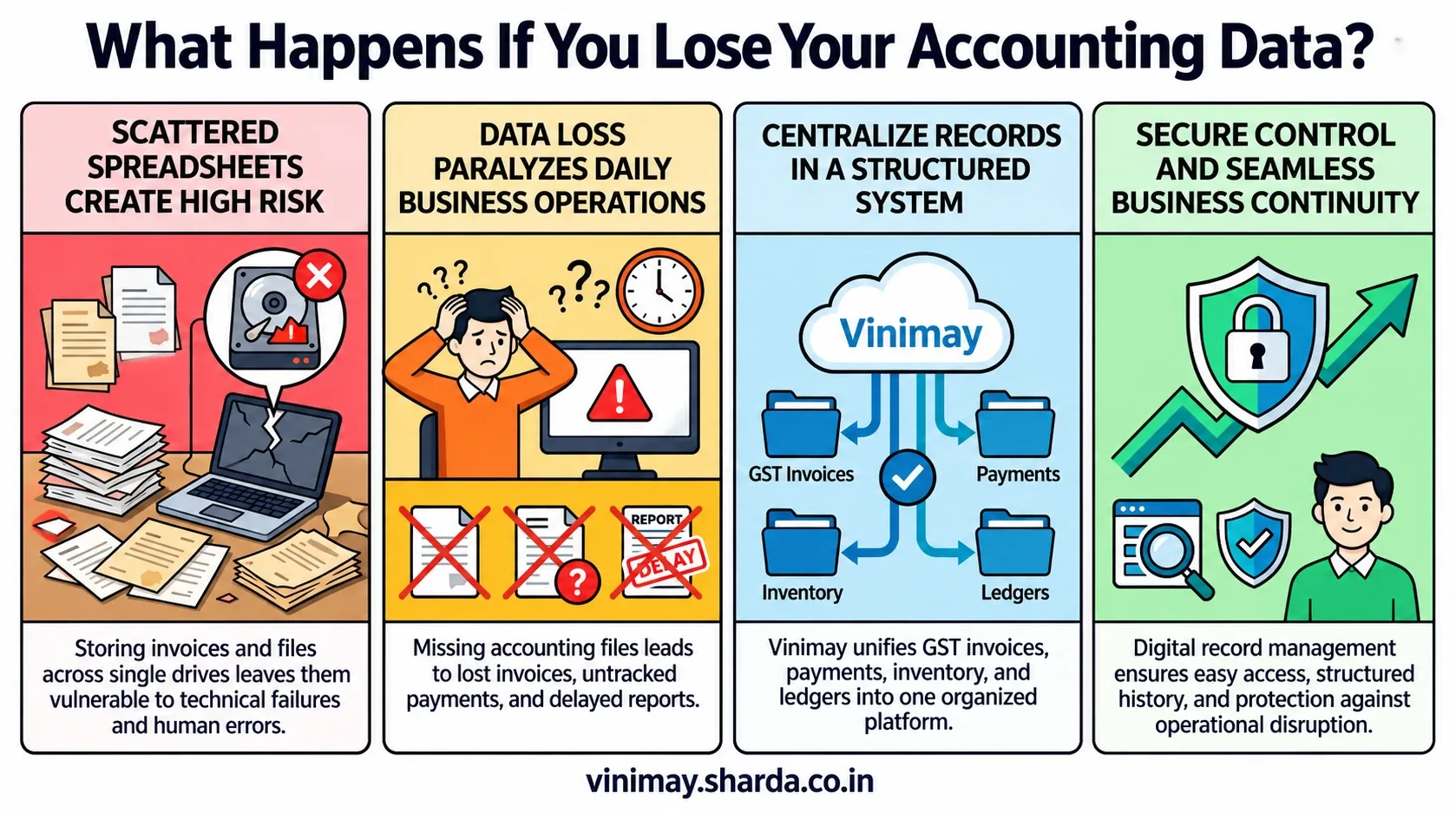
Understanding business profitability requires a clear view of income, expenses, sales, and overall financial performance. When accounting records are incomplete or maintained across multiple files, it becomes difficult to accurately calculate profit and understand whether the business is growing or where costs need to be controlled.
Accounting software helps organize financial data by recording sales, expenses, purchases, and payments in one system. With accurate transaction records and financial reports, businesses can analyze revenue, costs, and profitability more effectively. Vinimay helps businesses manage accounting records, billing, and reports together, making it easier to track financial performance and make informed business decisions.
The Two Numbers That Actually Matter
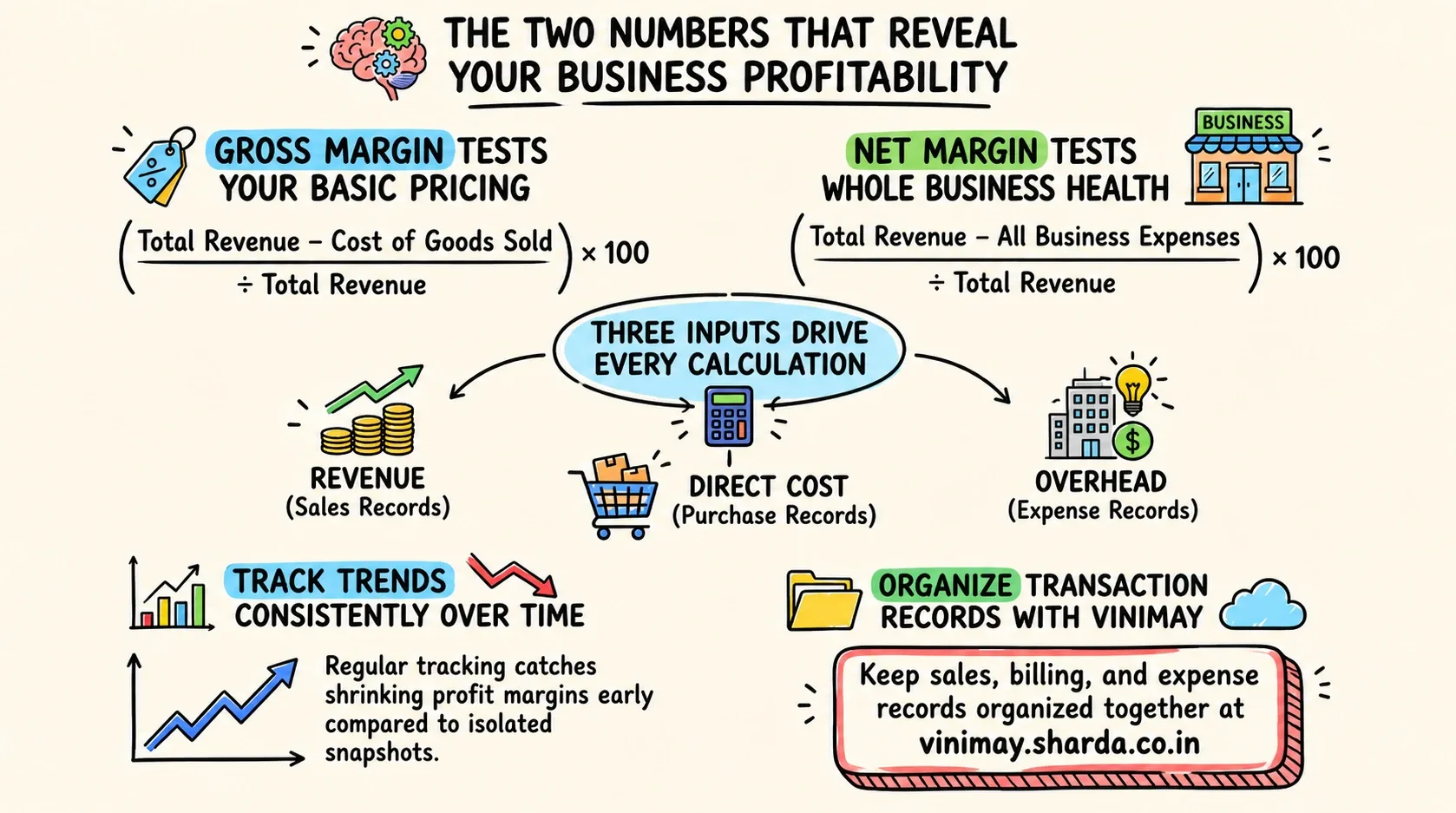
For most small businesses, two profitability measures cover what you actually need to know:
Gross profit margin—how much is left after the direct cost of what you sold, before other expenses
Net profit margin—how much is left after every single business expense, not just direct costs
Gross margin tells you whether your basic pricing works; net margin tells you whether the whole business, including overhead, actually makes money.
Formula 1: Gross Profit Margin
Gross Profit = Total Revenue − Cost of Goods Sold (what you paid to acquire or produce what you sold)
Gross Profit Margin = (Gross Profit ÷ Total Revenue) × 100
Formula 2: Net Profit Margin
Net Profit = Total Revenue − All Business Expenses (cost of goods sold, plus rent, utilities, staff, and everything else)
Net Profit Margin = (Net Profit ÷ Total Revenue) × 100
Where Each Number Comes From in Your Records
A Full Worked Example
Say a business had the following figures for one month:
Total revenue: ₹100,000
Cost of goods sold (materials/products purchased): ₹60,000
Other business expenses (rent, utilities, staff, etc.): ₹20,000
Step 1—Gross profit: ₹100,000 − ₹60,000 = ₹40,000 Step 2—Gross profit margin: (₹40,000 ÷ ₹1,00,000) × 100 = 40%
Step 3—Net profit: ₹100,000 − (₹60,000 + ₹20,000) = ₹20,000 Step 4—Net profit margin: (₹20,000 ÷ ₹1,00,000) × 100 = 20%
In this example, the business keeps 40% of revenue after direct costs, and 20% after every expense is accounted for.
What a "Good" Margin Actually Means
There's no single universal target—margins vary considerably by industry, with thin-margin, high-volume businesses looking very different from premium, low-volume ones. What matters more than hitting a specific benchmark is tracking your own margin consistently over time so you notice if it's shrinking and can investigate why before it becomes a serious problem.
What's Needed to Do This Calculation Reliably
For this calculation to actually be trustworthy, a few things need to be true of your records:
Revenue figures need to reflect actual sales for the exact period you're measuring, not an estimate
Cost of goods sold needs to reflect what was genuinely spent acquiring or producing what was sold in that same period, not total purchases regardless of timing
Expense records need to be complete—a missed expense category quietly inflates your apparent profitability
The calculation should be repeated on a consistent schedule so trends are visible rather than one-off snapshots
In Vinimay, sales records, purchase records, and expense records provide exactly the three inputs this calculation needs—total revenue, cost of goods sold, and overall expenses—pulled directly from transactions already being recorded through normal billing and purchasing. A dedicated, automatically generated profit and loss statement isn't currently part of Vinimay's confirmed feature set, so the margin calculation itself, using the formulas above, is something to run using the underlying figures from these records—either manually or with a simple spreadsheet alongside them—rather than expecting a single, automatically generated percentage.
Frequently Asked Questions
1. What's the simplest way to calculate business profitability?
Subtract your costs from your revenue, divide by revenue, and multiply by 100—this gives you a profit margin percentage.
2. What's the difference between gross and net profit margin?
Gross margin only accounts for the direct cost of what you sold; net margin accounts for every business expense.
3. Where do I find the numbers needed for this calculation?
Revenue comes from sales records, cost of goods sold from purchase records, and other expenses from expense records.
4. What counts as "cost of goods sold"?
This is what you spent acquiring or producing the specific products or services you sold during the period being measured.
5. Is there a universal "good" profit margin to aim for?
No—margins vary significantly by industry; tracking your own trend over time matters more than hitting a fixed benchmark.
6. How often should I calculate profitability?
Monthly is common for regular monitoring, allowing you to catch a shrinking margin early rather than discovering it much later.
7. Can incomplete expense records affect this calculation?
Yes—missing expense categories will make your calculated profitability look higher than it actually is.
8. Does accounting software automatically calculate profitability for me?
This depends on the specific software; some generate automatic profit and loss reports, while others provide the underlying revenue, cost, and expense figures for you to calculate manually.
9. What's a common mistake when calculating profitability?
Using total purchases for a period instead of specifically the cost of goods actually sold in that same period is a common source of inaccuracy.
10. Why does tracking profitability regularly matter more than a single calculation?
A single number tells you where you stand today; regular tracking reveals whether your margin is improving, shrinking, or stable over time.
Related Topics
Published by Team Vinimay
Our editorial and compliance specialists create practical guides, tax calculation rules, and operational strategies to empower Indian small business owners and accountants.