Is InvoiceNow Mandatory for All GST-Registered Businesses in Singapore?
Quick Answer: Yes. Singapore is making GST InvoiceNow mandatory for GST-registered businesses in phases from November 2025 to April 2031, subject to specific exemptions. Businesses must use InvoiceNow-Ready Solutions to submit prescribed invoice data electronically to the Inland Revenue Authority of Singapore (IRAS).
Singapore is expanding its nationwide electronic invoicing system to improve business efficiency and simplify GST administration. The initiative, known as InvoiceNow, uses the international Peppol network to exchange structured invoice information.
For GST-registered companies, retailers, wholesalers, consultants and service providers, the key question is when compliance becomes mandatory.
The Inland Revenue Authority of Singapore (IRAS) has published a phased implementation schedule based on GST registration status and annual supplies.
1. What Is the GST InvoiceNow Requirement in Singapore?
GST InvoiceNow is a mandatory requirement for covered GST-registered businesses to submit prescribed invoice data electronically to IRAS.
InvoiceNow was introduced by the Infocomm Media Development Authority (IMDA) in 2019.
The network allows suppliers and buyers to exchange structured invoices through compatible accounting systems.
Under the GST InvoiceNow Requirement, businesses must use an InvoiceNow-Ready Solution capable of transmitting the required invoice information to IRAS.
The main objectives include:
Reducing manual invoice processing.
Improving financial record accuracy.
Simplifying invoice exchange.
Supporting GST compliance.
Reducing administrative costs.
InvoiceNow does not replace existing GST return filing obligations.
2. When Does InvoiceNow Become Mandatory for Businesses?
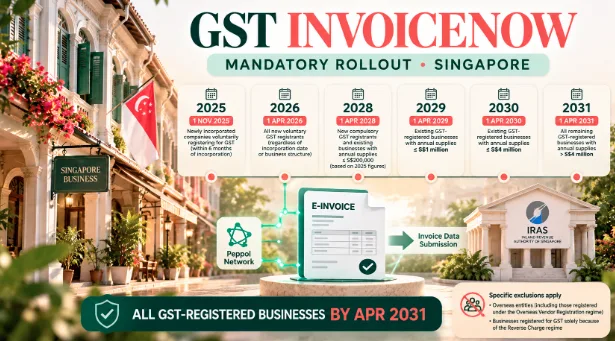
The Singapore government has established a phased implementation schedule extending through April 2031.
For existing GST registrants, the implementation phase is determined using total annual supplies reported for prescribed accounting periods ending in calendar year 2025.
IRAS has also started notifying existing businesses of their implementation dates.
3. How Does IRAS Determine a Business's InvoiceNow Deadline?
For existing GST-registered businesses, implementation dates depend on total annual supplies.
IRAS uses the value reported in Box 4 of the GST return, including:
Standard-rated supplies.
Zero-rated supplies.
Exempt supplies.
For example, suppose a Singapore trading company reported the following supplies for the relevant 2025 accounting periods:
The business generally falls within the implementation phase beginning on 1 April 2029.
Businesses should use the official IRAS implementation date calculator or notification rather than relying only on current turnover.
4. Which GST-Registered Businesses Are Exempt From InvoiceNow?
Although the requirement is being extended broadly, certain categories are excluded.
IRAS identifies two main exclusions:
Overseas entities: Businesses belonging outside Singapore for GST purposes, including overseas vendors registered under the Overseas Vendor Registration regime.
Reverse Charge-only businesses: Businesses required to register for GSTsolely because of the Reverse Charge regime.
These exclusions depend on specific circumstances.
For example, a Singapore business that makes some reverse-charge transactions but registered for GST for another reason is not automatically exempt.
Businesses should confirm their status using official IRAS guidance.
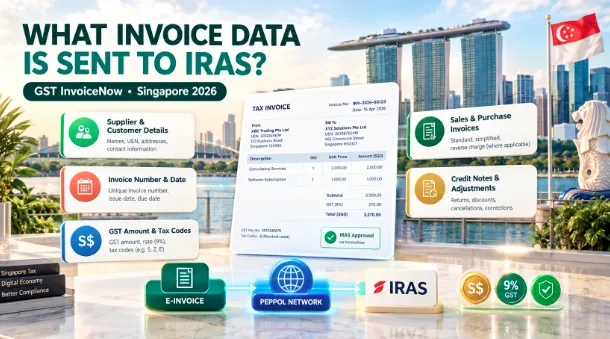
5. What Invoice Information Must Businesses Submit to IRAS?
Under GST InvoiceNow, businesses generally submit data for transactions reported in their GST returns.
This includes relevant standard-rated, zero-rated and exempt supplies and purchases.
Documents may include:
Sales invoices and tax invoices.
Purchase invoices.
Simplified tax invoices.
Credit notes and debit notes.
Certain serially numbered receipts.
Equivalent documents supporting payment adjustments.
IRAS allows aggregation for specified transactions, including qualifying point-of-sale supplies and petty cash purchases.
Invoice data must generally be submitted by the earlier of the relevant GST return filing date or its filing deadline.
Importantly, GST InvoiceNow reporting is not necessarily an immediate real-time submission requirement for every individual transaction.
6. Is InvoiceNow Free for Small Businesses in Singapore?
Businesses may be able to use free basic InvoiceNow solutions or receive government financial assistance.
The available support includes:
Grant eligibility and payment conditions differ by programme.
Some free solution packages provide the basic functions needed to meet GST InvoiceNow requirements, while additional accounting features may carry charges.
Businesses should review official IMDA information before applying or purchasing subscriptions.
7. How Can Businesses Register for GST InvoiceNow?
Businesses can begin by checking whether their existing accounting software is InvoiceNow-Ready.
The general process is:
Check the official IMDA list of InvoiceNow-Ready Solution Providers.
Confirm the software supports GST invoice data submission to IRAS.
Activate InvoiceNow through the selected provider.
Complete the required business identity verification.
Register or confirm the business's Peppol identifier.
Configure invoice and GST data fields.
Test invoice transmission and reporting.
Monitor submission errors and maintain records.
Some businesses may use their existing accounting software without replacing it.
Larger businesses operating customised ERP systems can work with an IMDA-accredited Access Point Provider.
8. How Should Small Businesses Prepare Before Their Deadline?
Businesses should begin by reviewing their current invoicing and GST recordkeeping processes.
A practical readiness checklist includes:
Confirm your mandatory implementation date.
Review GST registration details.
Check customer and supplier records.
Verify invoice numbers and GST classifications.
Select an InvoiceNow-Ready Solution.
Complete Peppol onboarding.
Test IRAS invoice data submission.
Train employees handling invoices and GST returns.
Accounting platforms such as Vinimay provide general invoicing, customer management, purchase tracking and accounting records that can help organise business transactions.
However, Vinimay's Singapore GST InvoiceNow readiness, Peppol connectivity and IRAS reporting capabilities have not been independently verified. Businesses must confirm these capabilities before relying on any software for mandatory compliance.
Preparing early helps identify incomplete records, integration difficulties and employee training needs.
Frequently Asked Questions
Related Topics
Published by Satyam mahajan
Our editorial and compliance specialists create practical guides, tax calculation rules, and operational strategies to empower Indian small business owners and accountants.