What Is a Risk-Based Internal Audit, and What Is Continuous Auditing?
Quick Answer: Risk-based internal auditing prioritises the business areas with the highest potential risks, such as fraud, inventory losses or tax errors. Continuous auditing uses technology and frequent data testing to identify unusual transactions or control failures earlier. Together, they help UAE businesses improve financial accuracy, internal controls and risk management.
For businesses in Dubai, Abu Dhabi and other Emirates, annual accounting reviews may not identify operational weaknesses quickly enough. Risk-based and continuous auditing offer two complementary ways to improve oversight.
1. What Is a Risk-Based Internal Audit?
A risk-based internal audit concentrates audit resources on activities that could significantly affect business objectives.
Instead of examining every department equally, auditors assess the likelihood and impact of risks, evaluate existing controls and prioritise the areas needing closer examination.
For example, a UAE trading company experiencing frequent stock shortages may prioritise inventory controls over lower-risk administrative activities.
The Institute of Internal Auditors (IIA) updated its guidance on developing risk-based internal audit plans in July 2025.
2. What Is Continuous Auditing?
Continuous auditing uses automated data analysis and repeated testing to evaluate transactions, risks and controls.
Instead of relying only on periodic reviews, auditors can identify exceptions more frequently.
For example, automated tests may flag duplicate supplier invoices, payments exceeding approval limits or unexpected inventory adjustments.
Continuous auditing does not necessarily mean every transaction is reviewed in real time. Tests may run daily, weekly or at other frequencies based on risk and available data.
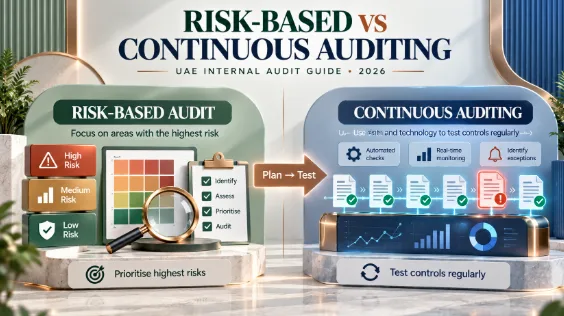
3. What Is the Difference Between Risk-Based and Continuous Auditing?
These approaches are not alternatives. Risk assessment helps determine what should be monitored continuously.
4. How Does a Risk-Based Internal Audit Work?
Auditors first identify the organisation's important processes and potential risks.
They then assess risk likelihood, financial impact, existing controls and management priorities.
A simplified example:
The audit plan is then approved through the appropriate governance process and reviewed when business risks change.
5. How Does Continuous Auditing Work in Practice?
Continuous auditing begins by selecting reliable data sources and defining tests.
For example, a manufacturing company may establish automated checks for negative stock balances, unusual material wastage and purchases without approval.
When an exception appears, the auditor investigates whether it reflects an actual control weakness or a legitimate transaction.
The resulting findings are documented and communicated to management.
Automated alerts require investigation; they do not automatically prove fraud or accounting errors.
6. What Is Continuous Auditing vs Continuous Monitoring?
These terms are related but have different responsibilities.
Continuous auditing is performed by internal auditors to provide independent assurance on selected risks and controls.
Continuous monitoring is generally performed by management to oversee daily business processes and respond to exceptions.
For example, the finance manager may monitor overdue receivables daily, while internal audit independently tests whether the company's credit-control process works effectively.
The IIA issued updated guidance on continuous auditing and monitoring in September 2025.
7. How Can UAE Businesses Implement These Approaches?
Businesses should start with their highest-priority financial and operational risks.
A practical implementation process involves:
Identify significant business risks.
Review existing accounting and operational controls.
Prepare a risk-based internal audit plan.
Select transactions suitable for automated testing.
Establish exception criteria and reporting frequency.
Investigate flagged transactions.
Report findings and monitor corrective actions.
For UAE VAT and Corporate Tax, relevant checks could include missing invoices, unusual adjustments and inconsistencies between accounting records and tax working papers.
Neither approach replaces statutory audits or Federal Tax Authority examinations.
8. How Can Vinimay Help With Audit Preparation?
Accurate transaction records are essential for effective internal auditing.
Vinimay provides general accounting features for invoices, purchases, expenses, customer and supplier ledgers, inventory management and financial reporting.
These records can help accountants investigate overdue balances, unusual expenses, inventory differences and transaction histories.
However, Vinimay's dedicated continuous audit engine, automated anomaly detection, risk-scoring tools and IIA standards compliance have not been independently verified.
Businesses should confirm the availability of data exports, access controls and any required audit automation features before implementation.
Frequently Asked Questions
Related Topics
Published by Satyam mahajan
Our editorial and compliance specialists create practical guides, tax calculation rules, and operational strategies to empower Indian small business owners and accountants.