What Is an Invoice? Meaning, Purpose, Types and Examples
Quick Answer: An invoice is a commercial document issued by a seller to a buyer showing goods or services supplied, quantities, prices, taxes and the amount payable. It requests payment and helps businesses track sales, outstanding customer balances and financial transactions accurately.
Invoices are an essential part of running a business, whether you operate a retail shop, consultancy, online store or trading company in Singapore.
They help businesses communicate payment details, maintain accounting records and track money owed by customers.
Understanding how an invoice works can also help small-business owners avoid payment delays and maintain more organised financial records.
1. What Is an Invoice in Simple Words?
An invoice is a document that tells a customer what they purchased, how much it costs and when payment is expected.
It is usually issued by a business after supplying goods or services, although invoices can also relate to advance payments or other agreed billing arrangements.
An invoice serves three main purposes:
Payment request: Communicates the amount the customer needs to pay.
Transaction record: Documents the goods or services supplied.
Accounting evidence: Supports sales recording, payment tracking and financial reporting.
For example, a Singapore marketing consultant completing a project worth S$1,000 may issue an invoice requesting payment within 30 days.
The invoice records the transaction even if the customer has not yet paid.
2. What Details Should an Invoice Include?
A professional invoice should contain sufficient information for the customer to understand and process the payment.
Invoice Field | Purpose |
|---|---|
Invoice number | Identifies the transaction |
Invoice date | Records when the invoice was issued |
Seller details | Identifies the supplying business |
Buyer details | Identifies the customer |
Description | Explains the goods or services |
Quantity and price | Shows how charges are calculated |
Discounts and taxes | Records applicable adjustments |
Total payable | Shows the final amount owed |
Due date | Communicates expected payment timing |
Payment details | Explains how the customer can pay |
For Singapore GST-registered businesses, additional tax invoice requirements may apply under IRAS rules.
Businesses should distinguish a general commercial invoice from a GST-compliant tax invoice.
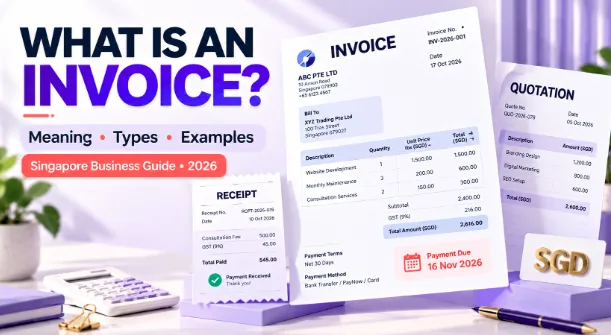
3. What Does an Invoice Example Look Like?
Consider a Singapore business supplying office equipment to another company.
Invoice Particulars | Example |
|---|---|
Invoice number | INV-2026-001 |
Invoice date | 17 October 2026 |
Seller | ABC Office Supplies Pte Ltd |
Buyer | XYZ Trading Pte Ltd |
Description | Office chairs |
Quantity | 4 |
Unit price | S$150 |
Subtotal | S$600 |
GST at 9% | S$54 |
Total payable | S$654 |
Payment terms | Net 30 days |
This example assumes a standard-rated supply made by a GST-registered supplier.
The customer receives the invoice, checks the information and pays according to the agreed terms.
The supplier then records the payment against the invoice.
4. What Is the Difference Between an Invoice, Bill and Receipt?
Although these documents are related, they perform different functions.
Document | Main Purpose |
|---|---|
Invoice | Records a transaction and requests payment |
Bill | Communicates an amount payable, often immediately |
Receipt | Confirms payment has been received |
Quotation | Provides an estimated price before an order |
Proforma invoice | Communicates proposed transaction details before final invoicing |
For example, a supplier may issue an invoice after delivering products. Once payment is received, the supplier may provide a receipt confirming settlement.
An invoice does not automatically prove that payment has been made.
Businesses should maintain payment records separately or record the payment status within their accounting system.
5. What Are the Common Types of Invoices?
Different invoices are used depending on the business transaction.
Common types include:
Sales invoice: Issued by a seller to a customer.
Purchase invoice: Recorded by a buyer for purchases from suppliers.
Tax invoice: Contains the prescribed tax information.
Proforma invoice: Shows proposed charges before the final invoice.
Recurring invoice: Used for regular services or subscriptions.
Commercial invoice: Used in trade transactions, including international shipping.
Electronic invoice: Created and exchanged electronically, potentially using a structured invoicing network.
For example, a Singapore consultancy may issue recurring invoices for monthly services, while an importer may use commercial invoices for international shipments.
6. What Are Invoice Payment Terms?
Payment terms explain when and how customers should pay an invoice.
Businesses often use terms such as:
Payment Term | Meaning |
|---|---|
Due on receipt | Payment requested when the invoice is received |
Net 7 | Payment due within seven days |
Net 15 | Payment due within fifteen days |
Net 30 | Payment due within thirty days |
Advance payment | Payment required before delivery or service completion |
For example, if an invoice dated 1 October specifies Net 30, payment is generally expected 30 days later, subject to the agreed contract and counting convention.
Businesses should communicate payment terms before completing the transaction.
Clear due dates, payment instructions and timely reminders can help reduce outstanding customer balances.
7. What Are the Invoice and GST Rules in Singapore?
Singapore GST-registered businesses must follow the relevant IRAS invoicing requirements.
The standard GST rate is currently 9%.
A GST-registered business making a standard-rated supply to another GST-registered business generally must issue a tax invoice containing the prescribed details.
Where the total payable, including GST, does not exceed S$1,000, a simplified tax invoice may be permitted.
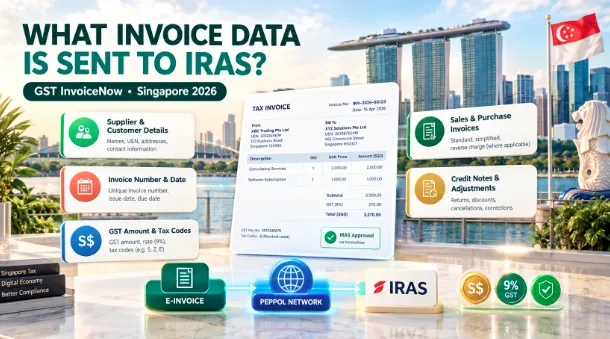
Businesses should also understand Singapore's GST InvoiceNow Requirement, which is being introduced progressively for GST-registered businesses.
InvoiceNow uses the Peppol network to support structured electronic invoice exchange and prescribed invoice data submission to IRAS.
Ordinary invoice creation and GST InvoiceNow compliance are not automatically the same thing.
8. How Can Small Businesses Create and Manage Invoices?
Businesses can create invoices using templates, spreadsheets or dedicated accounting software.
For businesses processing frequent transactions, accounting software can make invoice management more efficient.
A practical invoicing process includes:
Create a unique invoice number.
Enter the customer and transaction details.
Add products, quantities and prices.
Apply applicable taxes and discounts.
Confirm the total and payment terms.
Send the invoice to the customer.
Record payments and monitor outstanding balances.
For example, Vinimay provides general invoicing, customer records, payment tracking, sales and purchase management, and accounting reports.
These features can help businesses organise daily transactions.
However, Vinimay's Singapore GST and InvoiceNow compliance capabilities have not been independently verified. Businesses should confirm regulatory compatibility before relying on any software for mandatory tax reporting.
Accurate invoices and consistent payment tracking can improve recordkeeping and help businesses understand their cash flow.
Frequently Asked Questions
Published by Satyam mahajan
Our editorial and compliance specialists create practical guides, tax calculation rules, and operational strategies to empower Indian small business owners and accountants.