This is a genuinely different question from safety or protection—it's about legal and practical rights, not about how well-guarded the data is. Even perfectly secure data raises a fair question: if you stop using a platform, whose data was it in the first place? In virtually every standard accounting software arrangement, the business owner owns their own data—the transactions, invoices, and records you enter remain yours, with the software provider acting as a custodian or processor of that data rather than an owner of it. This is a near-universal standard in the industry, though the practical ability to access and export that data can vary between providers even when ownership itself isn't in question.
Why Ownership and Access Are Two Different Things
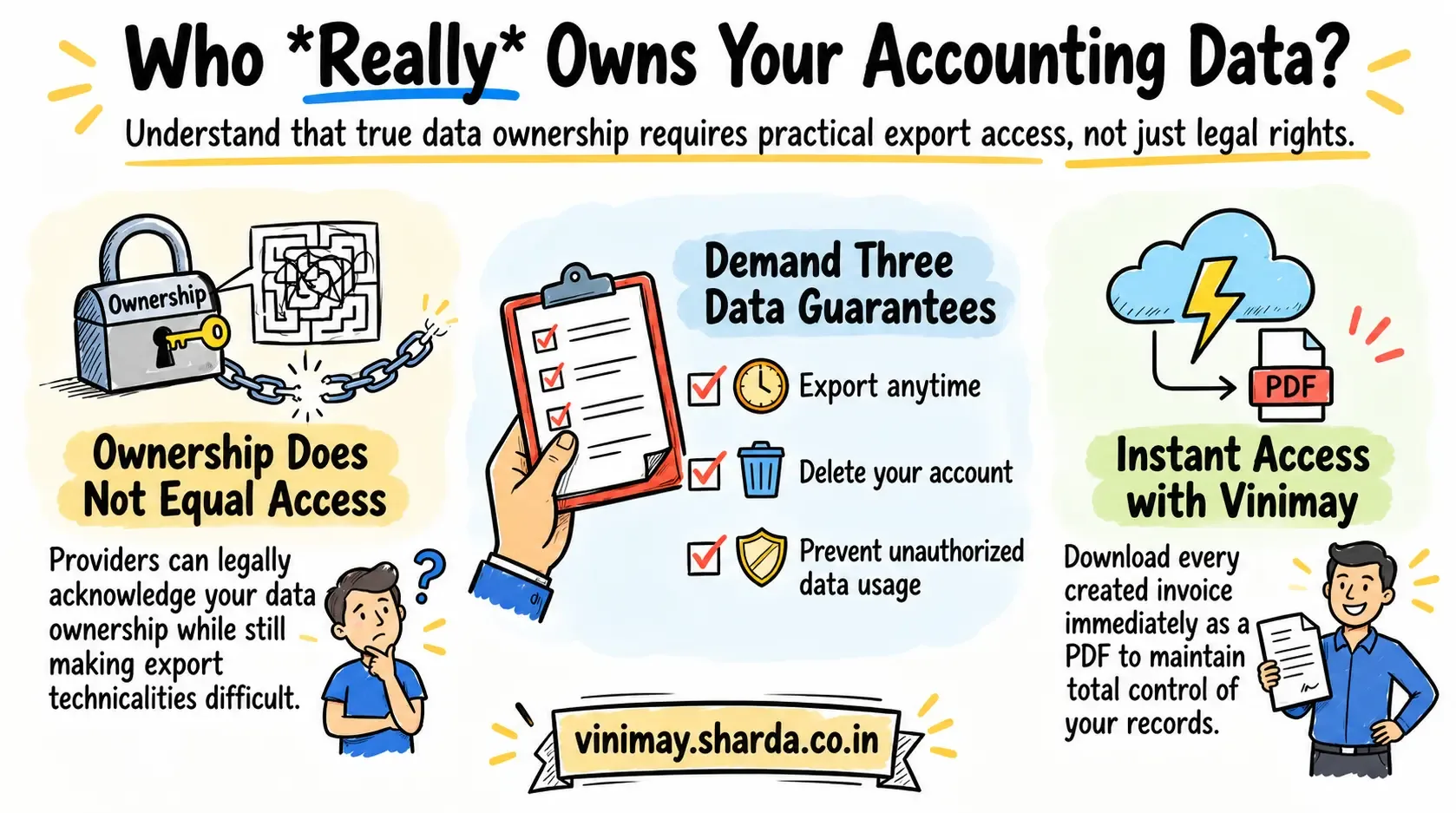
A provider can fully acknowledge that you own your data while still making it genuinely difficult to access or export in a usable format—ownership is a legal and contractual matter, while export capability is a practical, technical one. Both matter, but they're not automatically the same thing.
What "Ownership" Should Practically Guarantee
The right to export your own records at any time, in a usable format
The right to delete your account and data, subject to any legal record-keeping requirements that might apply
The provider not using or selling your specific business data for unrelated purposes without your knowledge
Where This Gets Murkier: Data Used for Aggregate Purposes
Some providers use aggregated, anonymized data (not identifiable to your specific business) for broader analysis or product improvement—this is generally considered separate from "owning" your specific data, but it's worth understanding if a provider's terms mention this practice, since it's a genuinely different use than simply storing your invoices.
Why This Question Matters More Than It Might Seem
If you ever need to switch providers, respond to a legal request for your own records, or simply want your own backup, clarity on ownership—backed by actual export capability—determines whether that's a five-minute task or a frustrating dispute.
Where Vinimay Stands on This
You own the business data you enter into Vinimay—your invoices, customer records, and transaction history are yours. Every invoice created through Vinimay's free tool can be downloaded immediately as your own PDF file, giving you direct, practical access to your own records independent of ongoing platform access. For specific current terms on data ownership and any aggregate data practices, Vinimay's official terms provide the most accurate detail.
Frequently Asked Questions
Q1. Does the software provider own my business data by default?
No, in standard arrangements, you own your own data, with the provider acting as a custodian rather than an owner.
Q2. Is owning my data the same as being able to easily export it?
No, these are related but separate—ownership is a legal matter, while export capability is a practical, technical one worth verifying directly.
Q3. Can a provider use my data for something else without telling me?
Reputable providers state their data use practices clearly in their terms—this is worth checking specifically if it concerns you.
Q4. What should I be able to do if I truly own my data?
Export it at any time in a usable format, and delete your account and data, subject to any applicable legal retention requirements.
Q5. Does Vinimay let me keep my own copy of my invoices?
Yes, every invoice created can be downloaded immediately as a PDF, independent of ongoing platform access.
Q6. Why does data ownership matter even if the data is completely secure?
Because security addresses protection from unauthorized access, while ownership addresses your own rights and control over the data long-term.
Q7. Can businesses back up their accounting data independently?
Yes, businesses should maintain their own copies of important invoices and financial records where the software allows downloads or exports, providing an additional layer of control.
Q8. Why is data export important when choosing accounting software?
Data export makes it easier to move records to another system, maintain independent backups, or access historical information if the business changes software providers.
Q9. Can businesses delete their accounting data whenever they want?
Not always. Deletion may depend on the provider's policies and legal or tax record-retention requirements that require certain financial records to be preserved.
Q10. Should businesses read the software provider's data policy before signing up?
Yes, reviewing the terms and privacy policy can clarify how data is stored, used, exported, retained, and deleted, helping businesses understand their rights and responsibilities.
Related Topics
Published by Team Vinimay
Our editorial and compliance specialists create practical guides, tax calculation rules, and operational strategies to empower Indian small business owners and accountants.