
accounting software
Read post UAE Restaurant & Café Daily Sales and Purchase Records
Learn how UAE restaurants and cafés can track daily sales, record supplier purchases, reconcile payments, manage food inventory and maintain accurate VAT.
Learn how UAE restaurants and cafés can track daily sales, record supplier purchases, reconcile payments, manage food inventory and maintain accurate VAT.

Create professional GST-compliant invoices in under 30 seconds, send WhatsApp payment links, and track inventory effortlessly.
Learn how to track daily business expenses in the UAE, organise receipts, manage petty cash, monitor spending, and maintain accurate VAT and tax records.
Quick Answer: UAE businesses can track daily expenses by recording every payment with its date, amount, category, payment method, and supporting receipt. They should separate business and personal spending, maintain accurate petty cash and bank records, categorise expenses correctly, and regularly reconcile transactions. A structured expense register or suitable accounting software can help identify unnecessary spending and support financial and tax recordkeeping.
Managing daily business expenses is an important part of running a successful small business in the United Arab Emirates. Whether a business operates a retail shop in Dubai, a restaurant in Abu Dhabi, a consultancy in Sharjah, or a trading company in Ajman, everyday expenses directly affect its profitability and available cash.
Businesses regularly spend money on rent, electricity, transportation, employee wages, office supplies, packaging materials, repairs, delivery charges, and other operating activities. While some payments are substantial, many are relatively small and occur repeatedly throughout the month.
These smaller expenses can become difficult to track when employees make payments in cash, use different bank accounts, or fail to preserve receipts.
For example, a business may spend AED 50 on transportation, AED 75 on packaging, and AED 100 on minor supplies during a single day. If these transactions are not recorded, monthly expense reports may underestimate actual operating costs.
Poor expense tracking can also create difficulties when preparing financial statements, reviewing VAT records, or determining the correct treatment of expenses for UAE Corporate Tax.
A consistent daily expense recording process helps UAE businesses control spending, maintain reliable financial records, and make better financial decisions.
The following eight practical steps explain how businesses can manage daily expenses more effectively.
Daily expense tracking allows business owners to understand where money is being spent and how those payments affect business operations.
Without accurate expense records, a business may generate reasonable sales revenue but still struggle to maintain sufficient cash for rent, salaries, supplier payments, and other obligations.
For example, a small grocery store in Dubai may record monthly sales of AED 100,000. However, the store also incurs inventory costs, employee salaries, electricity, delivery expenses, and other operational payments.
If the owner records only major expenses while ignoring smaller daily payments, the financial reports may present an inaccurate picture of profitability.
Regular expense tracking helps businesses identify recurring costs, monitor unexpected spending, and compare actual expenses against planned budgets.
It also creates supporting documentation for accounting and tax purposes.
The UAE Federal Tax Authority highlights the importance of maintaining accounting records covering payments, receipts, purchases, sales, profits, and expenses.
A consistent expense recording process can help a business answer important questions, such as whether transportation costs are increasing, which department spends the most money, and whether routine purchases are exceeding budget.
Tracking expenses daily reduces the risk of missing transactions and provides a clearer understanding of business performance.
Businesses should record all relevant expenses and classify them according to their nature.
Different types of businesses incur different operating costs.
For example, restaurants spend money on food ingredients, packaging, cleaning materials, and utilities. Trading businesses may incur transport, warehousing, and handling costs, while service businesses often spend more on communication, subscriptions, professional services, and office operations.
Common expense categories include:
Expense category | Examples |
|---|---|
Rent and utilities | Shop rent, electricity, water |
Employee expenses | Salaries, allowances, staff-related costs |
Transportation | Fuel, delivery charges, local travel |
Office expenses | Stationery, printing, office supplies |
Marketing | Advertising, promotional materials |
Repairs and maintenance | Equipment servicing, minor repairs |
Communication | Internet, business telephone expenses |
Professional services | Accounting, legal and consultancy fees |
Miscellaneous | Other genuine business operating expenses |
Businesses should use consistent categories so that monthly reports remain comparable.
However, not every payment should automatically be classified as an expense.
Purchases of inventory, fixed assets, loan principal repayments, refundable deposits, and owner drawings may require different accounting treatment.
For example, purchasing a delivery vehicle is generally different from paying for routine vehicle fuel.
The vehicle may be recognised as an asset, while qualifying fuel costs may be treated as operating expenses.
Correct classification helps avoid inaccurate profit calculations and supports appropriate tax treatment.
A daily expense register is one of the simplest methods for monitoring business spending.
It provides a structured record of transactions and makes it easier to identify missing payments or unusual expenses.
For each expense, businesses should capture the transaction date, description, expense category, amount, payment method, and supporting reference.
For example, a small trading business may record the following transactions:
Date | Expense | Amount | Payment method |
|---|---|---|---|
20 Oct | Office supplies | AED 120 | Cash |
20 Oct | Delivery charges | AED 180 | Bank |
20 Oct | Cleaning materials | AED 75 | Cash |
20 Oct | Internet expense | AED 250 | Bank |
Total | AED 625 |
The register shows that the business incurred AED 625 in recorded spending during the day.
Businesses should also record the supplier name, invoice number, and VAT details where applicable.
A useful distinction is whether the amount has already been paid or remains payable.
For example, an electricity bill may be recognised as an expense before the actual bank payment occurs, depending on the accounting basis used.
A daily payment register and an accounting expense ledger therefore serve related but different purposes.
Owners should review the register regularly and ensure that every entry has appropriate supporting documentation.
This process improves transaction traceability and supports more reliable monthly accounts.
Petty cash is commonly used by small businesses to pay for low-value operational expenses such as minor supplies, local transport, small repairs, or refreshments purchased for legitimate business purposes.
Although individual transactions may be small, repeated petty cash spending can become significant.
For example, a retail business may maintain a petty cash fund of AED 2,000 for daily operational payments.
If employees use the cash without recording transactions or preserving receipts, the business may struggle to explain differences between the recorded and actual cash balance.
A basic petty cash register can show the opening cash balance, payments made, reimbursements received, and closing balance.
ILLUSTRATIVE PETTY CASH RECONCILIATION
Opening balance
Cash expenses
Cash replenishment
Expected closing cash
The physical cash should be counted and compared with the calculated balance.
Any difference should be investigated rather than automatically entered as an unexplained expense.
Businesses can strengthen petty cash controls by appointing a responsible custodian, setting payment limits, requiring supporting receipts, and approving replenishments.
Regular petty cash reconciliation helps reduce unrecorded transactions, accidental mistakes, and unauthorised spending.
Expense tracking becomes less reliable when businesses record payments but fail to preserve the supporting documents.
Receipts, supplier invoices, utility bills, payment confirmations, and reimbursement claims provide evidence of transactions.
Businesses often receive these documents through printed receipts, email attachments, messaging applications, or supplier portals.
If the documents remain scattered across employee devices, they can be difficult to retrieve during accounting reviews.
A central filing system helps solve this problem.
Businesses may organise digital receipts according to year, month, and expense category.
For example:
Business Expenses
Each document can be saved using a consistent reference format.
For example:
2026-10-20_Office-Supplies_AED120.pdf
Where VAT applies, businesses should preserve relevant tax invoices and assess whether they meet the requirements for input VAT recovery.
For UAE VAT purposes, required records generally must be kept for at least five years after the relevant tax period, subject to particular extensions and exceptions.
For UAE Corporate Tax, relevant records generally must be retained for seven years following the end of the tax period.
Businesses should apply the longest relevant retention requirement and maintain appropriate security, backups, and document access controls.
Mixing personal and business spending is a common bookkeeping problem, especially among sole proprietors and owner-managed businesses.
When the same bank account or cash balance is used for personal purchases and business payments, financial records can become confusing.
For example, a business owner may use the company payment card to purchase personal groceries worth AED 300.
If that amount is recorded as a normal business operating expense, the company's accounts may overstate legitimate business costs.
The payment should instead be classified according to the applicable legal and accounting structure, such as an owner drawing or amount recoverable from the owner.
Businesses should maintain clear boundaries between personal and commercial spending.
Using separate business bank accounts and maintaining appropriate approval procedures can make reconciliation easier.
Where an expense has both personal and business purposes, the relevant business portion should be identified and supported.
The FTA explains that expenditure with dual purposes may require reasonable apportionment for Corporate Tax purposes.
Businesses should not assume that every transaction paid using a company card automatically qualifies as a deductible business expense.
Separating personal and business spending improves the accuracy of profit calculations and supports more reliable tax records.
Accurate expense records are important for businesses that are registered for VAT or subject to UAE Corporate Tax.
For VAT-registered businesses, input VAT recovery depends on the nature of the purchase, possession of appropriate supporting documentation, and satisfaction of the applicable legal conditions.
For example, a business may purchase office supplies worth AED 1,000 plus AED 50 VAT.
If the purchase qualifies for input VAT recovery and all applicable conditions are met, the recoverable VAT may be recorded separately from the expense amount.
However, not all VAT charged on purchases is automatically recoverable.
Certain expenses may be subject to restrictions or special treatment.
Similarly, under UAE Corporate Tax rules, expenditure generally needs to be incurred wholly and exclusively for business purposes and must satisfy applicable deductibility rules.
Capital expenditure, personal spending, certain entertainment expenditure, and other restricted items may require different tax treatment.
For example, normal office utility costs may generally qualify as business expenses, while purchasing machinery may require capitalisation and appropriate depreciation treatment.
Daily bookkeeping helps accountants identify the nature and purpose of each transaction before preparing financial statements and tax calculations.
It also helps businesses avoid claiming unsupported expenses or overlooking legitimate costs.
Correct expense documentation improves financial reporting and makes VAT and Corporate Tax reviews more manageable.
Accounting software can help businesses maintain more organised daily financial records by reducing dependence on handwritten registers and disconnected spreadsheets.
A suitable system may support expense and payment entries, transaction categorisation, supplier records, cash and bank ledgers, and financial reporting.
For example, when a business pays AED 200 for local transportation, an employee may record the transaction under the appropriate expense category and payment account.
The entry then becomes part of the business's accounting records.
When used consistently, accounting software can help business owners review monthly expense totals, compare operating costs, and identify recurring spending patterns.
Businesses should verify that the chosen system supports their actual payment methods, expense classifications, reporting requirements, and applicable UAE tax needs.
Features such as receipt attachments, automated bank reconciliation, spending budgets, and approval workflows should be checked individually rather than assumed to be available.
UAE small businesses considering digital bookkeeping solutions may evaluate Vinimay Accounting Software for recording routine financial transactions.
Vinimay includes accounting workflows relating to payments, purchases, parties, ledgers, and financial reporting.
These types of functions can support businesses seeking a more organised approach to recording operational payments and maintaining account balances.
Before adopting the software, UAE businesses should verify the availability and suitability of expense categories, daily expense reports, AED currency handling, VAT treatment, receipt attachments, and cash or bank reconciliation functions.
A practical software test should include recording a cash expense, entering a supplier payment, reviewing the relevant ledger, and checking whether the transaction appears correctly in the financial reports.
The most useful accounting software is one that makes daily transaction recording consistent, understandable, and reliable.
Our editorial and compliance specialists create practical guides, tax calculation rules, and operational strategies to empower Indian small business owners and accountants.
Learn how to understand a small business balance sheet in the UAE, including assets, liabilities, equity, working capital and financial health.
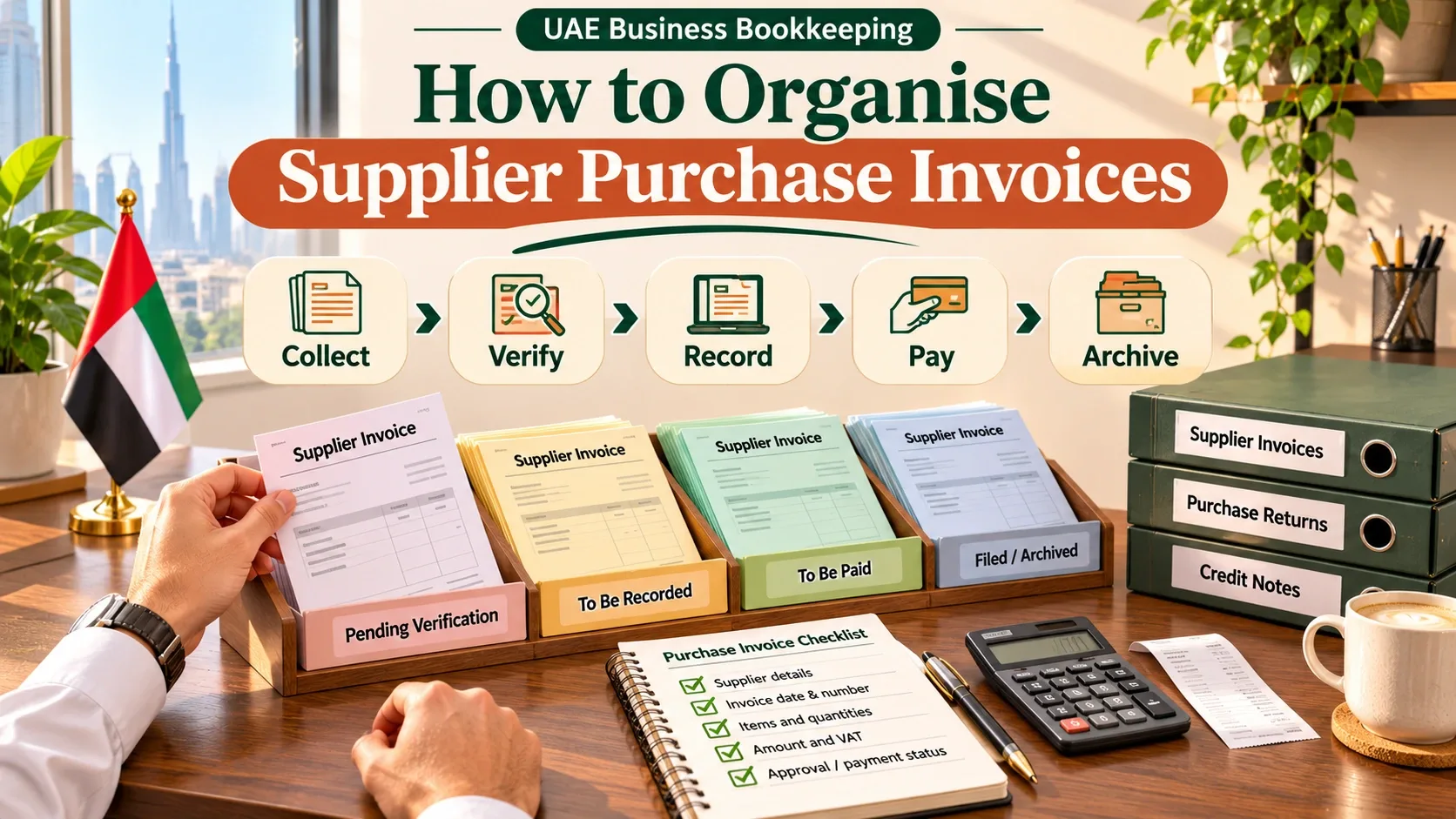
Learn how UAE small businesses can organise supplier purchase invoices, verify VAT details, track payments, prevent duplicates and maintain accurate records.
Create and download professional, GST-compliant tax invoices in under 30 seconds.
Create Free Invoice Now →