
accounting software
Read post UAE Restaurant & Café Daily Sales and Purchase Records
Learn how UAE restaurants and cafés can track daily sales, record supplier purchases, reconcile payments, manage food inventory and maintain accurate VAT.
Learn how UAE restaurants and cafés can track daily sales, record supplier purchases, reconcile payments, manage food inventory and maintain accurate VAT.

Create professional GST-compliant invoices in under 30 seconds, send WhatsApp payment links, and track inventory effortlessly.
Quick Answer: A balance sheet shows what a business owns (assets), what it owes (liabilities), and the remaining financial interest belonging to its owners (equity) on a particular date. UAE small business owners can understand their balance sheets by reviewing cash, inventory, customer receivables, supplier payables, loans, and capital, then checking whether total assets equal total liabilities plus equity.
Understanding a balance sheet is an essential financial skill for small business owners in the United Arab Emirates. Whether a business operates a retail shop in Dubai, a trading company in Sharjah, a restaurant in Abu Dhabi, or a consultancy in Ajman, a balance sheet helps explain its financial position.
Many entrepreneurs regularly review sales revenue and profit but pay less attention to assets, outstanding customer payments, supplier liabilities, and borrowing obligations.
A business may report healthy sales while facing difficulties paying suppliers because customers have not settled their invoices. Similarly, a company may own valuable machinery and inventory but have insufficient cash to meet short-term payments.
A balance sheet helps business owners recognise these situations by presenting a structured summary of financial resources and obligations.
Under recognised accounting standards, a balance sheet, also called a statement of financial position, presents assets, liabilities, and equity as of a specified reporting date.
The following eight sections explain how to read a small business balance sheet, understand its important figures, and use the information to make better financial decisions.
A balance sheet is a financial statement showing the financial position of a business at a particular point in time.
Unlike a profit and loss statement, which summarises income and expenses over a period, the balance sheet shows the balances of assets, liabilities, and equity on a specific date.
For example, a trading business may prepare a balance sheet as of 31 December 2026.
The statement shows the resources controlled by the business and its outstanding obligations at that date.
The balance sheet is based on a fundamental accounting equation:
The fundamental accounting equation
This means the resources of a business are financed through obligations to external parties and the financial interest of its owners.
For example, if a small business has total assets worth AED 200,000 and total liabilities of AED 80,000, its equity would be AED 120,000.
A balance sheet helps owners understand whether the business has enough resources to meet its obligations, how much money is tied up in inventory, and how dependent operations are on borrowing.
Banks, investors, accountants, and business owners may also review balance sheets when evaluating financial stability.
The balance sheet does not directly show how much profit a business earned during the year, but it provides important information about its financial strength.
Assets are economic resources controlled by a business as a result of past events and have the potential to generate future economic benefits.
For small businesses, assets commonly include cash, bank balances, amounts receivable from customers, inventory, equipment, furniture, and vehicles.
Assets are often divided into current assets and non-current assets.
Current assets are generally expected to be realised, sold, consumed, or converted into cash during the business's normal operating cycle or within the relevant short-term classification criteria.
Common examples include cash, bank balances, trade receivables, and inventory.
Suppose a grocery business in Dubai has the following current assets:
Current asset | Amount |
|---|---|
Cash and bank | AED 20,000 |
Customer receivables | AED 15,000 |
Inventory | AED 35,000 |
Total current assets | AED 70,000 |
These assets support the store's day-to-day operations.
However, they do not all have the same liquidity. Cash is immediately available, while receivables require collection and inventory generally needs to be sold.
Non-current assets are resources used or held over a longer period.
They may include machinery, delivery vehicles, office furniture, computers, and business equipment.
For example, a trading business may own a delivery van recorded at a carrying amount of AED 40,000.
The balance sheet normally reflects relevant accounting measurements such as cost less accumulated depreciation and impairment, rather than automatically showing current selling prices.
Understanding asset categories helps business owners distinguish readily available cash from resources that may take longer to convert into money.
Liabilities represent present obligations that a business must settle by transferring economic resources.
For small businesses, liabilities commonly arise from supplier purchases, loans, unpaid bills, employee-related obligations, and taxes payable.
Liabilities are generally divided into current and non-current categories.
Current liabilities include obligations due for settlement within the applicable short-term classification rules.
Examples may include trade payables, outstanding operating expenses, current tax liabilities, and the current portion of loan repayments.
Consider a UAE retailer with the following current liabilities:
Current liability | Amount |
|---|---|
Supplier payables | AED 22,000 |
Outstanding expenses | AED 8,000 |
Short-term loan obligations | AED 10,000 |
Total current liabilities | AED 40,000 |
These figures help the owner identify payments that may need to be settled in the near future.
Non-current liabilities generally include borrowing and other obligations that do not meet the current-liability classification criteria.
For example, a business may have a long-term bank loan used to purchase equipment.
A portion of the loan may still be classified as current if it is due within the next reporting period.
Why does this matter?
A business with significant liabilities may face financial pressure even when it has valuable assets.
Owners should therefore review when liabilities become payable and whether sufficient cash can be generated to meet those commitments.
The goal is not necessarily to eliminate every liability, but to maintain a manageable relationship between business resources and financial obligations.
Owner's equity represents the residual financial interest in a business after deducting its liabilities from its assets.
In simple terms, equity is the accounting value attributable to the owners.
It is calculated as:
For example, if a UAE small business reports total assets of AED 300,000 and total liabilities of AED 110,000, its equity is AED 190,000.
Equity may include contributed capital, retained earnings, and other recognised equity balances, depending on the legal structure of the business.
For an owner-managed business, profits retained in the business can increase equity, while losses and applicable owner withdrawals or distributions can reduce it.
It is important to understand that equity is not the same as the amount of cash available in the bank.
A business may have positive equity because of inventory, equipment, and receivables but still have limited cash.
Similarly, the accounting equity figure does not automatically represent the price at which the business could be sold.
Reviewing equity over multiple periods can help owners understand how their financial position has changed.
A practical example makes the balance sheet easier to understand.
Consider a small UAE trading company preparing its balance sheet as of 31 December 2026.
Illustrative UAE Small Business Balance Sheet
As at 31 December 2026
Particulars | Amount (AED) |
|---|---|
Assets | |
Cash and Bank | 30,000 |
Trade Receivables | 40,000 |
Inventory | 60,000 |
Equipment (Net) | 70,000 |
Total Assets | 200,000 |
Liabilities | |
Supplier Payables | 35,000 |
Outstanding Expenses | 5,000 |
Bank Loan | 60,000 |
Total Liabilities | 100,000 |
Equity | |
Owner Capital and Retained Earnings | 100,000 |
Total Liabilities + Equity | 200,000 |
The accounting equation balances.
Illustrative figures in AED
The company controls total assets of AED 200,000 and owes AED 100,000 to external parties. The remaining AED 100,000 represents equity.
However, its cash and bank balance is only AED 30,000.
This means the business should not assume that all AED 200,000 of assets are available for immediate spending.
Some resources are held in inventory, some are receivable from customers, and others are invested in equipment.
This distinction is essential for understanding the company's actual financial position.
A balance sheet helps business owners assess whether they can meet their short-term financial obligations.
Two useful measures are working capital and the current ratio.
Working capital is calculated as:
Using the earlier example, current assets total AED 130,000, while current liabilities total AED 40,000.
Working capital therefore equals AED 90,000.
Positive working capital generally indicates that current assets exceed current liabilities.
However, it does not guarantee that the business has enough immediately available cash, because inventory and receivables may take time to convert into money.
The current ratio compares current assets with current liabilities:
In the example, the ratio is 3.25:1.
Working Capital & Current Ratio Calculator
Working Capital
Current Ratio
Businesses should interpret these figures according to their industry, operating cycle, customer collection patterns, and supplier payment terms.
For example, a cash-based grocery business may operate differently from a wholesale company that sells products on 60-day credit.
There is no single ideal current ratio that applies to every UAE small business.
Balance sheets can become unreliable when transactions are missed, duplicated, or incorrectly classified.
One common mistake is recording a purchase twice, which may overstate inventory, expenses, or supplier liabilities.
Another is failing to record customer credit sales correctly. In such cases, the business may understate receivables and revenue.
Businesses may also incorrectly classify machinery purchases as routine operating expenses instead of recognising the appropriate asset.
Other errors include failing to record loan liabilities, omitting accrued expenses, leaving old receivables unreconciled, and not accounting for depreciation or inventory adjustments.
For example, a trading business may report AED 80,000 in inventory even though its physical stock count supports only AED 72,000.
The difference requires investigation and appropriate accounting treatment.
A balance sheet can also balance mathematically while still containing incorrect entries.
Therefore, simply checking whether assets equal liabilities plus equity is not enough.
Businesses should reconcile bank balances, customer accounts, supplier ledgers, inventory records, and loan statements.
Regular reviews help ensure that reported balances reflect the underlying transactions.
Accounting software can make financial information easier to organise by maintaining transaction records and producing reports based on the relevant accounting entries.
A suitable accounting system may bring together sales, purchases, receipts, payments, customer balances, supplier balances, inventory records, and ledger information.
When transactions are recorded correctly, this information can support balance sheet preparation and financial review.
For example, recording a credit sale may increase customer receivables, while collecting the payment subsequently reduces receivables and increases cash or bank balances.
Likewise, purchasing equipment through a loan may increase both the relevant asset and financial liability.
These transactions affect the balance sheet even though they do not necessarily create immediate profit or loss.
UAE small businesses exploring digital bookkeeping may consider Vinimay Accounting Software when reviewing accounting systems.
Vinimay includes workflows for sales, purchases, receipts, payments, inventory, ledgers, and financial transaction management.
These accounting records are relevant to preparing and understanding financial statements.
Before relying on any software for balance sheet reporting, businesses should verify that it supports accurate account classification, opening balances, depreciation adjustments, loan balances, inventory valuation, and the required financial reporting outputs.
They should also confirm the current availability of UAE currency, reporting, and tax-specific capabilities.
A reliable balance sheet depends on accurate underlying accounting entries, not simply the ability to generate a financial report.
Our editorial and compliance specialists create practical guides, tax calculation rules, and operational strategies to empower Indian small business owners and accountants.
Learn how to track daily business expenses in the UAE, organise receipts, manage petty cash, monitor spending, and maintain accurate VAT and tax records.
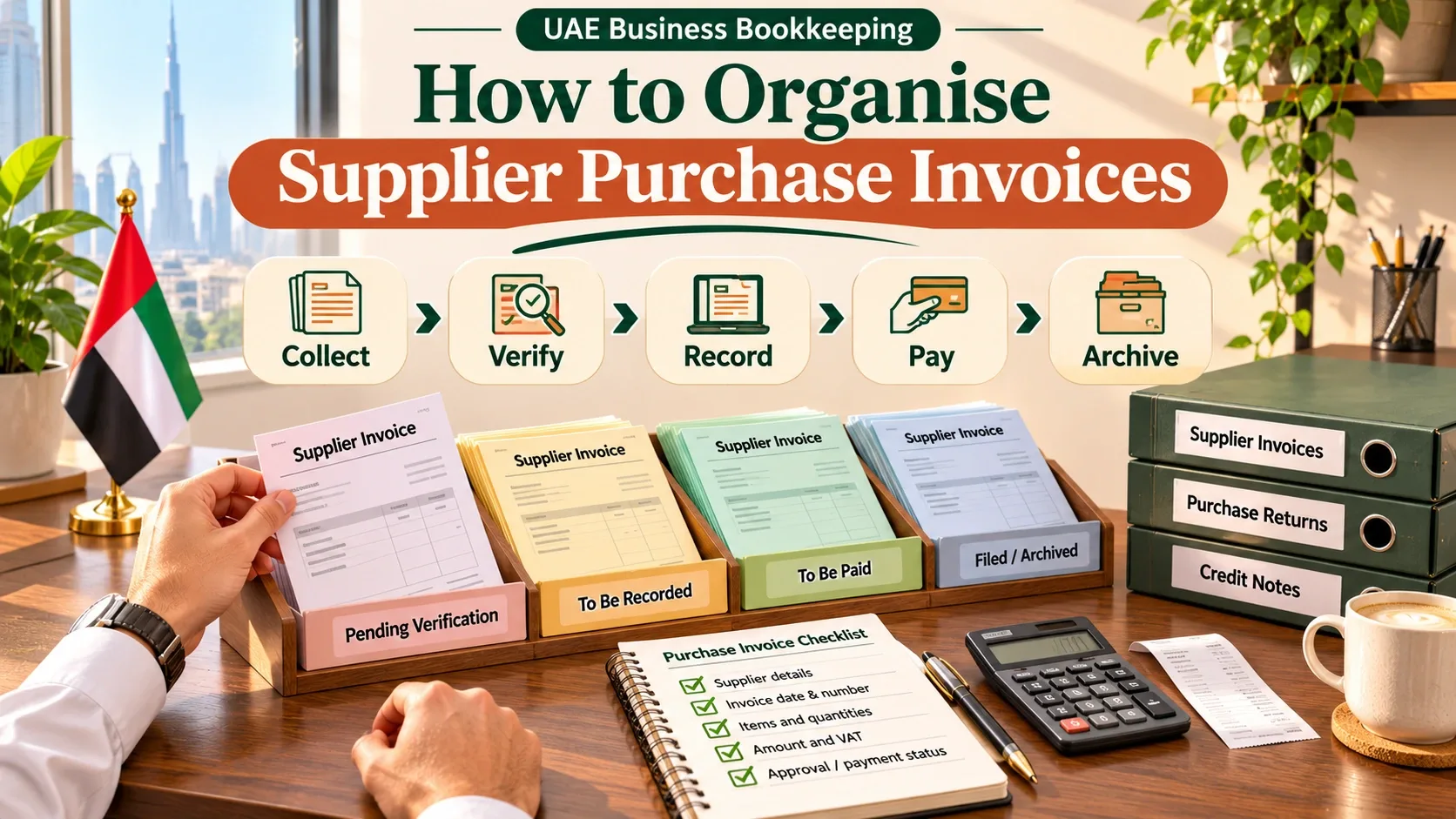
Learn how UAE small businesses can organise supplier purchase invoices, verify VAT details, track payments, prevent duplicates and maintain accurate records.
Create and download professional, GST-compliant tax invoices in under 30 seconds.
Create Free Invoice Now →