How Does the Peppol 5-Corner Model Work in the UAE?
Quick Answer: The UAE Peppol 5-corner model allows suppliers and buyers to exchange structured electronic invoices through Accredited Service Providers (ASPs). The Federal Tax Authority (FTA) acts as the fifth corner, receiving tax data while businesses exchange invoices through the decentralized network.
The UAE is introducing a digital invoicing framework that changes how businesses create, send, receive, and report invoices.
Instead of relying on emailed PDFs or manually entering invoice information, businesses can exchange structured electronic invoices through accredited technology providers.
For companies in Dubai, Abu Dhabi, Sharjah and other Emirates, understanding the five-corner model is essential for preparing accounting systems and meeting electronic invoicing requirements.
What Is the Peppol 5-Corner Model in UAE E-Invoicing?
The Peppol 5-corner model is a decentralized electronic invoicing framework connecting suppliers, buyers, their accredited service providers, and the Federal Tax Authority.
It is officially described as the Decentralized Continuous Transaction Control and Exchange (DCTCE) model.
The framework builds on Peppol's established four-corner invoice exchange arrangement by incorporating tax authority reporting as the fifth corner.
Its main objectives include:
Secure electronic invoice exchange.
Automated invoice validation.
Standardised financial information.
Electronic tax data reporting.
Reduced manual invoice processing.
Improved transaction traceability.
Unlike a centralised invoicing system, businesses do not have to send every complete invoice through a single government portal for onward delivery.
Who Are the Five Corners in the UAE E-Invoicing Model?
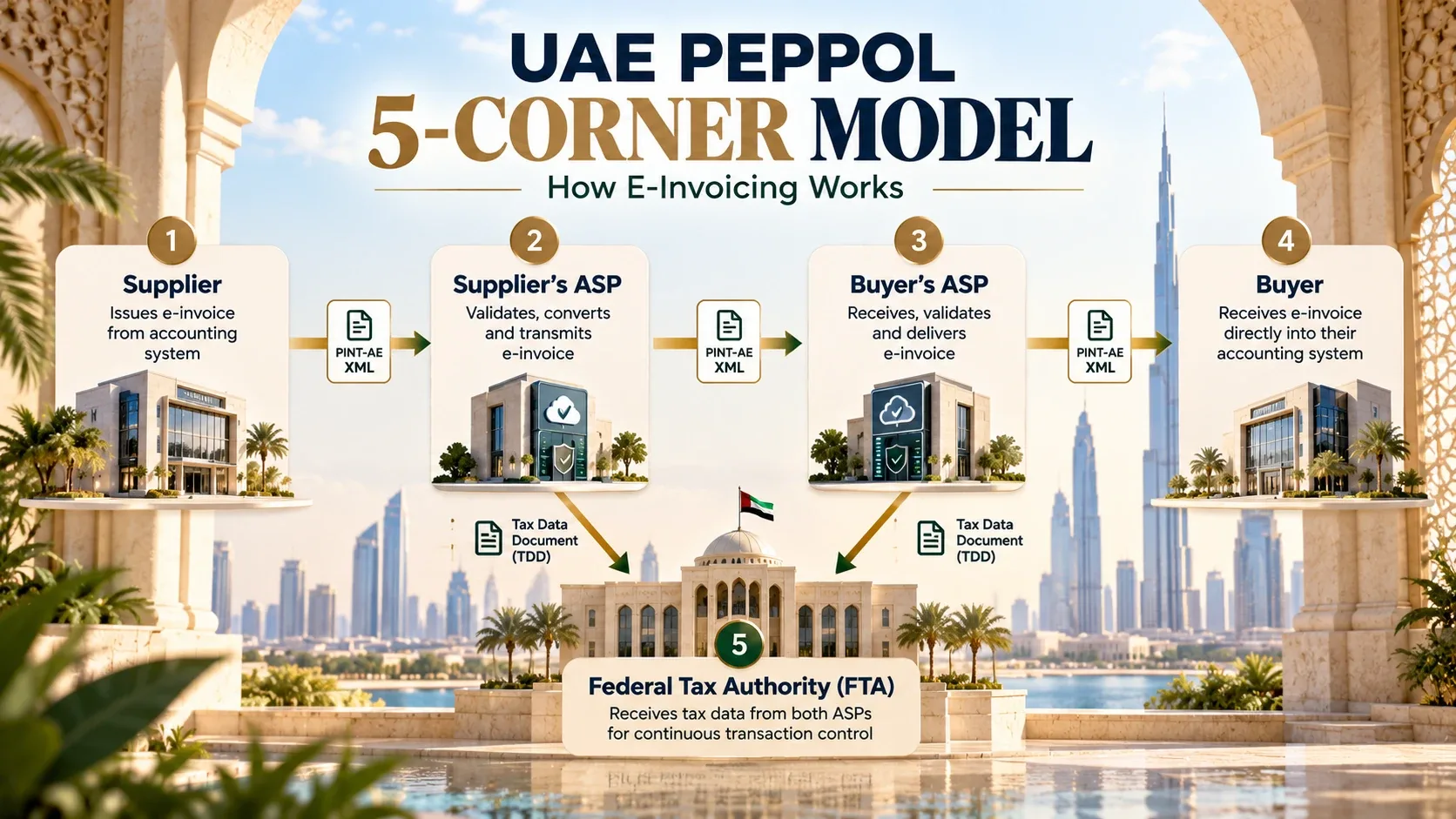
The framework contains five participants, each with a specific responsibility.
Corner 1 – Supplier: The business creates an invoice using its accounting software or ERP system.
Corner 2 – Supplier's ASP: The provider validates the invoice, converts it into the required XML format if necessary and sends it to the recipient's ASP.
Corner 3 – Buyer's ASP: The recipient's provider validates the electronic invoice and delivers it to the buyer.
Corner 4 – Buyer: The customer receives the electronic invoice for processing and accounting.
Corner 5 – FTA: The authority receives the required Tax Data Document and provides reporting status confirmations.
How Does an Electronic Invoice Move Through the Five Corners?
Consider a Dubai trading company selling products to another business.
The electronic invoicefollows this process:
The supplier creates an invoice in its accounting or ERP system.
The supplier's ASP receives and validates the invoice data.
The supplier's ASP transmits the structured invoice to the buyer's ASP.
The supplier's ASP also reports the required Tax Data Document to the FTA.
The buyer's ASP validates the received invoice.
The buyer's ASP delivers the invoice to the customer and, after successful validation, reports the relevant tax data to the FTA.
Status messages are returned through the network to indicate exchange and reporting outcomes.
If validation fails, the buyer's ASP sends a negative status message according to the prescribed process.
This helps businesses identify errors rather than assuming every transmitted invoice has been successfully delivered.
What Is the Role of PINT-AE and Accredited Service Providers?
PINT-AE is the UAE-specific Peppol electronic invoicing specification.
It establishes the structure and validation rules for machine-readable invoices.
A compliant electronic invoice includes relevant information such as:
Invoice number and date.
Supplier and customer identification.
Electronic participant addresses.
Product or service descriptions.
Quantities and prices.
VAT categories and amounts.
Invoice totals.
Accredited ServiceProviders facilitate electronic invoice exchange between businesses.
They also support validation, technical integration and required reporting to the FTA.
Businesses should select a provider accredited under the UAE Ministry of Finance framework and verify compatibility with their existing accounting software.
How Does the FTA Receive Invoice Data in the Five-Corner Model?
The fifth corner is the Federal Tax Authority.
Instead of acting as the sole intermediary between every supplier and buyer, the FTA receives prescribed transaction information from the accredited provider network.
This information is transmitted through a Tax Data Document (TDD).
The supplier's ASP reports the TDD to the FTA, while the buyer's ASP also reports relevant tax information following successful invoice validation.
The FTA returns a Message Level Status (MLS) confirming the relevant reporting outcome.
An MLS is a technical status message, not a blanket guarantee that an invoice's commercial or VAT treatment has been approved.
This distinction matters because businesses remain responsible for their underlying tax compliance and accurate transaction records.
What Is the Difference Between the Four-Corner and Five-Corner Models?
Both models support structured electronic invoice exchange through service providers.
The UAE announced a four-corner exchange milestone in April 2026 and launched the five-corner pilot in July 2026.
The additional fifth corner supports tax reporting while preserving the decentralised exchange of invoices between businesses.
When Must UAE Businesses Use the Five-Corner E-Invoicing System?
The UAE's implementation schedule depends on the business's annual revenue and entity category.
The voluntary program began on 1 July 2026.
Mandatory requirements generally cover business-to-business (B2B) and business-to-government (B2G) transactions, subject to specified exclusions.
Business-to-consumer (B2C) transactions remain outside the initial mandate.
Businesses should identify their applicable deadline rather than assuming that all companies must adopt the system simultaneously.
How Can Dubai Businesses Prepare for the Peppol 5-Corner Model?
Preparation begins with reviewing existing invoice and accounting processes.
Businesses should:
Confirm whether their transactions are covered.
Verify supplier and customer identifiers.
Review invoice fields and VAT calculations.
Check PINT-AE compatibility.
Appoint an accredited ASP by the applicable deadline.
Test electronic invoice transmission.
Review rejected invoice and status message procedures.
Train accounting and finance employees.
For example, a wholesaler processing numerous monthly invoices should test whether its accounting system can transmit accurate structured data without repeated manual entry.
General accounting platforms such as Vinimay can help organise invoices, customer records, sales and payment information.
However, Vinimay's UAE PINT-AE compliance and ASP integration have not been independently verified. Businesses should confirm the necessary capabilities before relying on any software for mandatory electronic invoicing.
The priority is accurate source data, dependable provider integration and successful invoice delivery and reporting.
Conclusion
The UAE Peppol 5-Corner Model creates a secure and standardized process for electronic invoicing between suppliers, buyers, Accredited Service Providers (ASPs), and the Federal Tax Authority (FTA). It enables invoice data to be validated, exchanged in the PINT AE format, and reported electronically to the tax authorities. Businesses should prepare by reviewing their invoicing software, selecting an appropriate accredited service provider, and organizing their customer and transaction records. Unlike ordinary PDF invoices, structured e-invoices support automated processing and digital tax reporting. For everyday billing and record management, businesses can also use Vinimay's free bilingual billing software to create invoices in English and Hindi, manage sales bills, and organise transaction records. However, businesses must separately verify Peppol connectivity and UAE e-invoicing compliance before using any software for mandatory e-invoice exchange.
Frequently Asked Questions
Related Topics
Published by prachi kahar
Our editorial and compliance specialists create practical guides, tax calculation rules, and operational strategies to empower Indian small business owners and accountants.