How to Keep Stock Counts Accurate Without Manual Counting
Almost every business that sells physical products eventually hits the same frustrating pattern: a physical stock count doesn't match what the records say, and no one can quite explain why. It's rarely one dramatic event—it's usually the accumulation of small gaps between what actually happened (a sale, a return, a damaged item) and what got recorded, or didn't.Manual
The instinct is often to count more frequently, hoping extra vigilance will close the gap. This helps temporarily, but it doesn't address the underlying issue—if stock isn't updated automatically as transactions happen, someone still has to manually reconcile it every time, and manual reconciliation is exactly where these small errors keep entering the system in the first place.
This guide explains why manual stock counts drift from reality, why recounting alone doesn't solve it, and what actually keeps stock accurate without repeated manual effort.
Why Do Manual Stock Counts Almost Always Drift From Reality?
Direct answer: Manual stock counts drift because inventory is updated separately from sales and purchases, relying on someone remembering to adjust the count every time a transaction happens—and any missed, delayed, or incorrect update creates a gap that accumulates unnoticed until the next physical count reveals it.
A sale recorded without a matching stock deduction leaves inventory overstated
A stock update entered against the wrong product creates two inaccurate counts instead of one
Damaged, returned, or given-away stock is often the easiest to forget recording
Why Recounting More Often Isn't the Real Fix
Counting stock more frequently feels like the responsible solution, but it's really just catching the same underlying problem sooner rather than preventing it. If sales and stock aren't connected automatically, every single transaction still carries the same risk of a missed or delayed update, regardless of how often someone physically checks the shelves afterward. More frequent counting also has a real cost—staff time spent recounting is time not spent on customers or other work, and for a busy retail or wholesale operation, that cost adds up quickly. The businesses that actually solve this problem aren't the ones counting most often; they're the ones where a sale automatically reduces the recorded stock the moment it happens, removing the manual step where the gap was being introduced in the first place.
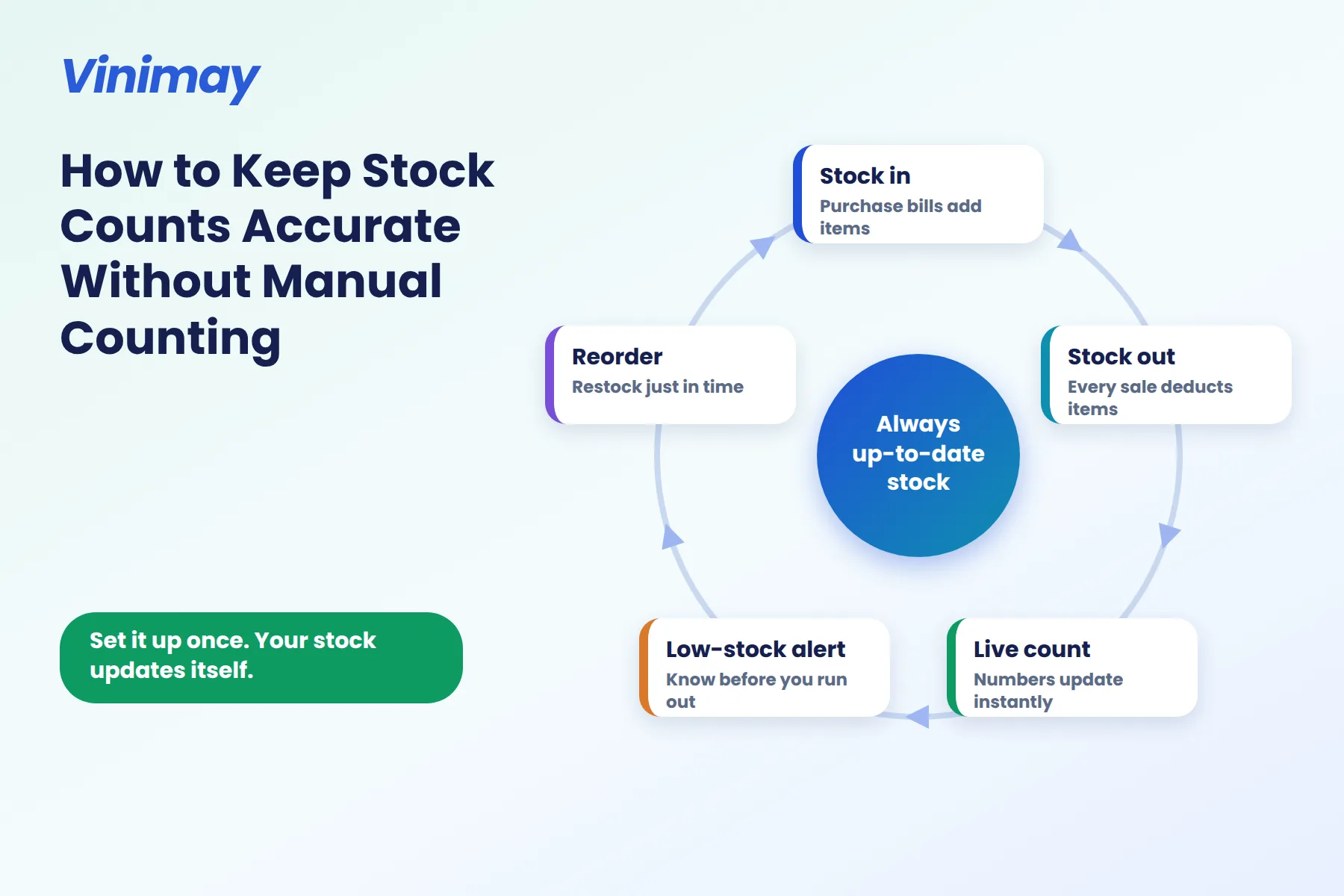
What Keeps Stock Counts Accurate Automatically
Practical Habits to Support Automatic Stock Accuracy
Record every sale and purchase through the same connected system, rather than logging some transactions elsewhere
Log damaged, returned, or written-off stock explicitly, rather than letting it silently disappear from the count
Do a periodic physical count as a confirmation, not a replacement—it should rarely surface a big surprise if the automatic system is working
Investigate discrepancies immediately when they appear, rather than just adjusting the number and moving on
Keep product entries specific and consistent—vague or duplicate product listings make automatic tracking less reliable
Train anyone entering transactions on the correct product and quantity fields, since a small entry error here is where drift usually starts
How Vinimay Keeps Your Stock Counts Accurate
Updates stock automatically through inventory and product management as sales and purchases are recorded
Keeps stock tracking connected to sales records and purchase records, so inventory reflects actual recorded transactions
Maintains product-level detail, reducing the risk of an update being applied to the wrong item
Supports accurate reporting on stock position, making periodic physical counts a confirmation step rather than the main method of tracking
Keeps this connected across ledger management and reports, giving a reliable, ongoing view of inventory alongside sales performance
Conclusion
Manual stock counts drift because inventory updates depend on someone remembering to record them accurately every time
Counting more often catches the problem sooner but doesn't prevent it—automatic stock updates do
Connecting sales and purchases directly to stock removes the manual step where drift usually starts
Vinimay updates stock automatically as transactions happen, making physical counts a confirmation rather than the core system
FAQs
How can I keep stock counts accurate without manual counting?
By using a system where sales and purchases automatically update stock levels, rather than relying on separate, manual inventory adjustments after each transaction.
Why does my stock count never match my actual inventory?
This usually happens because inventory is updated manually and separately from sales, so any missed or delayed update creates a gap that accumulates over time.
Does counting stock more often fix inaccurate inventory?
It catches discrepancies sooner but doesn't prevent them — the underlying fix is connecting stock updates directly to sales and purchases automatically.
What causes the most common stock discrepancies?
Missed stock deductions on sales, incorrect product selection during entry, and unrecorded damaged or returned items are common causes.
Should physical stock counts be stopped once automatic tracking is in place?
No, periodic physical counts are still valuable as a confirmation check, but they shouldn't be the primary method of tracking inventory.
How does automatic stock tracking actually work?
Software deducts sold quantities and adds purchased quantities to stock levels automatically as transactions are recorded, without a separate manual update.
Can product management help prevent stock errors?
Yes, specific, consistent product entries reduce the risk of a stock update being applied to the wrong item, which is a common source of discrepancy.
What should I do if I find a stock discrepancy?
Investigate it immediately to understand the cause, rather than simply adjusting the number — this helps prevent the same gap from recurring.
Is manual stock counting ever sufficient for a small business?
For very low product variety and transaction volume, it can work reasonably well, though it becomes less reliable as complexity and volume grow.
Does inaccurate stock tracking affect anything beyond inventory itself?
Yes, it can distort sales reports, lead to overselling out-of-stock items, or tie up capital in inventory that isn't accurately accounted for.
Related Topics
Published by Team Vinimay
Our editorial and compliance specialists create practical guides, tax calculation rules, and operational strategies to empower Indian small business owners and accountants.