There's a specific confusion worth clearing up before answering this question directly: a GST-compliant invoice and an "E-invoice" in the official Indian sense are not the same thing, even though both are digital and both include tax details. Assuming a tool that creates GST invoices automatically also supports e-invoicing can lead to a compliance gap that isn't obvious until it matters.
Some accounting software can generate e-invoices, but this specifically requires integration with the government's Invoice Registration Portal (IRP) to generate a unique Invoice Reference Number (IRN) and QR code for each invoice—a regular GST-compliant invoice, without this IRP integration, is not the same as an e-invoice, regardless of how professional or accurate it looks.
This guide explains exactly what separates a standard GST invoice from a true e-invoice, who's required to use e-invoicing, and how to check whether any specific tool genuinely supports it before assuming it does.
What Makes an Invoice an "E-Invoice" Specifically
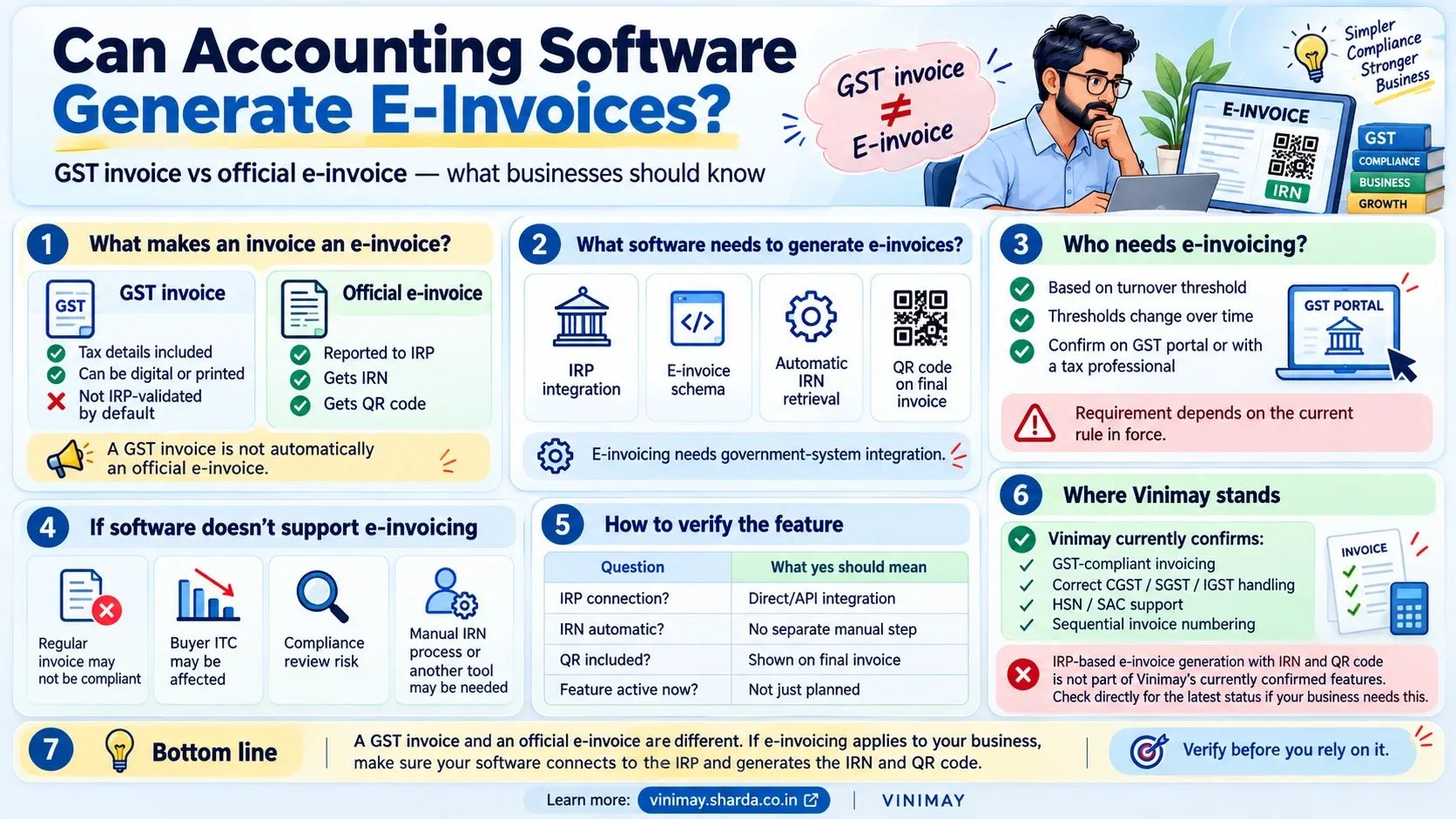
An e-invoice, under India's GST e-invoicing system, is a standard-format invoice that has been reported to and validated by the government's Invoice Registration Portal, which then issues a unique IRN and a QR code back to the business. This IRN and QR code are then included on the invoice, making it "e-invoiced" in the official sense. A digital, GST-compliant invoice that hasn't gone through this IRP validation—no matter how well-formatted—is not a valid e-invoice for businesses that fall under the e-invoicing mandate.
What a Tool Needs to Actually Generate E-Invoices
For software to genuinely support e-invoicing, it needs a direct or indirect connection to the government's IRP system, the ability to format invoice data according to the required e-invoice schema, and the ability to receive and attach the IRN and QR code back onto the invoice after validation. This is meaningfully more complex than simply creating a GST-correct invoice—it requires ongoing integration with a government system, not just internal tax calculation.
Who Is Required to Use E-Invoicing
E-invoicing requirements in India are based on business turnover thresholds set by the government, and these thresholds have changed over time to cover progressively smaller businesses. Whether your specific business currently falls under this requirement depends on your turnover and the current threshold in effect—this is worth confirming through the official GST portal or a tax professional, since it changes periodically and getting it wrong has compliance consequences.
What Happens If a Business Needs E-Invoicing But the Software Doesn't Support It
If your business is required to generate e-invoices and your billing software only produces standard digital invoices, those invoices are not compliant for the transactions that fall under the e-invoicing mandate, even if they're GST-correct in every other respect. This can affect the buyer's ability to claim input tax credit and may result in compliance issues during a GST review. Businesses in this situation typically need either dedicated e-invoicing software, a tool with genuine IRP integration, or a workaround process to generate the IRN separately and attach it manually.
How to Check If a Tool Genuinely Supports This
Since "e-invoice ready" is sometimes used loosely in marketing, it's worth verifying specifically: ask whether the tool integrates directly with the government's IRP, whether the IRN and QR code are generated and attached automatically or require a manual step elsewhere, and whether this feature is confirmed as currently active rather than "planned" or "coming soon."
Where Vinimay Stands on E-Invoicing
Vinimay's confirmed feature set covers GST-compliant invoicing—correct CGST, SGST, and IGST application, HSN/SAC codes, and sequential invoice numbering. E-invoice generation, specifically requiring IRP integration and IRN/QR code issuance, is not part of Vinimay's currently confirmed features. If your business falls under the e-invoicing mandate, it's worth checking directly with Vinimay for the most current status on this specific capability, since it involves a distinct government-integration requirement beyond standard GST invoicing.
Conclusion
A GST-compliant invoice and a true e-invoice are different things, and the difference matters specifically for businesses that fall under India's e-invoicing mandate. Genuine e-invoice generation requires direct integration with the government's Invoice Registration Portal to produce an IRN and QR code—a capability distinct from standard tax calculation and invoice formatting. Before assuming any software supports this, verify it specifically using the questions in this guide, and confirm your own business's requirement directly through the GST portal or a tax professional.
Frequently Asked Questions
1. Is a GST invoice automatically an e-invoice?
No. An e-invoice specifically requires validation through the government's Invoice Registration Portal, resulting in an IRN and QR code—a standard GST invoice doesn't have this by default.
2. Who is required to generate e-invoices?
Businesses above a certain turnover threshold set by the government, which has changed over time — check the current threshold via the GST portal.
3. What happens if I issue a regular invoice when e-invoicing is required?
It may not be considered compliant for that transaction, potentially affecting the buyer's input tax credit and creating compliance issues.
4. Does every accounting software support e-invoicing?
No, this specifically requires integration with the government's IRP, which not all tools include.
5. Does Vinimay generate e-invoices with IRN and QR codes?
This is not part of Vinimay's currently confirmed feature set—check directly for the most current status if this applies to your business.
6. How can I tell if a tool's e-invoicing claim is genuine?
Ask specifically whether it integrates directly with the IRP and generates the IRN and QR code automatically, rather than as a manual workaround.
7. Can I manually generate an e-invoice if my software doesn't support it?
Yes, businesses can register invoices separately through the government portal, though this adds a manual step outside standard billing.
8. Does e-invoicing replace GST return filing?
No, e-invoicing feeds data toward GST returns but is a separate process from filing the returns themselves.
9. Is e-invoicing the same across all business types?
No, requirements depend on turnover thresholds, which are set at the business level, not by industry type alone.
10. Where can I confirm if my business needs e-invoicing?
The official GST portal or a tax professional can confirm your current requirement based on your turnover.
Related Topics
Published by Team Vinimay
Our editorial and compliance specialists create practical guides, tax calculation rules, and operational strategies to empower Indian small business owners and accountants.