Quick Answer: A UAE business that misses its mandatory Accredited Service Provider (ASP) appointment deadline may face an AED 5,000 fine for each month or part of a month of delay. The penalty is prescribed under Cabinet Decision No. 106 of 2025.Invoicing
Missing an ASP appointment deadline can create financial and operational difficulties for businesses in Dubai and across the UAE.
The Ministry of Finance has introduced administrative penalties to encourage timely adoption of the UAE Electronic Invoicing System. Businesses must understand when these penalties apply, how much they may cost and what steps can help them become compliant.
What Is the Penalty for Missing the UAE ASP Appointment Deadline?
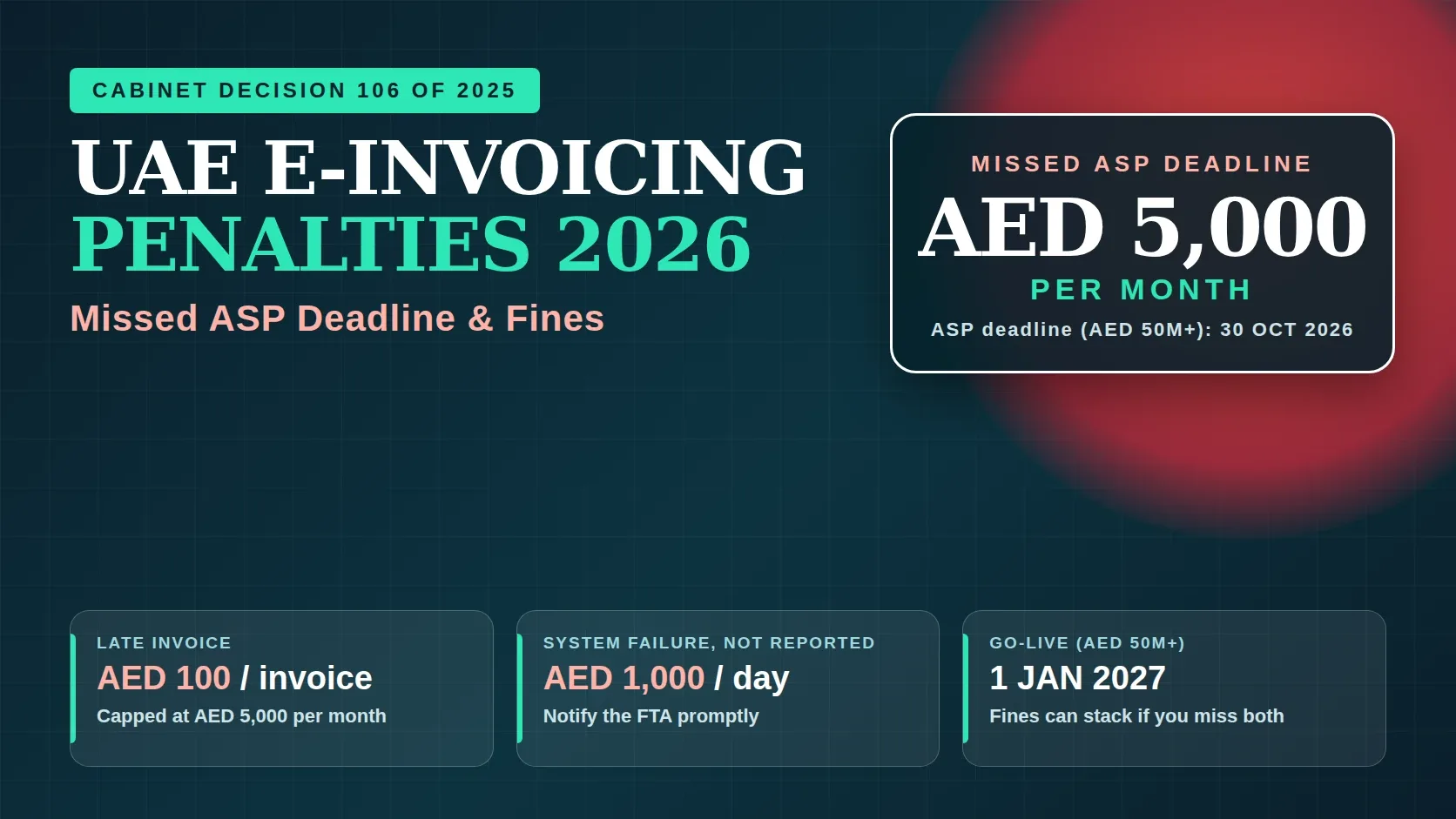
Under Cabinet Decision No. 106 of 2025, a business required to implement UAE e-invoicing may face a penalty of AED 5,000 for each month or part of a month of delay.
The violation covers failure to implement the Electronic Invoicing System, including failure to appoint an accredited service provider within the prescribed deadline.
For example, the penalty could amount to:
These are illustrative calculations, not assessments of a particular business. The actual penalty depends on the applicable compliance deadline, period of delay and enforcement of the relevant provisions.
Which UAE Businesses Must Meet the ASP Deadline?
The ASP appointment deadline depends on a business's applicable e-invoicing implementation phase.
The first-phase appointment deadline was extended from 31 July to 30 October 2026 through Ministerial Decision No. 66 of 2026.
The extension did not change the mandatory implementation date.
Businesses should confirm their revenue category and whether their transactions fall within the e-invoicing mandate.
What Are the Other UAE E-Invoicing Penalties?
Besides late ASP appointment, the UAE has introduced penalties for other electronic invoicing violations.
These penalties apply to specified violations under the UAE e-invoicing legislation. The applicable obligation, reporting deadline and implementation phase must be considered before determining liability.
Can Missing the ASP Deadline Affect Business Operations?
Yes. Apart from possible administrative penalties, delayed ASP appointment can disrupt a business's e-invoicing preparation.
Businesses may face difficulties with:
Integrating existing ERP or accounting software.
Preparing accurate supplier and customer information.
Mapping invoice fields to UAE technical standards.
Testing electronic invoice transmission.
Resolving data validation errors.
Training accounting employees before implementation.
For example, a Dubai trading company processing hundreds of B2B invoices may experience additional administrative work if its accounting system is not ready.
However, missing the deadline does not automatically mean that every invoice becomes invalid or that input VAT recovery is denied. Any VAT implications must be assessed under the applicable legislation and the facts of the transaction.
What Should a Business Do If It Misses the Deadline?
Businesses that miss their ASP appointment deadline should take corrective action promptly rather than delaying implementation further.
Recommended steps include:
Confirm the applicable deadline: Check annual revenue and the implementation phase.
Select an accredited ASP: Review the official Ministry of Finance register.
Document the delay: Maintain records explaining the appointment status and actions taken.
Complete provider onboarding: Finalise contracts and integration requirements.
Prepare invoice information: Verify customer, supplier and transaction details.
Complete required testing: Check whether invoices can be exchanged correctly.
Seek professional guidance: Obtain advice on potential penalties and available administrative procedures.
Appointing an ASP late does not automatically cancel penalties already incurred. Businesses should seek guidance rather than assuming that subsequent compliance removes earlier violations.
How Can Businesses Find an Approved ASP in the UAE?
An accredited service provider facilitates structured electronic invoice exchange and related reporting under the UAE framework.
Businesses should verify the provider's accreditation before signing an agreement.
Important considerations include technical compatibility, service charges, information security, implementation support and the ability to handle UAE PINT AE invoice requirements.
The official UAE Ministry of Finance e-invoicing portal provides accreditation information and regulatory guidance.
Businesses should confirm a provider's current status rather than relying only on software advertisements or outdated provider lists.
How Can Accounting Software Help Reduce E-Invoicing Errors?
Accurate accounting records can make the transition to electronic invoicing easier.
Common preparation problems include incomplete customer information, incorrect invoice amounts, missing tax details and inconsistent transaction records.
Accounting software can help businesses maintain organised records before introducing compliant electronic invoice exchange.
For example, Vinimay offers general invoicing, customer management, sales and purchase tracking, and accounting reports. These features can support everyday financial recordkeeping.
However, Vinimay's UAE PINT AE compliance and ASP integration have not been independently verified. Businesses should confirm UAE-specific capabilities before relying on any software for mandatory electronic invoicing.
How Can UAE Businesses Avoid E-Invoicing Penalties?
The most effective approach is to prepare before the applicable deadline.
Businesses should establish responsibility for ASP selection, review existing invoice records and confirm the technical requirements with their chosen provider.
Regular data checks, staff training and invoice transmission testing can help identify problems before mandatory implementation.
Businesses should also monitor official FTA announcements because reporting procedures, accreditation requirements and compliance guidance may be updated.
For organisations operating in Dubai, Abu Dhabi, Sharjah and other Emirates, maintaining reliable accounting records and completing ASP onboarding on time are important steps towards avoiding preventable compliance difficulties.
Conclusion
Frequently Asked Questions
Related Topics
Published by prachi kahar
Our editorial and compliance specialists create practical guides, tax calculation rules, and operational strategies to empower Indian small business owners and accountants.