What Is the Difference Between Internal and External Audit?
Quick Answer: An internal audit evaluates a company's processes, internal controls, risks and operational efficiency. An external audit independently examines financial statements and provides an audit opinion. Internal audits help management improve business operations, while external audits give shareholders, regulators and other stakeholders confidence in financial reporting.
Businesses operating in Dubai, Abu Dhabi and other Emirates need accurate financial information and effective controls. However, internal and external audits serve different purposes.
Understanding both helps business owners decide which audit is appropriate and prepare for UAE financial reporting requirements.
1. What Is an Internal Audit?
An internal audit is an independent, objective review of a company's operations, processes and internal controls.
Its main purpose is to identify weaknesses and recommend improvements.
For example, a UAE trading company may conduct an internal audit to investigate stock shortages, duplicate payments or missing purchase approvals.
Internal audits can be performed by an in-house audit team or an outsourced professional firm. The auditors must maintain appropriate objectivity and independence from the activities they examine.
2. What Is an External Audit?
An external audit is an independent examination of a company's financial statements by an external auditor.
The auditor evaluates whether those statements are prepared fairly, in all material respects, under the applicable financial reporting framework.
For example, an auditor may examine sales invoices, bank balances, receivables, inventory valuation and financial statement disclosures.
The external auditor issues a report expressing an opinion based on the audit evidence obtained.
3. What Are the Main Differences?
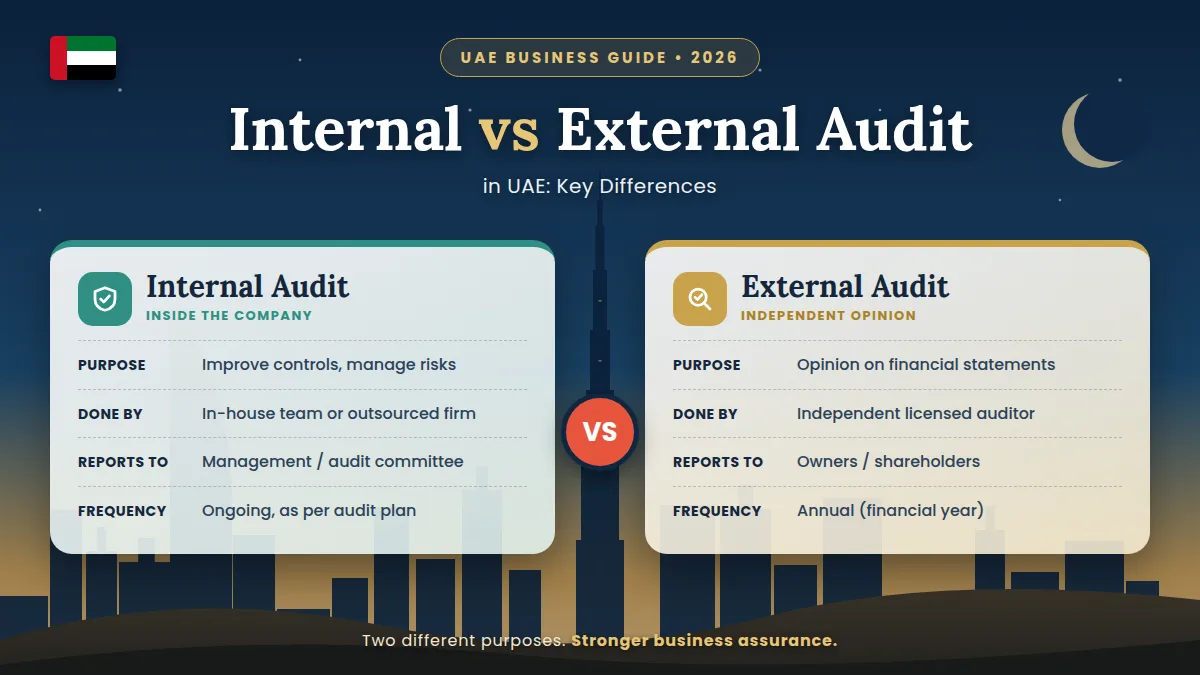
The central difference is purpose: internal audit focuses on improving how a business operates; external audit focuses on the reliability of its financial statements.
4. What Do Internal and External Auditors Examine?
Internal auditors may review purchasing approvals, stock handling, payment controls, employee responsibilities and fraud risks.
External auditors focus on financial statement assertions, including whether revenue, expenses, assets and liabilities are materially accurate.
For example, an internal auditor might investigate why warehouse stock regularly goes missing.
An external auditor might test whether the inventory balance of AED 500,000 is appropriately stated in the financial statements.
Both can examine inventory, but their objectives differ.
5. Are Internal and External Audits Mandatory in the UAE?
An internal audit is not universally mandatory for every UAE business. Some regulated entities and organisations must maintain internal audit functions under applicable governance requirements.
External audit requirements depend on company law, Free Zone regulations and Corporate Tax rules.
Under Ministerial Decision No. 84 of 2025, audited financial statements are required for:
Taxable persons outside Tax Groups with revenue exceeding AED 50 million.
Qualifying Free Zone Persons, regardless of revenue.
Corporate Tax Groups, through audited special-purpose financial statements.
These Corporate Tax requirements apply to tax periods beginning on or after 1 January 2025. Other legal audit obligations may apply separately.
6. How Do Both Audits Benefit UAE Businesses?
Internal audit helps companies discover weaknesses before they become larger financial problems.
External audit helps build confidence in financial statements among shareholders, lenders and other stakeholders.
Consider a manufacturing company with inventory discrepancies.
An internal audit may recommend stronger warehouse controls and approval procedures.
The external audit may assess whether those discrepancies create a material misstatement in the company's financial statements.
Together, these functions improve governance and financial reliability.
7. How Should Businesses Prepare for an Audit?
Businesses should regularly reconcile bank accounts, customer balances, supplier ledgers and inventory records.
Other useful preparation steps include maintaining complete invoices, documenting approval procedures, reviewing expenses and preserving supporting evidence.
For external audits, companies should also prepare a trial balance, financial statements, fixed asset schedules and relevant accounting reconciliations.
A company can use internal reviews throughout the year to identify issues before its annual external audit begins.
8. How Can Vinimay Help With Audit Preparation?
Accurate accounting records make both internal and external audits easier to perform.
Vinimay provides general accounting features for managing sales invoices, purchase records, customer and supplier ledgers, payments, inventory and financial reports.
These tools can help businesses organise transactions and retrieve information for audit reviews.
However, Vinimay's UAE-specific statutory audit compliance, automated internal audit controls, IFRS financial statement assurance and FTA audit integration capabilities have not been independently verified.
Accounting software supports recordkeeping but cannot replace an independent audit opinion.
Published by Satyam mahajan
Our editorial and compliance specialists create practical guides, tax calculation rules, and operational strategies to empower Indian small business owners and accountants.