How to Keep Customer Records Organised and Useful
Most businesses do technically "have" customer records — a contact list, a folder of past invoices, a mental sense of who the regulars are. The problem isn't a total absence of records; it's that scattered, inconsistent customer data is hard to actually use when it matters: confirming a customer's correct GST details for an invoice, checking their purchase history before a discount decision, or knowing at a glance what they currently owe.
Organised customer records aren't about maintaining an elaborate CRM system — they're about keeping each customer's essential details, transaction history, and outstanding balance in one place, updated consistently, so that information is immediately usable rather than something that needs to be reconstructed from old invoices or memory every time it's needed.
This guide covers what genuinely useful customer record-keeping involves, why "stored somewhere" isn't the same as "organized," and practical habits that keep the data reliable as your customer base grows.
What Does "Organised Customer Records" Actually Mean?
Direct answer: Organised customer records means keeping each customer's contact details, GST information (where applicable), purchase history, and outstanding balance in one consistent, updated place — so any of this can be checked instantly, rather than requiring a search through old invoices or messages.
Each customer should have one clear, current record, not several inconsistent versions
Purchase history should be reviewable per customer, not just as a general list of all invoices
Outstanding balances should reflect the current, accurate situation, not an estimate
Why Customer Records That Are Merely Stored Aren't the Same as Useful
A folder full of past invoices technically contains all the information about a customer, but it isn't organized in any way that makes it quick or reliable to use. Finding a customer's current GSTIN means opening their most recent invoice and hoping it's up to date. Checking their purchase history means scrolling through a general invoice list looking for their name. Confirming what they currently owe means manually adding up unpaid invoices, hoping none have been missed along the way. None of this is impossible, but it's slow, error-prone, and gets noticeably worse as the customer base grows — the records are "there," but they aren't actually organized in a way that supports quick, accurate decisions, which is the entire point of keeping them in the first place.
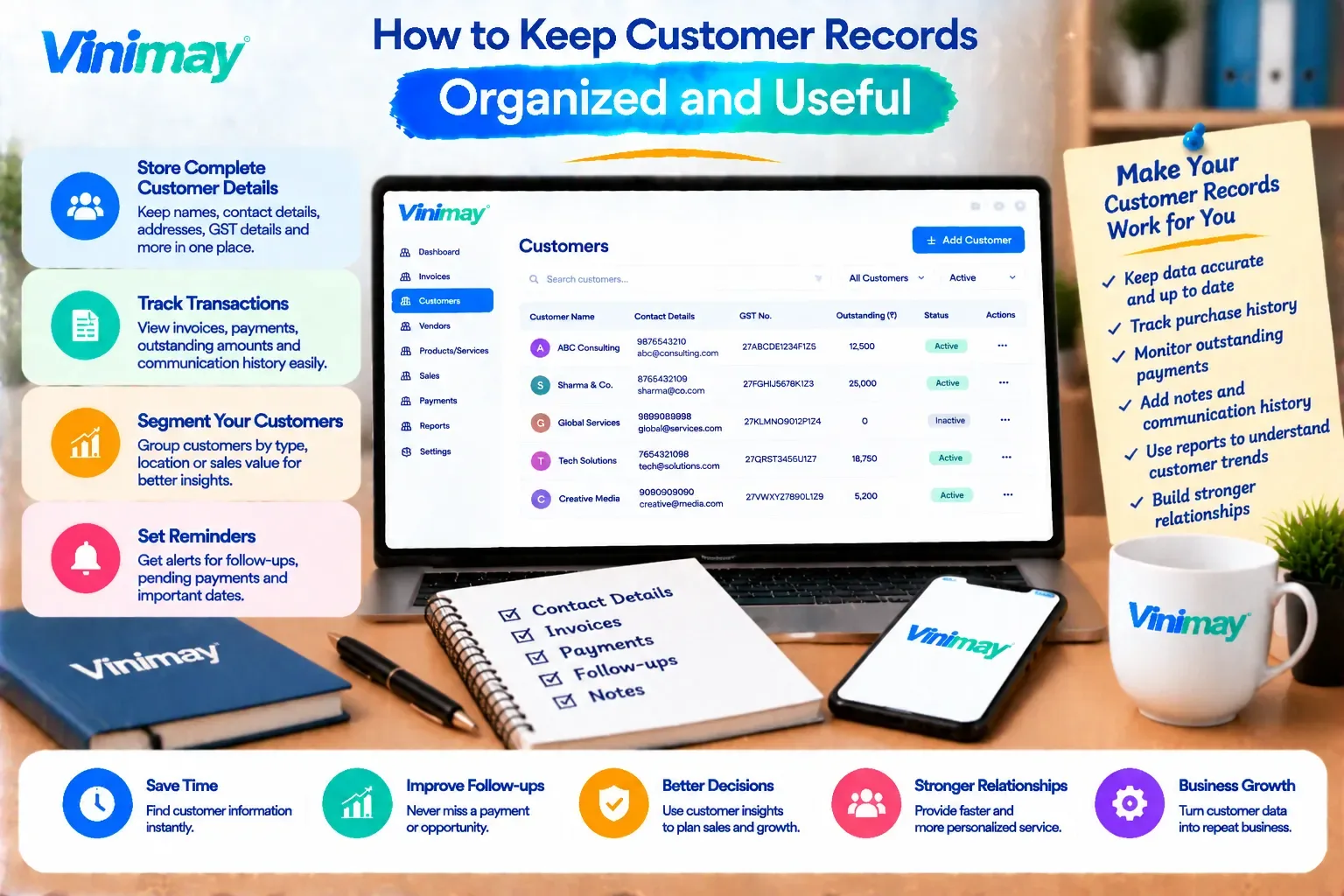
What an Effective Customer Record System Needs
Practical Habits for Keeping Customer Data Accurate
Update customer details as soon as they change — a new GSTIN, address, or contact should update immediately, not at the next invoice
Avoid creating duplicate customer entries — the same customer under two slightly different names splits their history and balance inaccurately
Record every transaction against the correct customer consistently — this is what makes purchase history genuinely useful later
Review customer balances periodically, not only when they raise a question or dispute
Check purchase history before offering credit or discounts — a quick look at past behavior supports better decisions than assumption
Clean up outdated or inactive customer records occasionally, so the active list stays relevant and easy to navigate
How Vinimay Keeps Customer Records Useful
Maintains one consistent record per customer through customer management, avoiding scattered or duplicate entries
Keeps GST-compliant invoicingconnected to customer records, so details stay accurate and current on every invoice
Tracks purchase history per customer through connected sales records, making it easy to review without searching a general list
Maintains accurate outstanding balances through receivables and payables, reflecting each customer's current status
Provides reports that draw on customer data, giving a clear view of billing and payment patterns across your customer base
Conclusion
Organized customer records mean data that's immediately usable, not just stored somewhere
Scattered records — even if technically complete — are slow and error-prone to actually use
An effective system keeps one current record per customer, with accurate history and balances
Vinimay keeps customer details, purchase history, and receivables connected and consistently accurate
FAQs
How can I keep customer records organized?
By maintaining one consistent, updated record per customer — contact details, purchase history, and outstanding balance — rather than scattered invoices and memory.
What's the difference between storing customer data and organizing it?
Stored data technically exists but requires manual searching to use; organized data is structured so any detail can be checked instantly and reliably.
Why do duplicate customer entries cause problems?
They split a customer's purchase history and outstanding balance across two records, making both inaccurate and harder to review.
How often should customer details be updated?
As soon as they change — a new GSTIN, address, or contact should be reflected immediately, not at the next transaction.
Can customer purchase history help with business decisions?
Yes, reviewing a customer's history before extending credit or offering a discount supports more informed decisions than relying on general impressions.
How can I check what a specific customer currently owes?
An organized system with accurate receivables tracking shows this instantly per customer, without manually adding up individual invoices.
Should inactive customer records be deleted or kept?
Generally kept for record-keeping purposes, but separated from active customers so your working list stays relevant and easy to navigate.
Does customer record organization affect billing accuracy?
Yes, outdated or inconsistent customer details directly lead to invoice errors, such as an incorrect GSTIN or address.
Is a spreadsheet enough to organize customer records?
It can work at low customer volume with consistent updates, but tends to become unreliable as the customer base and transaction count grow.
What's the biggest mistake businesses make with customer records?
Creating scattered or duplicate entries over time instead of maintaining one consistent, updated record per customer from the start.
Related Topics
Published by Team Vinimay
Our editorial and compliance specialists create practical guides, tax calculation rules, and operational strategies to empower Indian small business owners and accountants.