What Is E-Invoicing in the UAE and Which Businesses Must Follow It?
Quick Answer: UAE e-invoicing is a system for issuing and exchanging structured electronic invoices through Accredited Service Providers (ASPs), with information reported to the Federal Tax Authority (FTA). It generally covers B2B and B2G transactions, with mandatory implementation beginning in January 2027.
Businesses across Dubai, Abu Dhabi, Sharjah, and other Emirates are preparing for new electronic invoicing requirements. The UAE Ministry of Finance has introduced a phased system designed to improve tax reporting, reduce invoice errors, and simplify business transactions.
Understanding which businesses are covered, the implementation timeline and how the system works can help companies prepare before their compliance deadlines.
What Is E-Invoicing in the UAE?
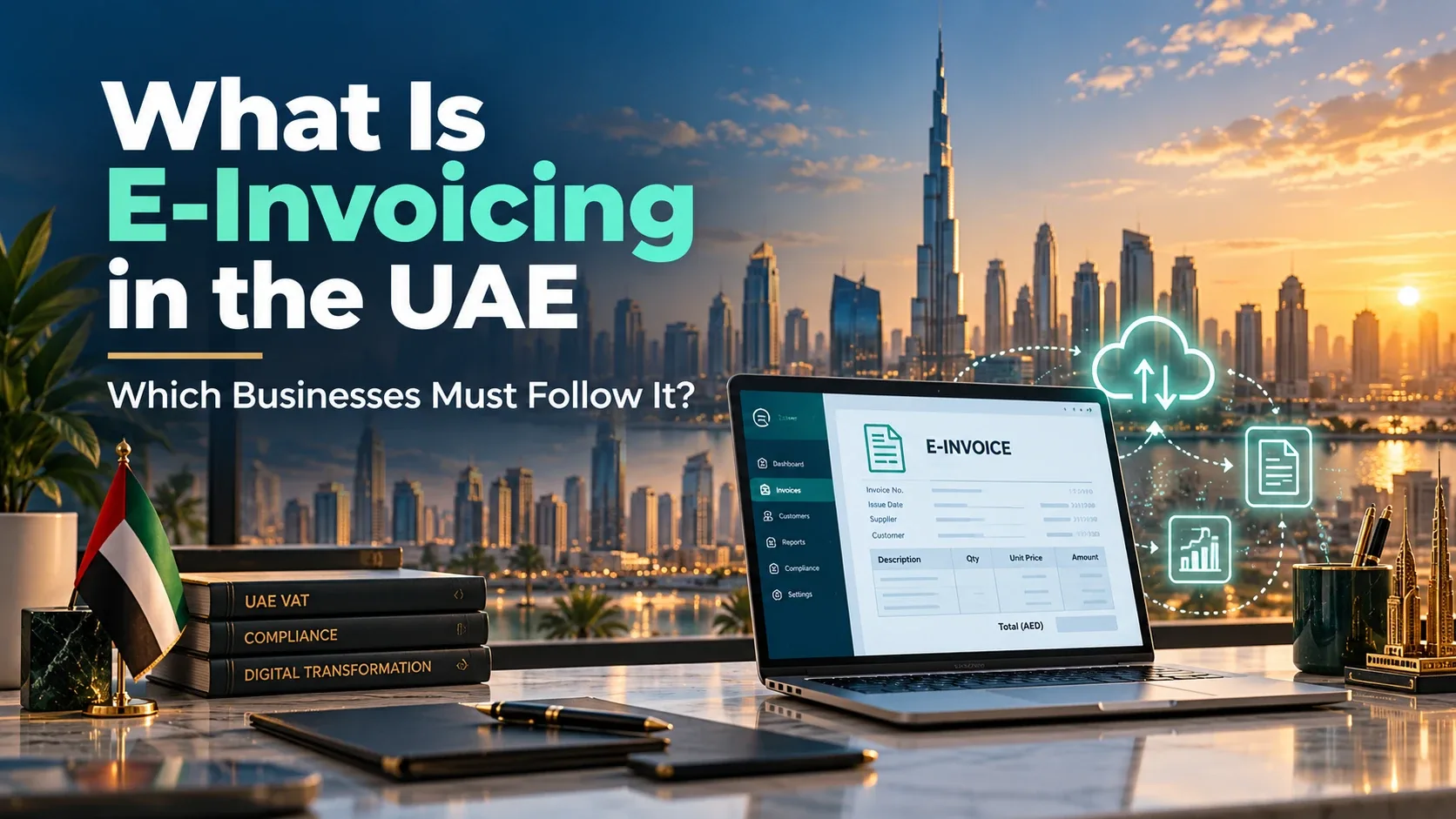
E-invoicing is the process of creating, sending and receiving invoices in a structured, machine-readable electronic format.
Under the UAE system, invoices follow prescribed electronic standards, including PINT AE, which uses XML-based data structures.
Unlike ordinary digital invoices, the following documents alone are not considered compliant e-invoices:
Microsoft Word invoices
Scanned paper invoices
Invoice images
Invoices sent through ordinary emails
For example, when a Dubai trading company sells goods to another business, invoice data can be exchanged automatically between compatible systems rather than manually entered from a PDF.
The UAE framework uses a Peppol-based model to facilitate secure electronic invoice exchange.
Which Businesses Must Follow UAE E-Invoicing Requirements?
The UAE e-invoicing mandate generally covers businesses conducting qualifying business-to-business (B2B) and business-to-government (B2G) transactions.
Businesses potentially affected include:
Trading and wholesale companies
Manufacturing and industrial businesses
Construction and contracting firms
Professional service companies
E-commerce businesses making B2B supplies
Small and medium enterprises
Free-zone companies conducting covered transactions
The requirements are not limited to VAT-registered businesses. Certain non-VAT-registered entities may also fall within the mandatory framework.
A company's legal structure or location does not automatically determine whether it must comply. The nature of its transactions and applicable legal exclusions are important.
UAE E-Invoicing Timeline: When Does It Become Mandatory?
The UAE Ministry of Finance has established different implementation deadlines based on annual revenue and entity category.
The pilot and voluntary implementation programme started on 1 July 2026.
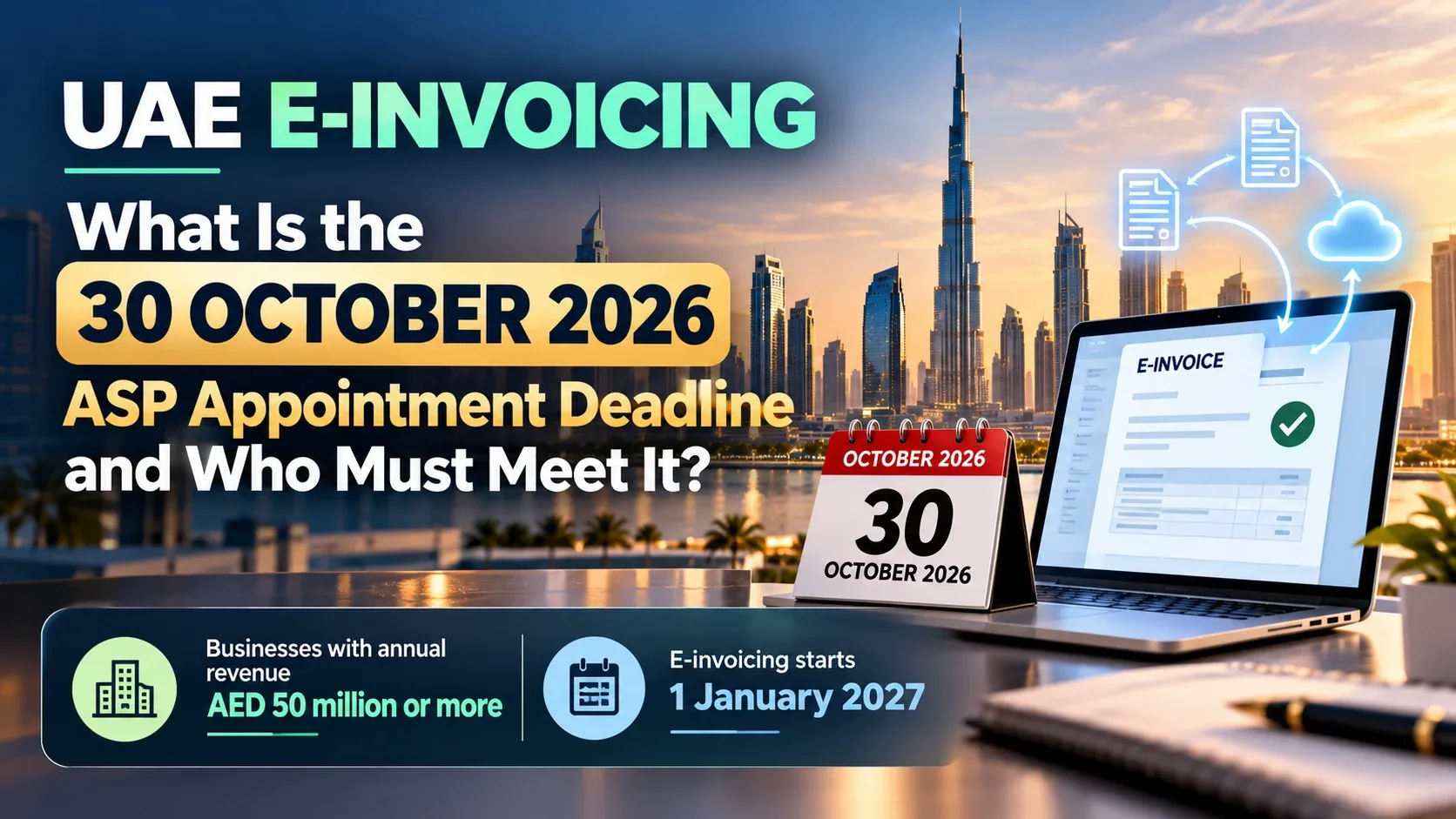
The government extended the first-phase ASP appointment deadline from 31 July 2026 to 30 October 2026. However, mandatory implementation for large businesses still begins on 1 January 2027.
Businesses should confirm their annual revenue classification using the prescribed rules rather than relying on estimates.
Which Transactions Are Covered or Excluded?
The UAE electronic invoicing framework generally covers commercial transactions between businesses and relevant government transactions.
Transactions generally covered:
Business-to-government supplies
Qualifying government commercial transactions
Covered transactions involving non-VAT-registered businesses
Transactions currently excluded or subject to specific exclusions:
Business-to-consumer (B2C) transactions
Government activities performed in a sovereign capacity
Certain airline passenger transportation services
Specified international air cargo transactions during the applicable exclusion period
Certain financial services meeting prescribed conditions
Businesses operating in multiple sectors should assess each transaction category separately.
For example, a retail business selling directly to consumers may have different obligations from a wholesaler supplying products to other companies.
How Does UAE E-Invoicing Work?
The UAE uses a decentralized five-corner electronic invoicing model based on Peppol.
The five participants are the supplier, the supplier's accredited service provider, the buyer's accredited service provider, the buyer and the Federal Tax Authority.
The process generally works as follows:
The supplier generates a structured electronic invoice.
The supplier's ASP processes and validates the invoice.
The electronic invoice is transmitted through the provider network.
The buyer receives the invoice through its ASP.
Required invoice data is reported electronically to the FTA.
This process can help reduce manual data entry, improve invoice accuracy and support automated recordkeeping.
What Are the Mandatory UAE E-Invoicing Requirements?
Businesses within the scope of the mandate must satisfy the applicable technical and regulatory requirements.
These include:
Using the prescribed structured electronic invoice format
Appointing an Accredited Service Provider
Maintaining accurate supplier and buyer details
Including mandatory invoice and tax information
Exchanging qualifying invoices electronically
Reporting required invoice data to the FTA
Generating compliant electronic credit notes where applicable
Required invoice information may include invoice numbers, dates, supplier details, buyer identifiers, descriptions, amounts, tax rates and VAT values.
The precise mandatory fields depend on the applicable UAE invoice specification and transaction type.
Businesses should refer to the official technical documentation before updating their invoicing processes.
What Is an Accredited Service Provider in UAE E-Invoicing?
An Accredited Service Provider (ASP) is a provider accredited under the UAE Ministry of Finance framework to facilitate electronic invoice exchange and reporting.
Businesses subject to mandatory implementation must appoint an ASP according to their applicable deadline.
Before selecting a provider, businesses should check its accreditation status, software integration capabilities, security standards, technical support and pricing.
The Ministry of Finance updated the service provider accreditation framework through Ministerial Decision No. 168 of 2026.
Businesses can check the official UAE Accredited Service Providers list before choosing a provider.
How Can Small Businesses in Dubai Prepare for E-Invoicing?
Small businesses should begin by reviewing how they currently create invoices, maintain customer records and track payments.
Preparing for e-invoicing involves more than purchasing new software. Businesses need accurate supplier information, consistent invoice records and systems capable of supporting the prescribed electronic standards.
Practical preparation steps include:
Identify whether transactions fall within the mandate.
Confirm the applicable implementation deadline.
Review existing customer and supplier records.
Check accounting software compatibility.
Select an accredited provider when required.
Test invoice generation and electronic exchange.
Train accounting and finance employees.
Accounting solutions such as Vinimay offer general invoicing, sales and purchase records, payment tracking and financial reporting features that can help organise business information.
However, businesses must separately verify UAE-specific capabilities, including PINT AE support and ASP integration. General accounting or digital billing features do not automatically establish compliance with UAE FTA e-invoicing requirements.
Preparing accurate records and confirming technical compatibility early can make the transition easier.
Frequently Asked Questions
Related Topics
Published by prachi kahar
Our editorial and compliance specialists create practical guides, tax calculation rules, and operational strategies to empower Indian small business owners and accountants.