UAE Tax Credit Note: Meaning, Rules & Deadline (2026) Quick Answer: A tax credit note in the UAE is a document issued by a VAT-registered supplier to reduce or cancel an earlier taxable supply. It is required for qualifying returns, cancellations, discounts or VAT corrections and must generally be issued within 14 days of the adjustment event.
Businesses in Dubai, Abu Dhabi and across the UAE sometimes need to correct invoices after making a sale. A customer might return goods, cancel a service or receive a discount after invoicing.
Instead of deleting the original tax invoice, the supplier issues a tax credit note to document the reduction and adjust VAT correctly.
1. What Is a Tax Credit Note in the UAE?
A tax credit note is an official document that records a reduction in the value or VAT of an earlier taxable supply.
Under UAE VAT legislation, it allows the supplier to adjust output VAT that was previously charged.
For example, if a business charges AED 500 VAT but later determines that only AED 400 is payable, a qualifying tax credit note can document the AED 100 reduction.
The original invoice remains part of the accounting records.
2. When Must a Tax Credit Note Be Issued?
A VAT-registered supplier generally needs to issue a tax credit note when an event reduces the VAT previously charged.
Common situations include:
Customer returns goods and receives a refund.
A sale or service is cancelled.
The agreed selling price is reduced.
A discount is granted after invoicing.
Incorrect VAT was charged on the original supply.
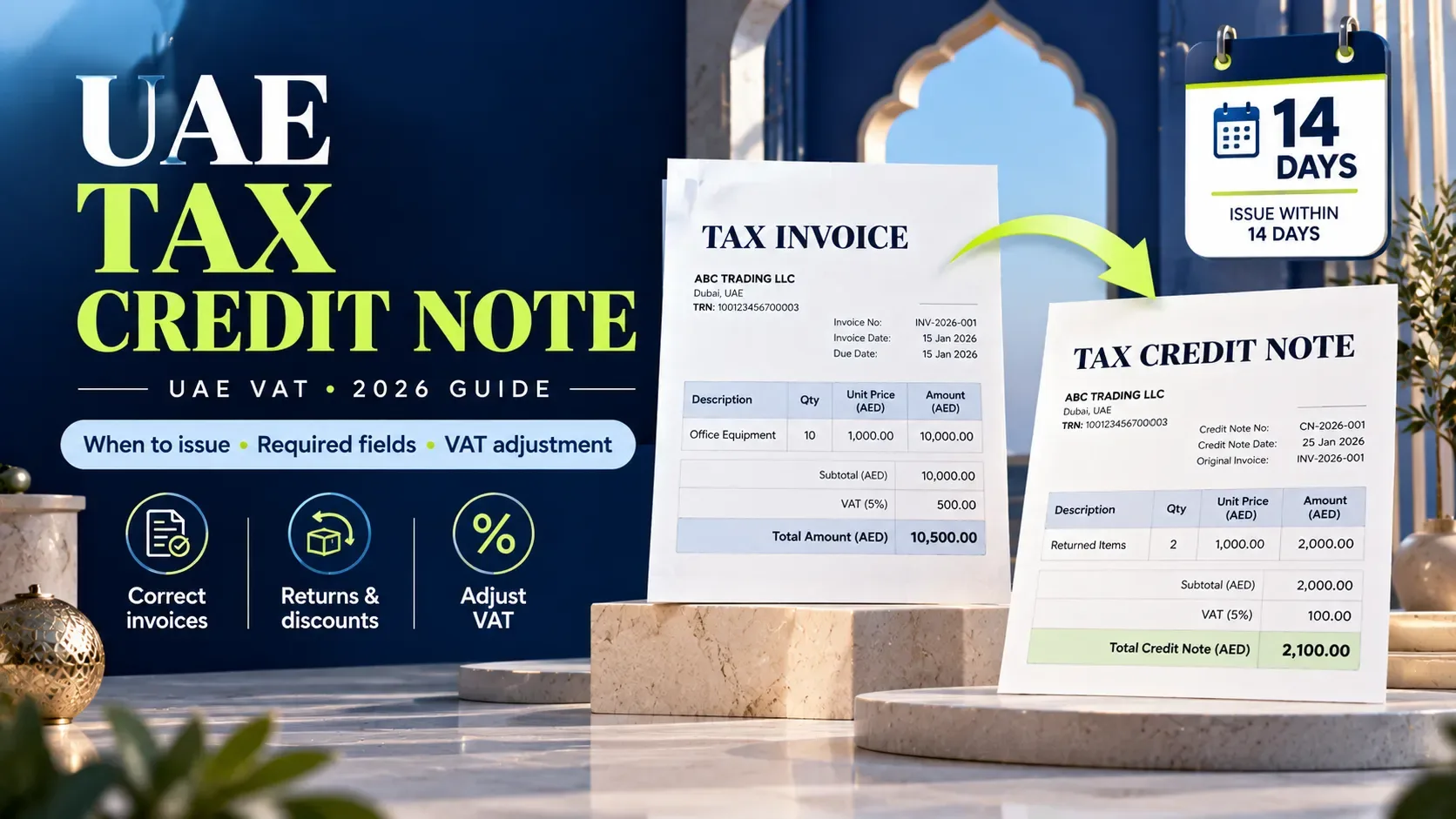
The supplier must generally issue the tax credit note within 14 days of the relevant adjustment event, under Article 62 of the UAE VAT Decree-Law.
3. How Does a Tax Credit Note Work? Example
Suppose a Dubai trading company sells products worth AED 10,000 plus 5% VAT.
The customer later returns goods worth AED 2,000.
The supplier issues a tax credit note for AED 2,000 plus AED 100 VAT.
Total credit note: AED 2,100.
This reduces the customer's outstanding amount or supports the appropriate refund and VAT adjustment.
4. What Details Must a UAE Tax Credit Note Contain?
Article 60 of the UAE VAT Executive Regulation prescribes the necessary information.
For multiple credit notes relating to the same invoice, businesses must use the correct remaining values under the amended regulations.
The FTA may grant specific administrative exceptions where the statutory conditions are satisfied.
5. What Is the Difference Between a Tax Invoice and a Credit Note?
A tax invoice records the original taxable transaction, while a tax credit note reduces the value or VAT previously charged.
If a correction increases the output VAT due, a new tax invoice may be required rather than a tax credit note.
6. How Does a Credit Note Affect VAT Returns?
Issuing a valid tax credit note may reduce the supplier's output VAT liability.
The customer may also need to adjust previously recovered input VAT.
For example, an AED 100 reduction in output VAT for the supplier can correspond to an AED 100 reduction in the customer's recoverable input VAT, assuming the customer originally recovered that amount.
Both parties should record the adjustment in the appropriate tax period and maintain supporting documents.
7. What Changes Under UAE E-Invoicing?
The UAE is introducing mandatory structured electronic invoicing from 2027.
For covered transactions, businesses must issue electronic credit notes through the prescribed PINT-AE framework and accredited service providers.
An emailed PDF alone will not satisfy the mandatory structured electronic credit note requirements.
Late issuance or transmission of an electronic credit note can attract AED 100 per note, capped at AED 5,000 per calendar month, under the applicable e-invoicing penalty rules.
Businesses should prepare their software to retain original invoice references and process adjustments correctly.
8. How Can Vinimay Help Manage Credit Note Records?
Proper records make invoice adjustments easier to identify and reconcile.
Vinimay offers general sales invoicing, customer accounts, purchase records, payment tracking and financial reporting features.
These functions can help businesses organise transactions and investigate returned goods, discounts or customer balance differences.
However, Vinimay's UAE tax credit note compliance, PINT-AE electronic credit note support, ASP integration and FTA reporting capabilities have not been independently verified. Businesses should confirm the required functions before using it for statutory compliance.
Frequently Asked Questions
Related Topics
Published by admin
Our editorial and compliance specialists create practical guides, tax calculation rules, and operational strategies to empower Indian small business owners and accountants.