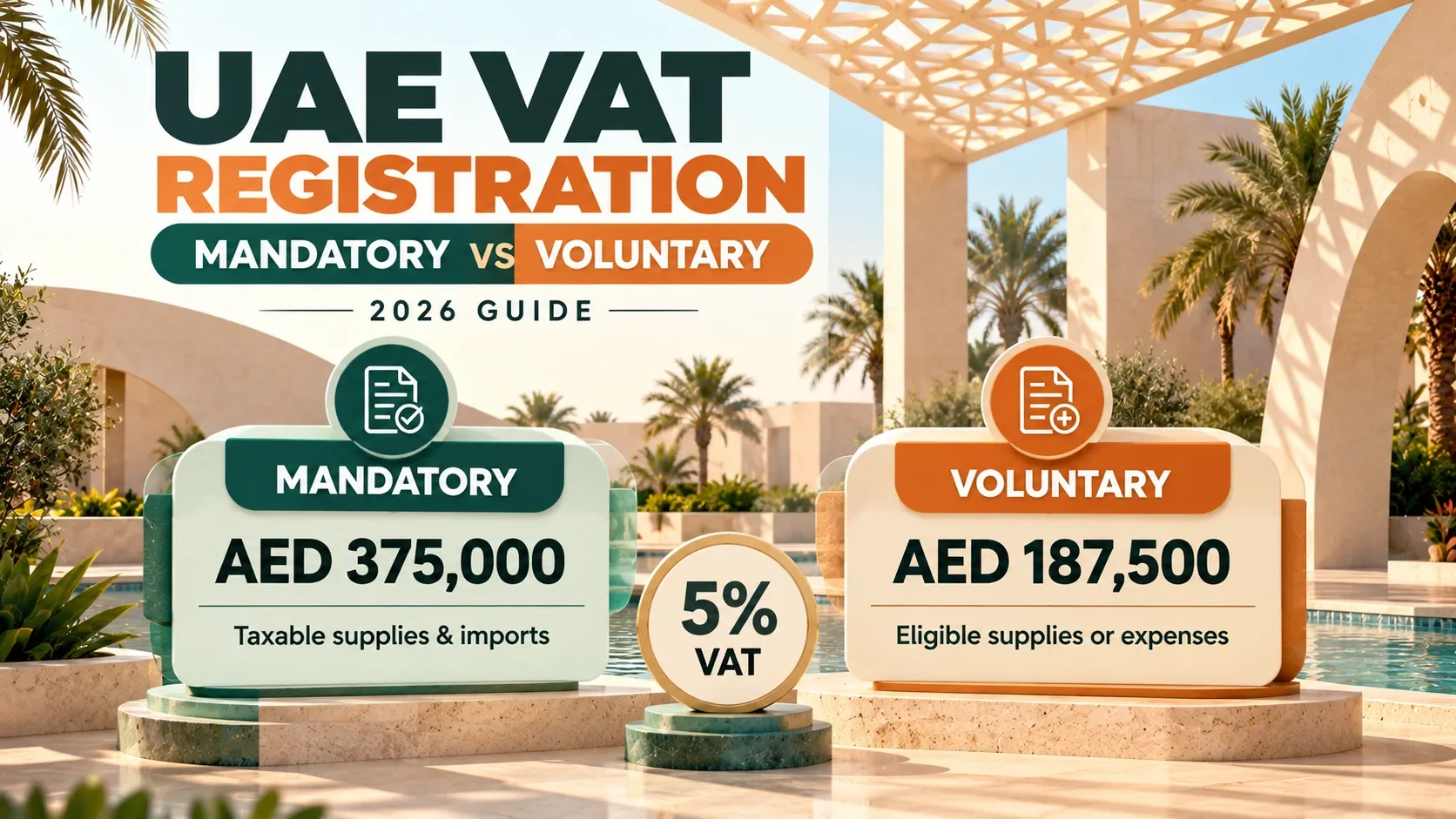
UAE VAT Registration: Mandatory vs Voluntary Rules 2026 Quick Answer: UAE VAT registration is mandatory when a resident business's taxable supplies and imports exceed AED 375,000 in the previous 12 months or are expected to exceed that amount in the next 30 days. Voluntary registration is available above AED 187,500, including qualifying taxable expenses.
Businesses operating in Dubai, Abu Dhabi and other Emirates must understand when Value Added Tax (VAT) registration becomes necessary.
The Federal Tax Authority (FTA) provides two registration categories: mandatory and voluntary. Both allow businesses to obtain a Tax Registration Number (TRN), but their eligibility conditions are different.
1. What Is Mandatory VAT Registration in the UAE?
Mandatory VAT registration is a legal requirement for businesses meeting the prescribed threshold.
A UAE-resident business must generally register when its taxable supplies and imports:
Exceed AED 375,000 during the previous 12 months; or
Are expected to exceed AED 375,000 during the next 30 days.
For example, a trading company recording AED 400,000 in taxable supplies over the preceding 12 months generally must register.
The business must submit its registration application within 30 days of becoming required to register.
Late registration can result in penalties and additional VAT liabilities.
2. What Is Voluntary VAT Registration?
Voluntary registration allows eligible businesses to register before reaching the mandatory threshold.
The voluntary threshold is AED 187,500.
A resident business may qualify when its taxable supplies and imports, or qualifying taxable expenses, exceed AED 187,500 during the preceding 12 months or are expected to exceed that amount in the next 30 days.
For example, a new company may have only AED 100,000 in sales but AED 220,000 in qualifying taxable business expenses.
It may qualify for voluntary registration, subject to FTA approval.
3. What Is the Difference Between Mandatory and Voluntary VAT Registration?
Once registered, both categories generally have the same VAT invoicing, recordkeeping and return-filing responsibilities.
4. Which Sales Count Towards the VAT Threshold?
Businesses should calculate taxable supplies and imports accurately.
Standard-rated and zero-rated supplies generally count towards the relevant threshold, while exempt supplies are not treated as taxable supplies.
For example:
In this simplified example, the taxable supplies exceed the mandatory threshold.
Businesses must also consider the correct treatment of imports and other transactions under UAE VAT law.
5. Is Voluntary VAT Registration Beneficial?
Voluntary registration may benefit businesses making substantial taxable purchases or dealing mainly with VAT-registered customers.
Its main advantage is the potential recovery of eligible input VAT.
For example, if a business purchases qualifying equipment for AED 100,000 plus AED 5,000 VAT, it may be able to recover the input VAT when the relevant conditions are satisfied.
However, registration also creates ongoing responsibilities, including charging applicable VAT, issuing compliant invoices and filing returns.
Businesses mainly selling to individual consumers should consider how VAT affects prices and profit margins.
6. How Can Businesses Register for VAT in the UAE?
VAT registration is available through the FTA's EmaraTax platform.
Follow these steps:
Visit the FTA website.
Create or access an EmaraTax account.
Create a Taxable Person Profile.
Select Register under Value Added Tax.
Enter business and ownership information.
Provide turnover details and supporting documents.
Submit the application for FTA review.
The FTA states that the application service is free, with an estimated processing time of 20 business days for completed applications.
Once approved, the business receives its VAT registration certificate and TRN.
7. Are Foreign Companies and Free Zone Businesses Covered?
Yes, but different rules may apply.
A non-resident business making taxable supplies in the UAE may be required to register regardless of the AED 375,000 threshold when no other party is responsible for accounting for the VAT.
Free Zone businesses are not automatically exempt from VAT registration.
Their obligations depend on their activities, supply arrangements and applicable VAT legislation.
Businesses making only zero-rated supplies may qualify for an exception from registration under specified conditions.
8. How Can Vinimay Help With VAT Registration Preparation?
Accurate accounting records help businesses monitor whether they are approaching the mandatory VAT threshold.
Vinimay offers general invoicing, sales tracking, purchase recording, customer management and financial reporting features.
These tools can help organise transaction information for turnover reviews, VAT registration preparation and discussions with accountants.
However, Vinimay's UAE-specific VAT compliance, FTA return filing, PINT-AE integration and mandatory e-invoicing capabilities have not been independently verified. Businesses should confirm these features before relying on the platform for statutory compliance.
Frequently Asked Questions
Related Topics
Published by admin
Our editorial and compliance specialists create practical guides, tax calculation rules, and operational strategies to empower Indian small business owners and accountants.