What Is Voluntary GST Registration in Singapore?
Quick Answer: Voluntary GST registration allows eligible Singapore businesses to register for GST even when they have not reached the compulsory S$1 million taxable turnover threshold. Registration enables eligible input tax claims but requires businesses to charge applicable GST, remain registered for at least two years and meet IRAS compliance conditions.
Voluntary GST registration can be useful for startups, small businesses, consultants and trading companies that incur GST on their business purchases.
However, registration is not automatically beneficial. The decision depends on customer types, taxable purchases, pricing and the costs of ongoing compliance.
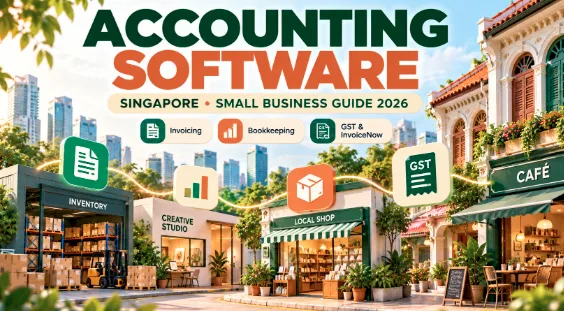
From 1 April 2026, new voluntary GST applicants must also meet Singapore's GST InvoiceNow Requirement, subject to applicable exclusions.
1. Who Can Register for GST Voluntarily in Singapore?
A business may apply for voluntary GST registration even if its taxable turnover does not exceed S$1 million.
IRAS allows applications from qualifying businesses that:
Make taxable supplies in Singapore.
Make certain out-of-scope supplies.
Make qualifying international financial services.
Import low-value goods or procure overseas services under applicable conditions.
Businesses intending to begin qualifying activities may also apply if they can demonstrate firm business plans.
For example, a newly established trading business expecting S$300,000 in annual taxable sales may apply voluntarily if it meets the eligibility conditions.
However, a business with no genuine commercial activity or sufficiently firm plans should not register merely to obtain a GST number.
2. What Are the Benefits of Voluntary GST Registration?
The primary benefit is the ability to claim eligible input GST incurred on business purchases.
For example, a GST-registered consultancy buying qualifying equipment for S$10,000 plus S$900 GST may be able to recover the S$900 as input tax.
Other potential benefits include easier GST management as the business approaches the compulsory threshold and the ability to issue GST tax invoices to business customers.
Potential Benefit | How It Helps |
|---|---|
Input GST recovery | Reduces the net cost of qualifying purchases |
Business-to-business invoicing | GST-registered customers may claim eligible input GST |
Preparation for growth | Avoids later transition if compulsory registration becomes necessary |
GST accounting procedures | Encourages structured tax and transaction records |
Input GST claims are subject to IRAS conditions. Registration does not mean every business expense qualifies.
3. What Are the Disadvantages of Voluntary Registration?
Voluntary registration creates continuing tax and administrative responsibilities.
Businesses must charge GST on standard-rated supplies, file returns, maintain records and meet the relevant InvoiceNow requirements.
For businesses mainly serving individual consumers, charging an additional 9% GST may make prices less competitive.
For example:
Particulars | Before Registration | After Registration |
|---|---|---|
Selling price excluding GST | S$100 | S$100 |
GST charged | S$0 | S$9 |
Customer pays | S$100 | S$109 |
If a business cannot increase the customer-facing price, it may need to absorb GST within its existing selling price, reducing its revenue excluding GST.
For this reason, businesses should evaluate the financial effect over at least two years.
4. What Conditions Apply to Voluntary GST Registration?
IRAS imposes conditions on eligible voluntary GST registrants.
Important requirements generally include:
Remaining registered for at least two years.
Completing the prescribed GST e-learning course and quiz unless exempt.
Arranging GIRO for GST payments and refunds.
Maintaining accurate accounting records.
Filing GST returns within the required deadlines.
Complying with the applicable GST InvoiceNow Requirement.
The two-year minimum commitment is especially important.
A business cannot simply deregister immediately because voluntary registration becomes inconvenient or unprofitable.
Non-compliance with applicable registration conditions may result in IRAS cancelling the registration.
5. Is InvoiceNow Mandatory for Voluntary GST Registrants in 2026?
Yes. From 1 April 2026, businesses applying for voluntary GST registration generally must adopt GST InvoiceNow regardless of business structure or incorporation date, subject to specific exclusions.
GST InvoiceNow uses Singapore's Peppol-based network to submit prescribed invoice information to IRAS.
Businesses should:
Check whether their accounting system is InvoiceNow-Ready.
Select a suitable IMDA-accredited solution provider.
Complete the necessary registration and verification.
Activate the required GST data submission functionality.
Test their invoice processing and reporting procedures.
InvoiceNow does not replace GST F5 return filing.
6. How Can Businesses Apply for Voluntary GST Registration?
Applications are generally submitted through the IRAS myTax Portal.
The process involves:
Review voluntary registration eligibility.
Complete the GST e-learning course where required.
Prepare financial records and evidence of business activities.
Log in to IRAS myTax Portal.
Select the GST registration service.
Choose voluntary registration and complete the form.
Upload the required documents.
Complete applicable GIRO and InvoiceNow arrangements.
Submit the application and respond to IRAS requests.
Once the application is approved, IRAS notifies the business of its effective GST registration date.
A business must not begin charging GST before that date.
7. When Does Voluntary GST Registration Make Financial Sense?
Voluntary registration may make sense when a business incurs substantial eligible GST on purchases and mainly sells to GST-registered customers.
It may be less attractive for businesses with limited claimable input tax and predominantly consumer customers.
Consider two illustrative situations:
Business Profile | Key Consideration |
|---|---|
B2B consultancy with substantial taxable business purchases | Eligible input GST recovery may be valuable |
Consumer-focused retailer with limited taxable purchases | Additional GST may affect pricing or margins |
The correct decision depends on both the potential tax recovery and the additional administrative burden.
Businesses should estimate expected output GST, eligible input GST and compliance costs before applying.
8. What Happens After Voluntary GST Registration?
Once registered, a business becomes responsible for complying with the applicable Singapore GST rules.
It must generally charge 9% GST on standard-rated local supplies, issue tax invoices where required, retain records and submit GST returns.
Most GST-registered businesses file returns quarterly, with filing and payment generally due one month after the accounting period ends.
Accounting platforms such as Vinimay offer general sales invoicing, purchase records, customer management and accounting reports that can help organise transactions.
However, Vinimay's Singapore GST and InvoiceNow compliance capabilities have not been independently verified. Businesses should confirm regulatory compatibility before using any software for statutory reporting.
The key takeaway: Voluntary GST registration should be a financial decision based on customer pricing, potential input tax recovery and the business's ability to meet ongoing compliance obligations.
Related Topics
Published by Satyam mahajan
Our editorial and compliance specialists create practical guides, tax calculation rules, and operational strategies to empower Indian small business owners and accountants.