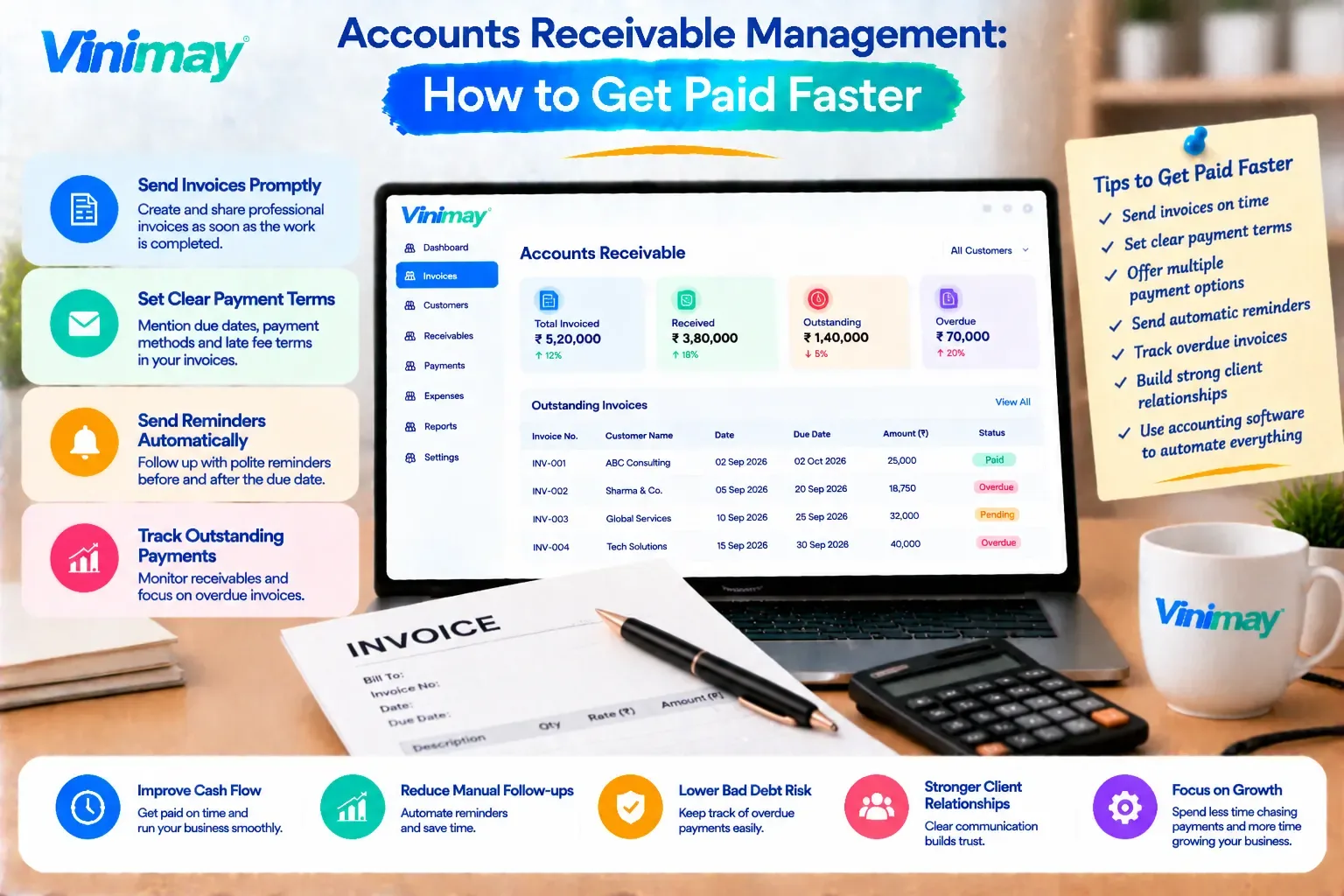
Accounts Receivable Management: How to Get Paid Faster
Getting paid faster is often treated as a matter of being firmer with customers — stronger reminders, less patience, more pressure. That approach helps occasionally, but it misses the bigger lever: how receivables are organised and reviewed in the first place. A business that manages receivables as a system collects money faster than one that manages it as a series of individual follow-ups.
Accounts receivable management means treating every outstanding amount as part of one organised, reviewable picture — sorted by how overdue it is, prioritised by size and risk, and followed up on a consistent schedule — rather than reacting to each unpaid invoice as it happens to come to mind. This shift, from reactive chasing to systematic management, is usually what actually shortens a collection cycle.
This guide walks through the specific steps that make up real receivables management, distinct from simply sending reminders when you remember to.
Why "Chasing Payments" Isn't the Same as Managing Receivables
Chasing a payment is a single, reactive action — you notice an invoice is late, and you follow up. Managing receivables is a standing system: every invoice has a status, every status is reviewed on a schedule, and follow-up happens based on that schedule rather than memory. The difference matters because chasing catches whatever you happen to notice; a system catches everything, including the amounts you'd otherwise forget about until they're seriously overdue.
Step 1: Age Your Receivables
Sort every outstanding invoice by how many days it's been unpaid
Group them into simple bands — current, 1-30 days overdue, 31-60 days, 60+ days
This single step reveals which amounts are still fresh and which are becoming a real risk
Without this grouping, a ₹5,000 invoice from last week and a ₹5,000 invoicefrom three months ago look identical on a flat list
Step 2: Prioritise by Amount and Age Together
A large amount that's slightly overdue may deserve more urgent attention than a small amount that's very overdue
A small amount that's very overdue, on the other hand, often signals a customer relationship problem worth addressing directly
Reviewing both dimensions together — not just one — gives a clearer sense of where to focus first
This prevents the common trap of chasing whichever invoice happens to be top of mind, rather than the one that actually matters most
Step 3: Standardise Your Follow-Up Cadence
Set a fixed schedule for follow-up based on aging band — for example, a gentle reminder at 7 days overdue, a firmer one at 30 days, and a call at 60 days
Apply this consistently to every customer, rather than deciding case by case
Consistency removes the emotional friction of deciding "should I follow up on this one yet?" every single time
It also sets a clear, predictable expectation for customers about how your business handles payment timing
Step 4: Make Payment Genuinely Easy
Every extra step between a customer deciding to pay and completing payment increases the chance of delay
State the payment method clearly on every invoice and reminder
Offer a method that matches how your specific customers actually prefer to pay
Removing friction at this stage often speeds up payment more than a firmer reminder does
Step 5: Review Receivables as a Regular Habit, Not a Crisis Response
Set a fixed time weekly to review the full aging picture, not just react when cash feels tight
A regular review catches emerging problems while they're still small and easy to address
Waiting until cash flow becomes visibly strained means addressing several overdue accounts at once, under pressure
A consistent weekly rhythm turnsreceivables managementinto routine maintenance rather than periodic firefighting
An Aging-Based Action Table
How Vinimay Supports This Process
Vinimay's payment trackingshows the outstanding balance on every invoice, linked directly to the transaction it belongs to, which gives you the accurate foundation this entire process depends on. Because every invoice carries its own status, reviewing your full receivables picture — rather than cross-referencing separate records — becomes a matter of checking one connected view.
To see this directly, Vinimay's free invoice tool lets you generate up to 5 GST invoices free, each with its own trackable payment status from the moment it's created.
Conclusion
Getting paid faster comes down to treating accounts receivable as an organised, regularly reviewed system rather than a series of reactive follow-ups — ageing every outstanding invoice, prioritising by amount and overdue period together, following a consistent reminder cadence, and reducing friction at the point of payment.
Vinimay'spayment tracking gives every invoice a trackable status from the moment it's created, providing the accurate foundation this entire system depends on.
Frequently Asked Questions
1. What's the difference between chasing payments and managing receivables?
Chasing is reactive, based on what you happen to notice; managing receivables is a standing system that reviews every outstanding amount on a schedule.
2. What does "aging" receivables actually mean?
It means grouping outstanding invoices by how long they've been unpaid, so older and newer amounts are treated differently.
3. Should I prioritise the largest overdue amount first?
Not always — consider both amount and how overdue it is together, since a smaller, very overdue amount often signals a different kind of problem.
4. How often should receivables be reviewed?
Weekly is a practical rhythm, so issues are caught early rather than discovered during a cash flow crunch.
5. Does making payment easier actually speed up collection?
Yes, reducing friction at the point of payment often has more impact than firmer reminders alone.
6. Does Vinimay track how overdue each invoice is?
Vinimay tracks outstanding balances against each invoice, giving you the data needed to age and prioritise receivables.
7. Should follow-up tone change based on how overdue a payment is?
Yes, a light reminder suits recent overdue amounts, while significantly overdue ones warrant a firmer, more direct approach.
8. How many free invoices can I test on Vinimay to see payment tracking?
Vinimay's free invoice tool allows up to 5 GST invoices free, each with trackable payment status.
Related Topics
Published by Team Vinimay
Our editorial and compliance specialists create practical guides, tax calculation rules, and operational strategies to empower Indian small business owners and accountants.