What to Look for in Billing and Invoicing Software for the Service Industry
Retail billing follows a simple, repeatable pattern: a customer picks items, pays, and gets a bill — all in one moment. Service industry billing rarely works this cleanly. A consultant might quote a project, receive an advance, complete the work over weeks, and invoice a final balance only once it's done. This stretched-out timeline is the core difference that shapes everything else in this guide.
Invoicing software built primarily around instant, item-based retail transactions often struggles to fit this pattern naturally, because it assumes billing and delivery happen at the same moment. A retail invoice tool expects one clean transaction; a service engagement often needs several connected documents spread across weeks or months.
Billing and invoicing software for the service industry needs to specifically handle timing flexibility, advance and milestone payments, pre-work quotations, and description-heavy line items — none of which map cleanly onto a simple "item, quantity, price" retail invoice structure. This guide walks through exactly what to check for, rather than assuming a generic invoicing tool automatically fits.
What This Actually Means for the Software You Choose
A retail sale and a service engagement follow completely different timelines, and that difference should directly shape how you evaluate software. Retail billing happens at a single point — the moment of purchase, with one invoice closing the transaction. Service billing can be spread across several distinct moments instead, and each of those moments typically needs its own document or record.
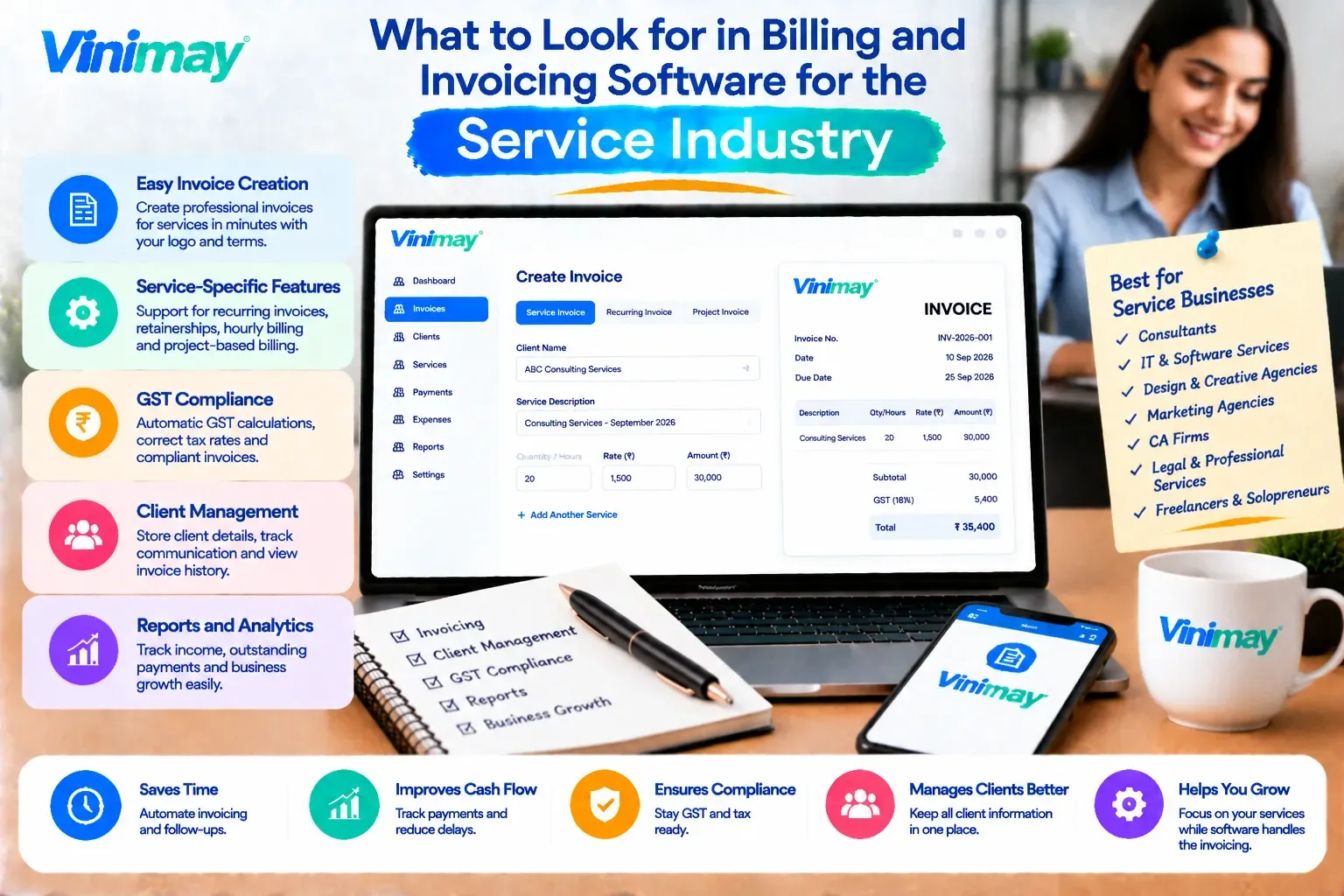
This is why a feature checklist built for retail businesses often misses what actually matters here — the individual features below aren't optional extras for a service business, they're the core requirements.
Invoice Timing: Before, During or After the Work
Service invoicing often needs to happen at more than one point in a single engagement
A quotation may be needed before starting, to agree on scope and price
An interim invoice may be needed during a longer project, to bill for progress
A final invoice is needed on completion, closing out the engagement
Software limited to one invoice per transaction forces awkward workarounds for anything beyond a simple, immediate service
Handling Advance Payments and Milestones
It's common in service work to collect a portion of payment upfront and the remainder later
Some engagements bill in stages tied to specific project milestones
Software needs to track these partial amounts against the same overall engagement
The outstanding balance should stay accurate automatically, not require manual recalculation
Treating each partial payment as a separate, unrelated transaction makes the client relationship harder to follow
Quotation and Estimate Documents Before the Final Bill
Many service providers need to send a formal quotation or estimate before committing to work
This is typically a proforma-style document, not a tax invoice
It sets expectations on price and scope upfront
Software that only generates final tax invoices misses this earlier, equally important step
Without it, price agreements often happen informally, which can lead to disputes later
Formatting for Description-Heavy Line Items
A retail line item is short — a product name, quantity, and price
A service line item is often a fuller description of the actual work performed
Example: "Website redesign, phase 2: homepage and product pages"
This needs more space and flexibility than a rigid, product-style row typically allows
Software should let a single line item carry a proper description, not just a short label
Tracking Partial Settlements on a Single Invoice
Clients often pay part of an invoice now and the rest later
The software should show both the original amount and the remaining balance clearly
This should happen on the same invoice record, not through a workaround
A common workaround is creating a second, separate invoice for the same engagement — which is confusing and error-prone
Proper partial-settlement tracking keeps one clean record per engagement
A Comparison: Retail Billing vs Service Industry Billing
Where Vinimay Fits Service Industry Invoicing
Vinimay supports proforma invoices for the quotation stage before work begins
GST is applied correctly on the final invoice using the appropriate tax classification
Payment tracking shows amounts received against what's still outstanding on any invoice
This directly supports advance-and-balance billing patterns common in service work
Customer records are saved for reuse across an ongoing engagement, avoiding repeated manual entry
To see how this fits a service-style billing pattern, Vinimay's free tool lets you generate up to 5 GST invoices free.
Conclusion
Billing and invoicing software for the service industry needs to handle a stretched timeline — quotations before work starts, advance and milestone payments during the engagement, and a final invoice on completion — rather than the single-point retail transaction most generic invoicing tools are built around.
Vinimay supports this pattern through proforma invoices, GST-correct final billing, and payment tracking that keeps advance-and-balance amounts clear on the same record.
Frequently Asked Questions
1. Why doesn't standard retail invoicing software work well for service businesses?
Because service billing often spans multiple stages — quote, advance, delivery, final invoice — that a single-point-of-sale retail structure doesn't naturally accommodate.
2. Do service businesses need a separate quotation document before invoicing?
Often yes, particularly for project-based work where scope and price need to be agreed before starting.
3. Can invoicing software handle an advance payment and a later balance on the same job?
Good invoicing software should track both as part of the same engagement, showing what's paid and what's still due.
4. Does Vinimay support quotations before a final invoice?
Yes, Vinimay includes proforma invoices for quoting work before the final GST invoice is issued.
5. What's the difference between HSN and SAC codes for invoicing?
HSN codes classify physical goods; SAC codes classify services—software should apply the correct one based on what's being billed.
6. How does Vinimay track partial payments on service invoices?
Vinimay's payment tracking shows the amount received against the total invoiced, keeping the outstanding balance visible.
7. How many free invoices can I test with Vinimay for service billing?
Vinimay's free invoice tool allows up to 5 GST invoices free, downloadable as PDF.
8. What's the biggest invoicing gap service businesses run into with generic tools?
The lack of support for pre-work quotations and staged or partial payments tied to a single ongoing engagement.
Related Topics
Published by Team Vinimay
Our editorial and compliance specialists create practical guides, tax calculation rules, and operational strategies to empower Indian small business owners and accountants.