A consultant, a salon, and a repair technician all fall under "service business," yet none of them sell physical stock the way a retail shop does—which raises a fair question: does billing software, often built with product-based businesses in mind, actually serve service businesses well, or does it force an awkward fit?
Yes, service businesses can absolutely use billing software effectively—in fact, several of the features that matter most for product-based businesses, like inventory tracking, become irrelevant for services, while other features, like flexible invoicing and payment tracking, matter just as much or more. The fit isn't worse for service businesses; it's simply different in what actually gets used.
What Changes for a Service Business Specifically
Unlike a retail sale, a service transaction often doesn't happen in one clean moment—a consultant might quote a project, receive a partial payment, and bill the balance only once the work is delivered. Billing software needs to accommodate this stretched timeline rather than assuming an instant, single-point transaction.
What Actually Matters for Service Billing
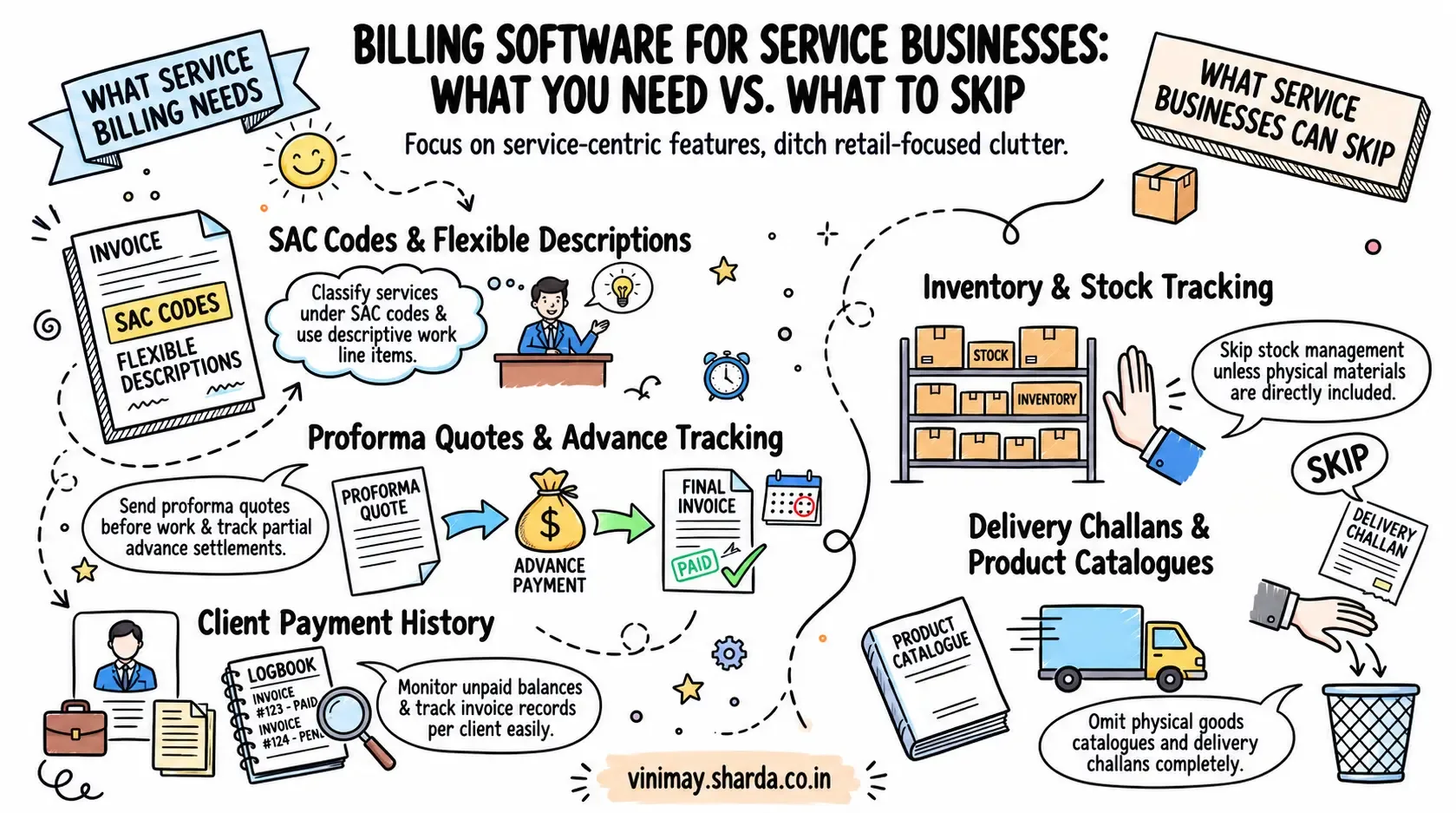
Flexible line items that describe work performed, not just a product name and quantity
Correct GST classification under SAC codes, distinct from the HSN codes used for goods
Support for proforma invoices or quotations before final billing
Payment tracking that handles advances and partial settlements cleanly
What Service Businesses Can Safely Ignore
Inventory or stock management, unless physical materials are part of the service
Product catalogue features built around goods rather than described work
Delivery-related documents like delivery challans, which apply to goods movement, not services
A Quick Self-Check for Service Businesses
Where Vinimay Fits Service Businesses
Vinimay applies correct GST handling for services, supports proforma invoices for quoting work before it begins, and tracks payments against invoices—directly useful for the advance-and-balance pattern common in service billing. Inventory features exist within Vinimay for businesses that need them, but service businesses can simply not use that part of the system without it getting in the way.
Frequently Asked Questions
Q1. Do service businesses need inventory management features?
Generally no, unless physical materials are directly part of the service being billed.
Q2. What's different about GST for service businesses versus retail?
Services are classified under SAC codes rather than the HSN codes used for physical goods.
Q3. Can service billing software handle advance payments?
Good billing software should track partial payments against a specific invoice, which matters significantly for service work.
Q4. Does Vinimay support quotations before a final service invoice?
Yes, through proforma invoices, which can inform the final GST invoice once work is confirmed.
Q5. Is billing software overkill for a small service business?
Not usually—even a solo consultant benefits from organized, GST-correct invoicing and payment tracking.
Q6. How many free invoices can a service business test with Vinimay?
Up to 5 GST invoices are free, with proforma invoice support for the quotation stage.
Q7. Can service businesses track customer-wise invoices and payments?
Yes, customer-wise records can help service providers review invoices, payment history, outstanding amounts, and previous transactions for each client.
Q8. Can service businesses create recurring invoices for regular clients?
Depending on the software, recurring billing features can help businesses manage regular service charges and reduce the need to create similar invoices manually.
Q9. Can billing software help service businesses track outstanding payments?
Yes, payment tracking can help identify unpaid or partially paid invoices and make it easier to follow up with clients.
Q10. Can service businesses maintain expense records along with invoices?
Yes, accounting software that includes expense tracking can help service providers record business expenses alongside their sales and payment records.
Generally no, unless physical materials are directly part of the service being billed.
Services are classified under SAC codes rather than the HSN codes used for physical goods.
Good billing software should track partial payments against a specific invoice, which matters significantly for service work.
Yes, through proforma invoices, which can inform the final GST invoice once work is confirmed.
Not usually—even a solo consultant benefits from organized, GST-correct invoicing and payment tracking.
Up to 5 GST invoices are free, with proforma invoice support for the quotation stage.
Yes, customer-wise records can help service providers review invoices, payment history, outstanding amounts, and previous transactions for each client.
Depending on the software, recurring billing features can help businesses manage regular service charges and reduce the need to create similar invoices manually.
Yes, payment tracking can help identify unpaid or partially paid invoices and make it easier to follow up with clients.
Yes, accounting software that includes expense tracking can help service providers record business expenses alongside their sales and payment records.
Related Topics
Published by Team Vinimay
Our editorial and compliance specialists create practical guides, tax calculation rules, and operational strategies to empower Indian small business owners and accountants.