What Should a Delivery Challan Include?
A delivery challan that's missing key details can cause real problems during transit — goods arriving without a clear indication of where they came from, why they're moving, or what exactly should be inside the shipment. Since a challan isn't a sale document, it doesn't automatically get the same scrutiny a tax invoice does, which is exactly why it's easy to prepare one that's technically fine but practically incomplete.
Knowing precisely what fields a challan should contain removes the guesswork every time goods move, whether that's to a customer for approval, between branches, or out for job work. This article lays out the core fields, the extra details specific situations call for, and the common gaps that create confusion later.
The Core Fields Every Delivery Challan Needs
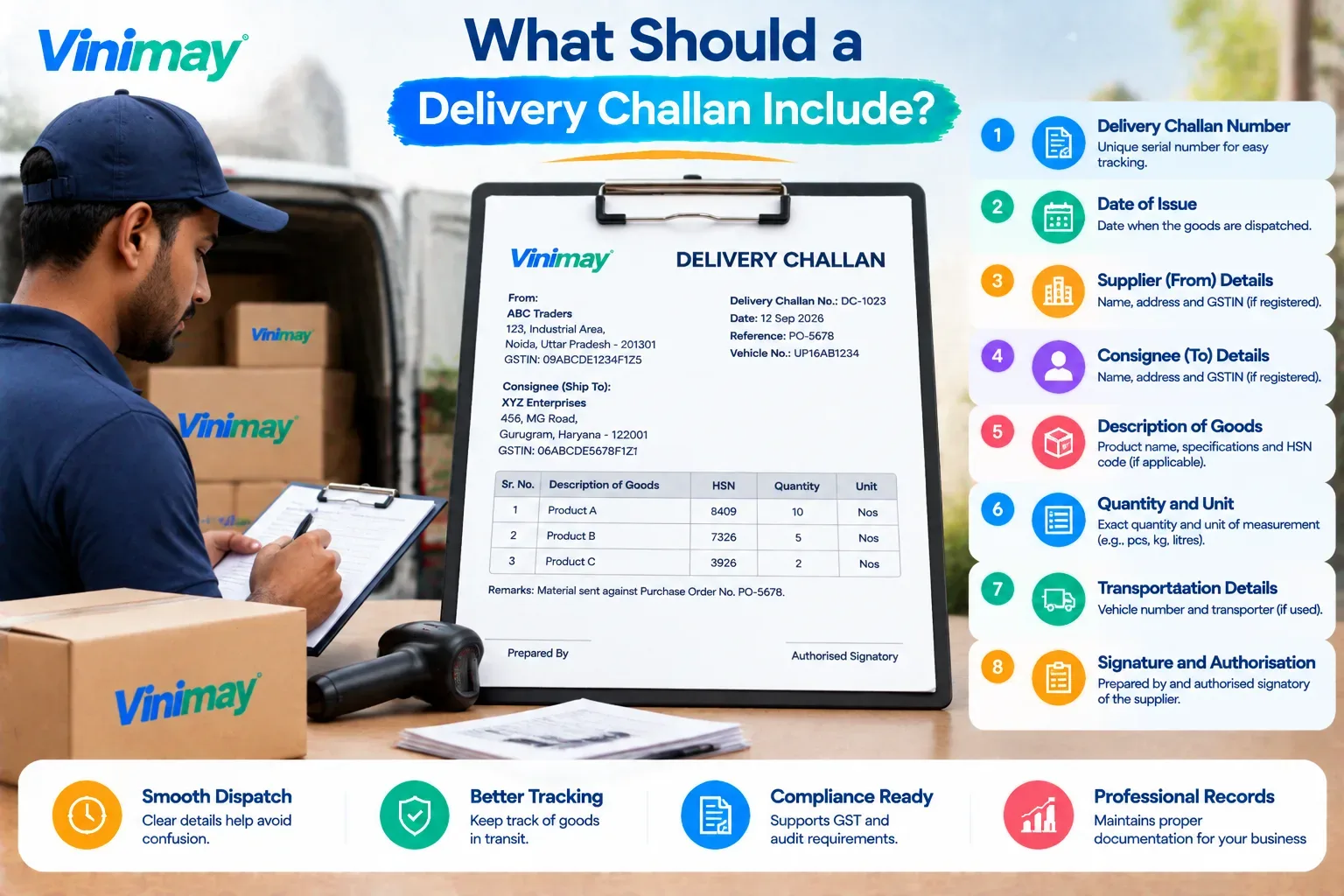
A complete delivery challan needs two layers of information: header details identifying the transaction, and item-level details describing what's actually moving.
Header-level fields:
Item-level fields, listed for each product being moved:
Item name or description
Quantity being moved
Unit of measurement (pieces, kg, boxes)
Any relevant batch or reference number, if the item requires tracking
Both layers matter—a challan with complete header details but vague item quantities is just as incomplete as one with clear items but no stated reason for movement.
Additional Details Depending on the Reason for Movement
The core fields stay constant, but a few situations call for extra detail:
Job work or processing — an expected return date or processing details should be noted
Inter-branch transfer — both locations should be clearly marked as sender and recipient, since both belong to the same business
Goods sent for approval — a note indicating the customer hasn't committed to purchase yet
Returnable equipment or samples — a note distinguishing it from goods being permanently transferred
Common Omissions That Cause Confusion Later
The reason for movement is left out entirely, leaving it unclear whether this is a sale, a transfer, or something else
No unit is specified at the item level, causing ambiguity about whether "10" means pieces, boxes, or kilograms
No expected return note is added for job work or sample items, making it hard to track what should come back
Sender or recipient addresses are illegible or missing, which becomes a real problem if the challan needs to be verified in transit
A Clear Answer for Vinimay Users
Vinimay generates delivery challans as part of its confirmed features, structured to capture item details, quantities, and the relevant sender and recipient information as a distinct document type from a tax invoice, so goods movement can be documented clearly without being mistaken for a completed sale.
Conclusion
A complete delivery challan isn't complicated, but it does require a specific, consistent set ofdetails—sender and recipient information, item quantities and units, and a clear reason for movement—to actually serve its purpose during transit.
Missing even one of these fields can turn a routine goods movement into a confusing or disputed one, which is why treating the challan with the same care as a tax invoice, despite it not representing a sale, avoids unnecessary friction.
FAQs
1. Is a delivery challan legally required for every instance of moving goods?
A delivery challan is generally expected whenever goods move without an accompanying tax invoice, such as for approval, job work, or inter-branch transfer, so it's good practice to issue one for any such movement.
2. Does a delivery challan need to show the value of the goods?
Depending on the reason for movement, a value may be shown for reference, but a challan generally doesn't represent a sale, so it isn't treated as a demand for payment the way a tax invoice is.
3. What's the difference between a challan for job work versus one for inter-branch transfer?
A job work challan typically includes a note on expected return or processing, while an inter-branch transfer challan simply documents movement between two locations of the same business, without any expectation of goods returning.
4. Should vehicle details always be included on a delivery challan?
Vehicle or transport details are useful, especially for larger shipments or when goods might be checked in transit, though they may not be strictly necessary for very short, local movements.
5. What happens if a delivery challan doesn't clearly state the reason for movement?
Without a clear reason stated, it can create confusion about whether the movement represents a sale or something else, which may cause complications if the shipment is questioned or reviewed.
Related Topics
Published by Team Vinimay
Our editorial and compliance specialists create practical guides, tax calculation rules, and operational strategies to empower Indian small business owners and accountants.