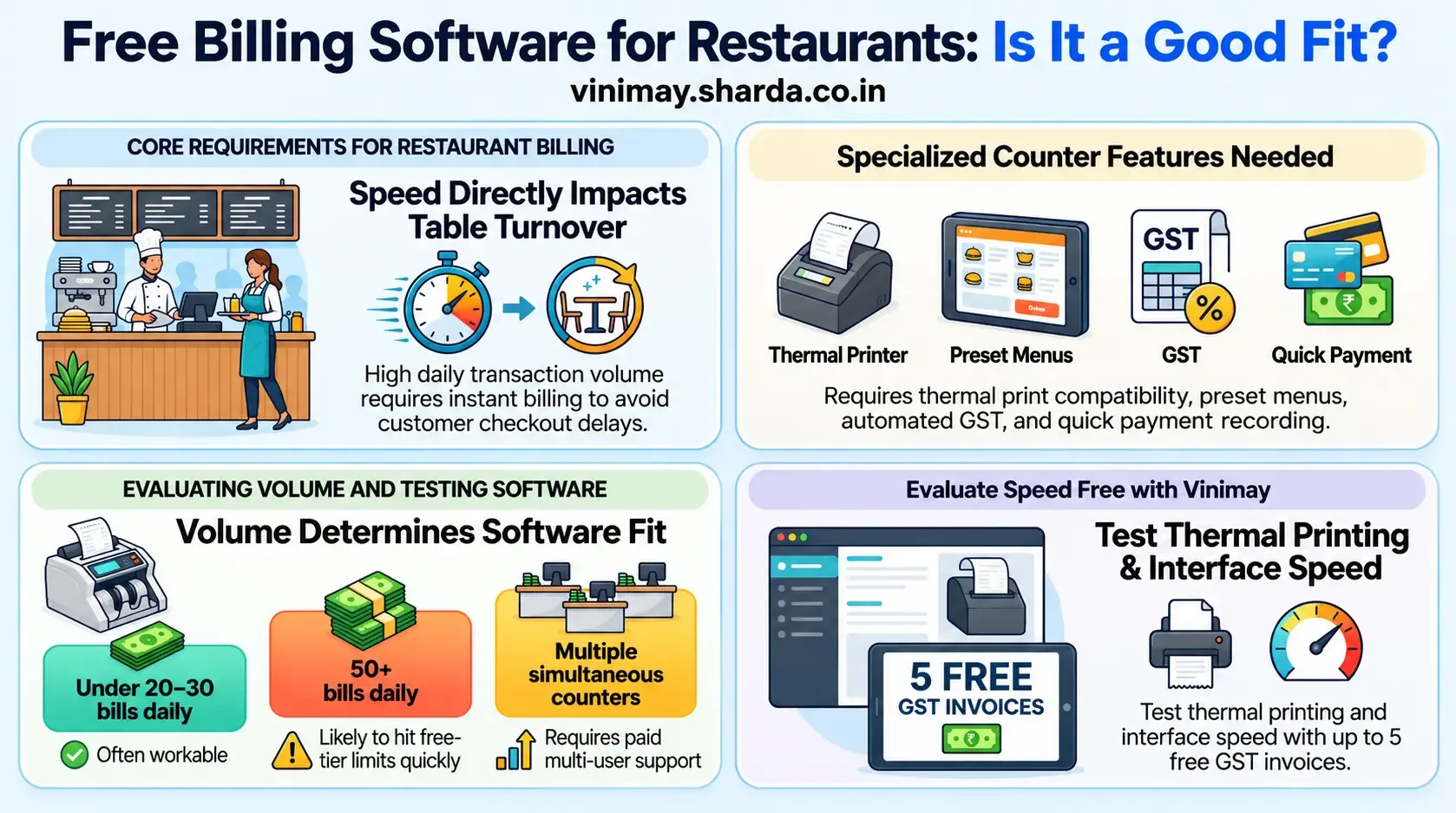
A restaurant's billing pattern looks nothing like a typical B2B business—dozens of small, quick transactions daily, often with immediate payment, and a heavy dependence on speed at the point of sale rather than detailed invoicing. Whether free billing software fits this specific rhythm is a genuinely different question than whether it fits a consultant or wholesaler. Yes, restaurants can use free billing software, particularly for straightforward GST-compliant billing at the point of sale, though the fit depends heavily on whether the free tier supports the specific volume and speed a restaurant needs, since restaurant billing patterns differ significantly from lower-frequency, higher-value transactions in other business types.
For restaurants, the practical requirements often go beyond simply generating an invoice. Fast bill creation, easy item selection, accurate GST calculations, thermal printing, payment recording, and clear daily sales reports can make a significant difference during busy hours. A restaurant should also check whether the software can handle menu items, different tax rates where applicable, discounts, cancellations, and multiple payment methods without slowing down the billing counter.
For a small restaurant with a manageable number of daily transactions, free billing software may be sufficient to get started. However, as order volume increases, businesses may need to consider features such as multiple users or counters, table management, kitchen order management, detailed inventory, integrations, and advanced reporting.
What Makes Restaurant Billing Different
High transaction frequency—potentially dozens or hundreds of bills daily
Immediate, full payment at the point of sale, rather than extended payment terms
A need for genuinely fast bill generation, since a slow billing process directly affects table turnover
Simple line items (food and beverage), rather than complex, description-heavy services
Where Free Software Fits This Well
For a smaller restaurant or cafe with moderate daily transaction volume, free billing software can genuinely work—quick GST invoice creation, a simple menu-based product list, and immediate PDF or print output cover the core need without requiring a paid, restaurant-specific point-of-sale system.
Where Volume Becomes the Deciding Factor
The Speed Factor Restaurants Can't Compromise On
Unlike many other business types, a restaurant genuinely cannot tolerate a slow billing process—a customer waiting for their bill directly affects table availability and customer experience. This makes interface speed and simplicity, not just cost, a real evaluation factor for restaurants specifically.
What Restaurants Should Verify Beyond Cost
Can the software generate a bill in seconds, not minutes, for a simple order?
Does it support the print format your existing printer uses (thermal, typically)?
Can it handle your typical daily volume without hitting a monthly cap too quickly?
Where Vinimay Fits Restaurant Billing
Vinimay supports GST-compliant invoicing with thermal print format compatibility, suited to counter-style, fast billing environments like restaurants and cafes. For a smaller restaurant testing this fit, Vinimay's free invoice tool allows up to 5 GST invoices to be free to evaluate speed and format before committing further.
Frequently Asked Questions
Q1. Is free billing software fast enough for a busy restaurant?
This depends on the specific tool's interface speed—testing with real, quick transactions is the best way to verify.
Q2. Does restaurant billing need different features than other businesses?
Yes, speed and print format (often thermal) matter more than detailed invoicing features restaurants rarely use.
Q3. What volume typically pushes a restaurant beyond free software?
Once daily billing regularly approaches or exceeds free-tier invoice caps, usually somewhere around 30-50 bills a day depending on the specific limit.
Q4. Does Vinimay support thermal printing for restaurant bills?
Yes, Vinimay supports thermal print formats suited to counter-style billing.
Q5. Can multiple restaurant counters bill simultaneously on free software?
This typically requires multi-user support, which is more commonly a paid-tier feature.
Q6. How many free invoices can a restaurant test with Vinimay?
Up to 5 GST invoices are free, useful for evaluating speed and format fit.
Q7. Can restaurant billing software manage different food items and prices?
Yes, restaurant billing software can maintain item-wise menus, prices, applicable taxes, and billing details, making counter billing easier to manage.
Q8. Can restaurant software track daily sales?
Yes, sales reports can help restaurant owners review daily transactions, total sales, and payment collections for better business monitoring.
Q9. Can restaurant billing software support different payment methods?
Yes, depending on the software, restaurants can record payments through methods such as cash, UPI, cards, and other available payment modes.
Q10. Can restaurant billing software help reduce billing errors?
Yes, automated calculations and predefined product, tax, and pricing details can reduce manual entry and calculation errors during busy billing hours.
This depends on the specific tool's interface speed—testing with real, quick transactions is the best way to verify.
Yes, speed and print format (often thermal) matter more than detailed invoicing features restaurants rarely use.
Once daily billing regularly approaches or exceeds free-tier invoice caps, usually somewhere around 30-50 bills a day depending on the specific limit.
Yes, Vinimay supports thermal print formats suited to counter-style billing.
This typically requires multi-user support, which is more commonly a paid-tier feature.
Up to 5 GST invoices are free, useful for evaluating speed and format fit.
Yes, restaurant billing software can maintain item-wise menus, prices, applicable taxes, and billing details, making counter billing easier to manage.
Yes, sales reports can help restaurant owners review daily transactions, total sales, and payment collections for better business monitoring.
Yes, depending on the software, restaurants can record payments through methods such as cash, UPI, cards, and other available payment modes.
Yes, automated calculations and predefined product, tax, and pricing details can reduce manual entry and calculation errors during busy billing hours.
Related Topics
Published by Team Vinimay
Our editorial and compliance specialists create practical guides, tax calculation rules, and operational strategies to empower Indian small business owners and accountants.