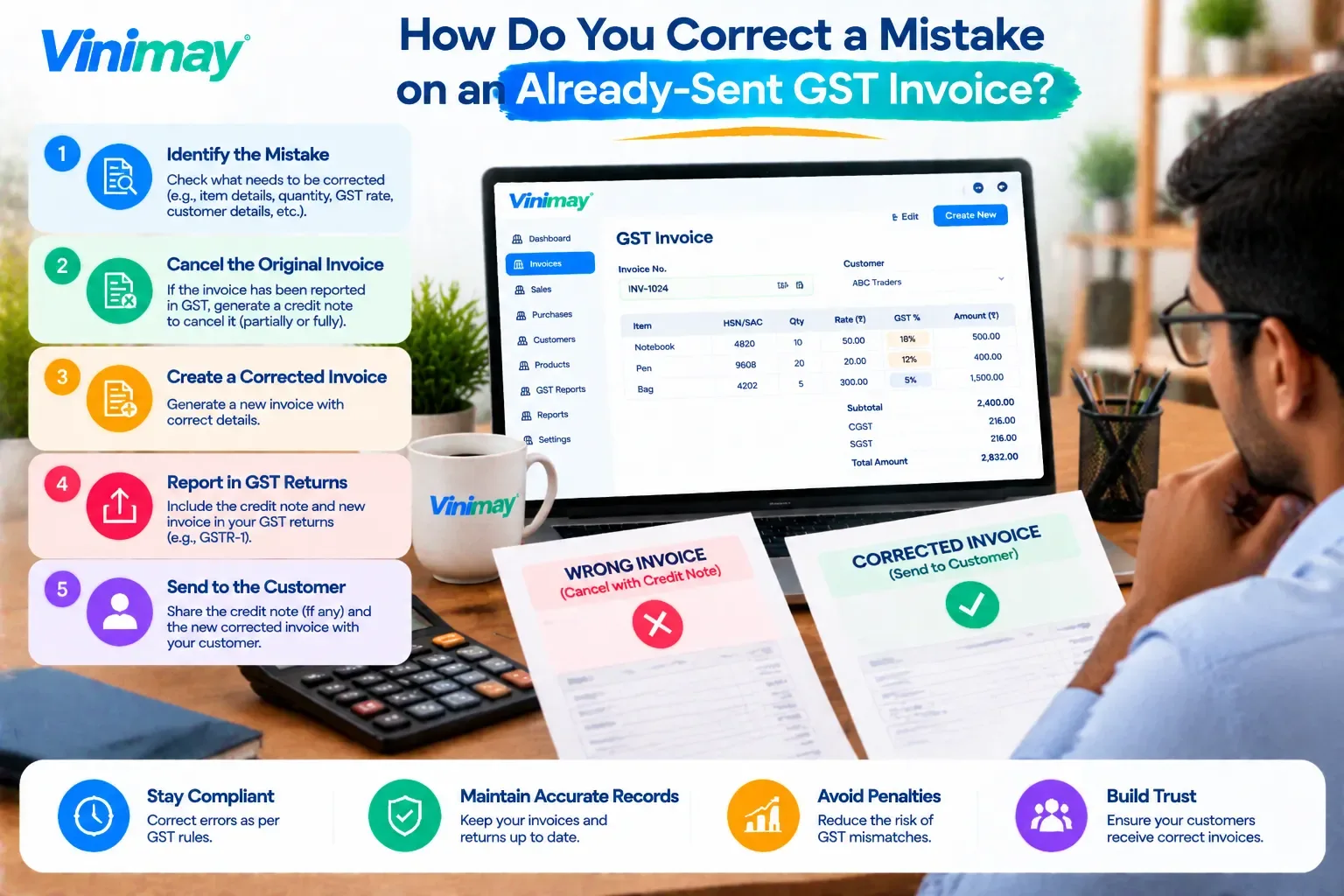
How Do You Correct a Mistake on an Already-Sent GST Invoice?
An invoice already sent to a customer, with an amount or tax detail already recorded, can't simply be edited and re-sent as if nothing happened — the customer already has a copy, and depending on timing, the figures may already be part of a GST filing period. A credit note exists precisely for this situation: a formal, separate document that corrects the original invoice's figures without altering or erasing the original record.
Understanding exactly how to issue one correctly matters because a credit note isn't just a note saying "sorry, ignore the previous amount." It's a structured document with its own requirements, and it needs to be linked clearly back to the original invoice so that anyone reviewing the records, including during a GST filing or audit, can see exactly what was corrected and why.
This article walks through what a credit note must contain, the step-by-step process of issuing one, and how it fits into GST filing, so a genuine invoicing mistake gets fixed properly rather than creating a second, unexplained inconsistency in your records.
Why a Credit Note Exists as a Separate Document
Direct answer: A credit note exists so that a correction to a sent invoice can be documented clearly, without erasing or directly altering the original invoice, keeping both the original error and its correction visible in the records.
If the original invoice were simply edited, there would be no record of what it originally said, no explanation for why it changed, and a mismatch between the customer's copy and your updated version. A credit note avoids all three problems by leaving the original invoice untouched and issuing a new, linked document instead.
What a Credit Note Actually Needs to Contain
A properly issued credit note should include:
The Step-by-Step Process of Issuing One
Identify the exact error — confirm whether it's an amount, an item, a tax rate, or a quantity issue
Reference the original invoice — note its invoice number and date on the credit note
Calculate the correction amount — the difference between what was originally billed and what should have been billed
State the reason clearly — a brief, specific explanation, such as "quantity billed incorrectly" or "goods returned"
Issue the credit note with its own sequential number — following its own separate numbering series, distinct from regular invoices
Share it with the customer — alongside the original invoice reference, so both documents are available together
Record it in your books — so receivables and GST records reflect the corrected figure going forward
Credit Note vs Debit Note: Which One Applies
How a Credit Note Affects GST Filing
Direct answer: A credit note adjusts the taxable value and GST amount in the filing period in which the credit note is issued, reducing the originally reported figures by the corrected amount, rather than requiring the original filing itself to be reopened or amended.
This is precisely why the credit note approach works better than editing the original invoice directly — the original filing period's figures stay historically accurate as originally reported, and the credit note captures the adjustment in its own period, keeping a clean, traceable record of both the original entry and its correction.
Common Errors When Issuing Credit Notes
Not referencing the original invoice number, making it unclear what the credit note is actually correcting
Vague or missing reason, which can raise questions during a review
Using the same numbering series as regular invoices, mixing two document types that should stay separate
Delaying the credit note for months, making it harder to trace back to the specific transaction
Forgetting to record it in receivables, leaving the customer's outstanding balance incorrect even after the credit note is issued
What a Credit Note Cannot Fix
A credit note corrects amounts and tax figures, but it doesn't address everything:
It doesn't change the original invoice's date or number retroactively
It doesn't resolve a dispute about whether the goods or services were delivered at all
It doesn't replace a completely new invoice if the original transaction needs to be re-billed under different terms entirely
A Clear Answer for Vinimay Users
Vinimay supports GST invoicing as part of its confirmed billing features, and correcting an already-sent invoice should follow the credit note process described above — referencing the original invoice, stating a clear reason, and recording the adjustment against the correct customer's receivables — to keep GST figures and customer balances accurate without altering the original invoice record.
Conclusion
Correcting a mistake on an already-sent GST invoice isn't about editing what was already issued — it's about documenting the correction clearly through a credit note, so the original record stays intact and the adjustment is traceable on its own. Getting the reference, reason, and numbering right on that credit note is what keeps both GST filing and customer receivables accurate going forward, without leaving an unexplained gap in the records.
FAQs
1. Can I just cancel and delete a wrong invoice instead of issuing a credit note?
Deleting a finalized invoice removes it from your numbering sequence and records entirely, which creates a gap that's harder to explain than a credit note, so issuing a credit note is generally the more traceable and compliant approach.
2. Does a credit note need to reference the exact original invoice number?
Yes, referencing the original invoice number is essential, since without it, there's no clear link showing which specific transaction the credit note is correcting.
3. What happens if I issue a credit note months after the original invoice?
It's still valid to issue one later, but the longer the delay, the harder it becomes to trace back the context clearly, so issuing it as soon as the error is identified is generally better practice.
4. Should a credit note follow the same invoice numbering series as regular invoices?
No, credit notes should maintain their own separate sequential numbering series, distinct from regular tax invoices, to keep the two document types clearly organized.
5. Does issuing a credit note mean I need to refund the customer money directly?
Not necessarily — a credit note can simply reduce the customer's outstanding balance if the invoice hasn't been paid yet, or it can be the basis for an actual refund if payment was already made in full.
6. Can a credit note be used to correct a wrong GST rate applied on the original invoice?
Yes, a credit note can adjust the tax amount to reflect the correct GST rate, as long as the corrected figures and the reason for the adjustment are clearly stated.
7. What if the entire invoice was issued to the wrong customer by mistake?
In this case, a credit note should be issued to reverse the original invoice for the incorrect customer, and a new, correct invoice should then be issued to the actual customer.
Related Topics
Published by Team Vinimay
Our editorial and compliance specialists create practical guides, tax calculation rules, and operational strategies to empower Indian small business owners and accountants.