Searching for the free plan with "the most features" assumes there's a hidden maximum-value option out there, if only you look hard enough. In reality, every free tier is built around the same trade-off: enough functionality to prove the software works, capped just short of what a growing business eventually needs. The real, useful question isn't which free plan has the most features—it's understanding exactly where that ceiling sits, so you're not caught off guard when you hit it.
This guide breaks down what free plans consistently offer, what they almost never include, and how to recognise the point where free stops being enough.
Why "Most Features for Free" Is the Wrong Way to Frame This
Free plans are designed as a functional preview of paid software, not a maximum-value tier, so comparing them by "most features" misses that they're all built to the same basic ceiling with minor variations.
Software providers need free users to eventually convert to paid plans to sustain the business, which means free tiers are deliberately capped—the differences between them are usually in where the cap sits, not whether one magically has "more".

The Realistic Feature Ceiling of Free Plans
This ceiling is usually enough for a single person handling low daily volume — the moment any one of these dimensions is stretched, the free plan starts to feel restrictive.
Features That Almost Never Stay Free
Regardless of which free tool is chosen, certain features are consistently reserved for paid tiers:
Multi-user access with role-based permissions — free tiers rarely support more than one login
Detailed, filterable reports — such as rate-wise GST breakdowns or slow-moving stock reports
Multiple company or branch management — handling more than one business entity under one account
Advanced document types at scale — unlimited delivery challans or proforma invoices beyond a small cap
Priority support or faster issue resolution — free tiers usually rely on self-service help
Expecting these in a free plan, regardless of provider, usually leads to disappointment — it's not a gap specific to one tool; it's how free tiers are structured industry-wide.
How to Know You've Reached the Ceiling
You've reached the ceiling when you're regularly working around a limitation rather than occasionally noticing one — for example, deleting old invoices to stay under a cap, or asking staff to share one login.
Signs worth watching for:
You're tracking invoice count manually to avoid hitting the monthly limit
A staff member waits for the owner to free up the login to bill a customer
You're exporting basic reports into a spreadsheet to build the analysis the software doesn't provide
You're maintaining a second business's records separately because the account can't handle multiple companies
You've started avoiding certain document types (like challans) because of a low free cap
Where Does Vinimay Fit Once You Hit That Ceiling?
Once a business is working around free-plan limits rather than occasionally bumping into them,
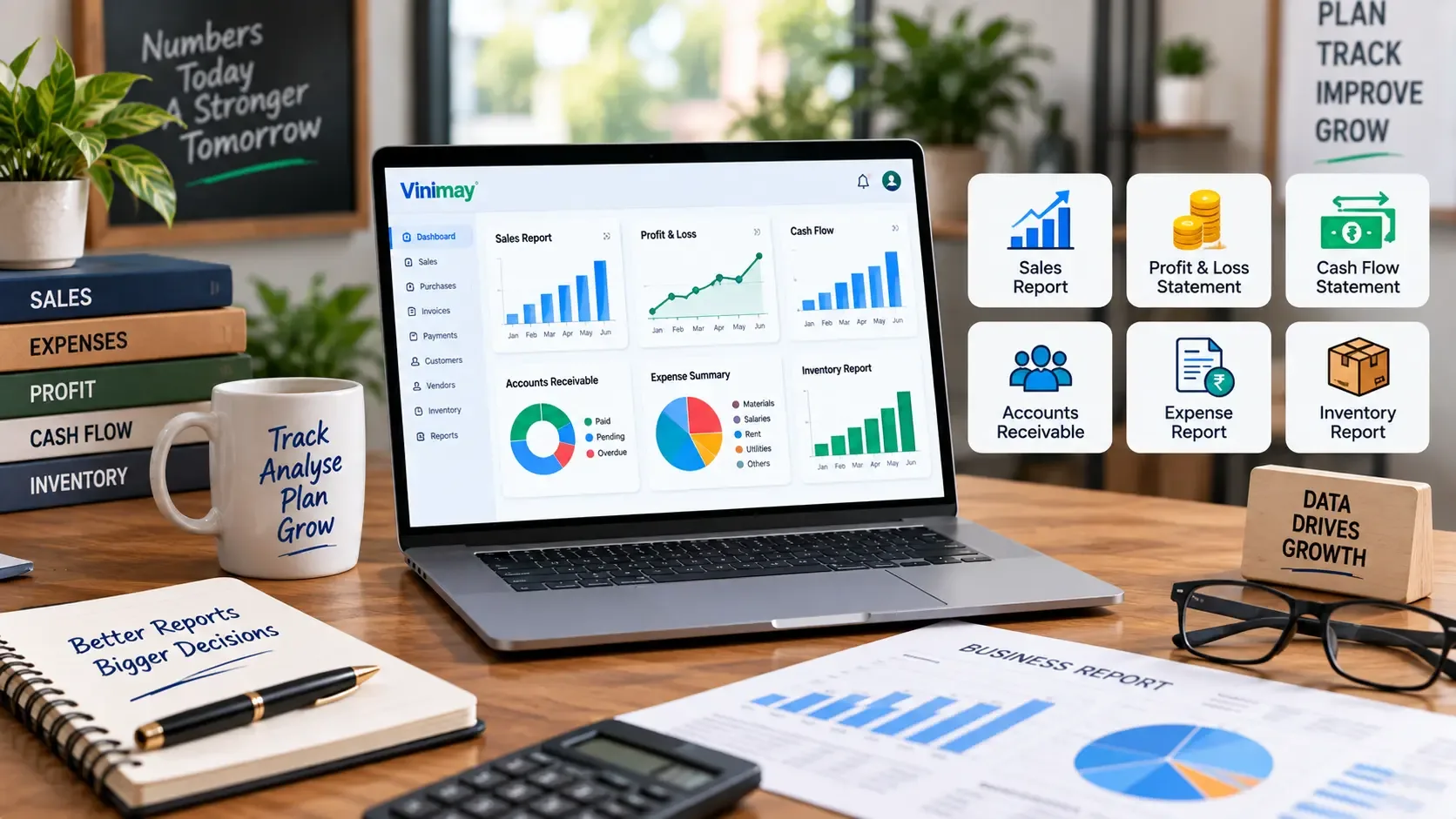
Vinimay brings GST invoicing, sales and purchase records, inventory tracking, customer and vendor management, ledger management, multiple company management, and reports together in one system—built for the stage where a business needs these working together consistently, not for a capped preview of them.
Conclusion
A free GST invoicing plan can take a small business quite far. It can help you create GST-compliant invoices, manage customer details, track transactions, and maintain basic business records without adding software costs.
However, as your business grows, you may need more than basic invoicing. Features such as inventory management, payment tracking, ledgers, reports, customer and vendor management can become important for managing day-to-day operations efficiently.
If you are looking for a more complete solution, you can explore Vinimay for GST invoicing and business management features in one place.
Frequently Asked Questions
1. Is it true that some free GST software plans offer more features than others?
The differences between free plans are usually minor — most are built around the same basic ceiling of limited invoices, one user, and basic reporting, with small variations in exactly where each provider draws that line. Chasing the plan with marginally more features rarely matters as much as understanding where any free plan's limits will eventually show up for your specific usage.
2. What features should I never expect to find in a free plan?
Multi-user access with different permission levels, detailed filterable reports, and support for managing multiple companies under one account are features almost universally reserved for paid tiers, regardless of the specific software. Expecting a free plan to include these isn't realistic, since offering them for free would remove the incentive for businesses to ever upgrade.
3. How do I know when my business has outgrown a free plan's features?
The clearest sign is when you start actively working around a limitation — deleting old invoices to stay under a cap, sharing one login between staff, or manually rebuilding reports the software doesn't provide — rather than simply noticing the limit exists. Occasional awareness of a limit is normal; regularly adjusting your workflow because of it means you've reached the ceiling.
4. Does a higher invoice limit on a free plan mean it's a better choice overall?
Not necessarily—a higher invoice cap helps with volume, but it doesn't address other common ceilings like single-user access or basic reporting, so it's worth checking all the relevant limits together rather than picking based on one number alone. A plan with a generous invoice limit but no multi-user support may still fall short for a business with more than one billing staff.
5. Why do free plans avoid offering multi-company management?
Multi-company management is typically reserved for paid tiers because it represents a scaled-up use case — a business large enough to run more than one entity is generally considered ready to pay for that added complexity. This keeps the free tier focused on its intended audience: single, smaller operations just getting started.
6. Can free plans support advanced documents like delivery challans and proforma invoices?
Some free plans include basic versions of these documents, but usually with a low monthly cap, similar to how regular invoices are limited, so heavy use of challans or proforma invoices tends to hit that cap quickly. If your business regularly needs these document types beyond occasional use, it's worth checking that specific limit before relying on a free plan.
7. Is it worth staying on a free plan just to avoid paying, even after hitting several limits?
Staying on a free plan while regularly working around multiple limitations often costs more time than the money saved, since manual workarounds — like shared logins or rebuilding reports manually — add up in effort every single day. At that point, the free plan isn't actually saving cost; it's shifting the cost into time and manual effort instead.
Related Topics
Published by admin
Our editorial and compliance specialists create practical guides, tax calculation rules, and operational strategies to empower Indian small business owners and accountants.