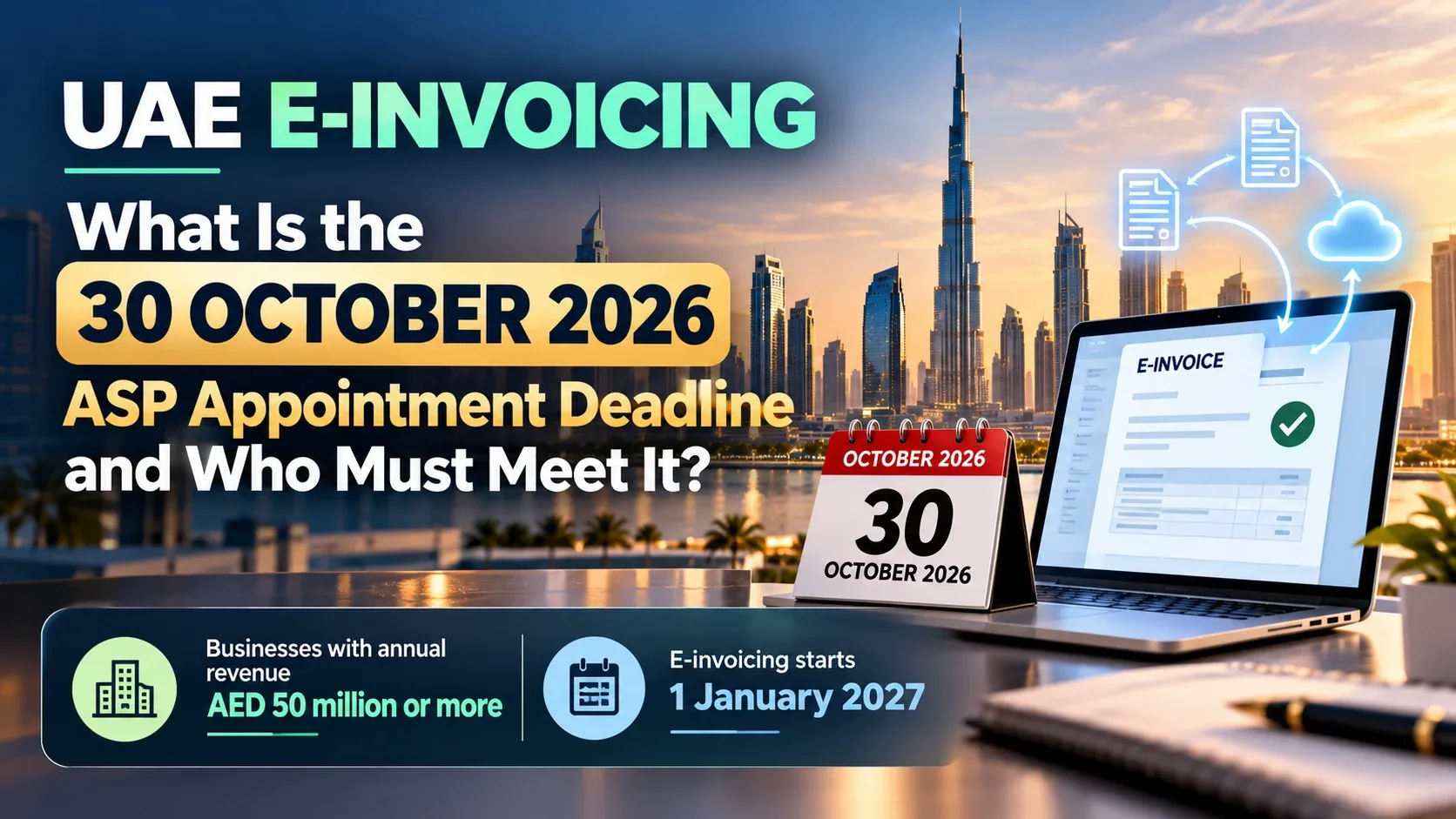
Quick Answer: The 30 October 2026 ASP appointment deadline applies to UAE businesses with annual revenue of AED 50 million or more. These businesses must appoint an Accredited Service Provider (ASP) before mandatory e-invoicing begins on 1 January 2027.
The UAE is introducing mandatory electronic invoicing to improve invoice processing, tax reporting, and financial transparency. Businesses operating in Dubai, Abu Dhabi, Sharjah, and other Emirates must understand the new requirements and their compliance deadlines.
The UAE Ministry of Finance extended the original ASP appointment deadline from 31 July 2026 to 30 October 2026. However, the mandatory e-invoicing implementation date for large businesses remains unchanged.
For affected businesses, selecting an accredited provider, preparing accounting systems and testing electronic invoice exchange are essential steps towards compliance.
What Is the UAE ASP Appointment Deadline?
The ASP appointment deadline is the official date by which businesses covered by the UAE e-invoicing mandate must appoint an accredited service provider.
An Accredited Service Provider (ASP) is a provider approved under the Ministry of Finance accreditation framework to facilitate electronic invoice exchange and related tax data reporting.
The appointment deadline was extended through Ministerial Decision No. 66 of 2026, amending Ministerial Decision No. 244 of 2025.
Businesses covered by Phase 1 must appoint their ASP by 30 October 2026 and prepare to implement compliant electronic invoicing from 1 January 2027.
Which UAE Businesses Must Meet the 30 October 2026 Deadline?
The deadline applies to businesses with annual revenue of AED 50 million or more that fall within the relevant UAE e-invoicing implementation phase.
Examples include:
Large trading and wholesale companies
Manufacturing and industrial businesses
Construction and contracting companies
Logistics and transportation companies
Professional service and consultancy firms
Large distributors and commercial enterprises
Free-zone businesses conducting covered transactions
The requirement is based on the prescribed revenue criteria, not simply the company's size, location or VAT registration status.
Businesses should review their revenue calculations and transaction types to determine whether they fall within the first implementation phase.
UAE E-Invoicing Timeline and Important Deadlines
The UAE Ministry of Finance has introduced a phased implementation schedule to give businesses sufficient time to prepare.
The voluntary e-invoicing programme began on 1 July 2026.
Although smaller businesses have a later deadline, they should begin evaluating their accounting software, invoice records and system compatibility.
Why Did the UAE Extend the ASP Appointment Deadline?
The Ministry of Finance extended the deadline from 31 July 2026 to 30 October 2026 to provide additional preparation time for businesses.
The extension allows organisations to:
Evaluate different accredited service providers.
Compare technical capabilities and service costs.
Review accounting and ERP integration requirements.
Negotiate suitable service arrangements.
Prepare internal systems for electronic invoicing.
However, the extension does not postpone the mandatory 1 January 2027 implementation date.
Businesses should therefore complete provider selection and technical preparation within the available period.
What Happens If a Business Misses the ASP Deadline?
Businessesthat fail to comply with the UAE e-invoicing requirements may face administrative penalties under Cabinet Decision No. 106 of 2025.
Important penalties include:
These penalties apply according to the relevant legal requirements and effective dates.
Businesses should monitor official updates and complete their compliance preparations before the applicable deadlines.
How Can Businesses Find an Accredited Service Provider in the UAE?
Businesses should select an ASP from the official Ministry of Finance accreditation register.
Before appointing a provider, organisations should check:
Official UAE accreditation status
Compatibility with existing accounting software
Support for UAE PINT AE invoice standards
Electronic invoice validation and exchange capabilities
Information security and data protection measures
Technical support, integration costs and ongoing charges
Businesses can consult the UAE Ministry of Finance E-Invoicing Portal for official information and provider resources.
Choosing a suitable ASP is particularly important for businesses processing large volumes of invoices.
How Should Dubai Businesses Prepare for Mandatory E-Invoicing?
Appointing an ASP is only the first stage of UAE e-invoicing compliance.
Businesses should review their invoicing operations and prepare their systems before mandatory implementation.
Important steps include:
Identify the applicable revenue category and implementation deadline.
Select and appoint an accredited ASP.
Review customer and supplier information.
Verify tax identifiers and required invoice fields.
Check compatibility between accounting software and the ASP.
Complete data mapping and electronic invoice testing.
Train finance and accounting employees.
Businesses using accounting platforms such as Vinimay should verify whether the software supports the required UAE e-invoicing standards and ASP integration. General digital invoicing features alone do not establish compliance with the UAE mandate.
What Should UAE Businesses Do Before 30 October 2026?
Businesses covered by Phase 1 should prioritize ASP appointments and technical readiness.
Large businesses should confirm their compliance responsibilities, finalize provider agreements, and establish a clear implementation plan for January 2027.
Smaller businesses can use the additional preparation period to review existing software, organize financial records, and understand the upcoming requirements.
Early preparation can reduce implementation delays, invoice processing difficulties, and potential administrative penalties.
The UAE e-invoicing framework represents an important change in business invoicing and tax reporting. Businesses that understand their deadlines and prepare suitable systems will be better positioned to meet their obligations.
Frequently Asked Questions
Related Topics
Published by prachi kahar
Our editorial and compliance specialists create practical guides, tax calculation rules, and operational strategies to empower Indian small business owners and accountants.