How Many Invoices Does a Typical Small Business Generate per Month?
It's tempting to want a single, clean number—"the average small business sends X invoices a month" — because it would make comparing your own business simple. The honest answer is that no such single number is meaningful, since invoice volume depends heavily on business type: a freelance consultant billing a handful of retainer clients and a retail shop billing every walk-in customer are both "small businesses," but their invoice counts can differ by a factor of a hundred or more.
What's actually useful isn't a universal average—it's understanding the range typical businesses fall into by type, so you can judge where your own business realistically sits and use that to make practical decisions, like whether a free billing plan's invoice cap is enough or whether you need something with more room to grow.
This guide covers why invoice volume varies so widely, rough benchmarks by business type, and why your own specific number matters more than any general average.
Is There a Single "Typical" Number?
Direct answer: No—invoice volume for small businesses varies enormously by type, from a handful of invoices a month for a solo freelancer to hundreds for a retail shop or wholesaler, so no single average number is genuinely useful for comparison.
Reported figures for invoice volume vary widely depending on the source and business type studied
A meaningful comparison has to account for your specific kind of business, not businesses in general
The more useful question is usually "what's typical for a business like mine," not "what's typical overall"
Why Invoice Volume Varies So Much Between Businesses
The scale of difference here is genuinely large, not just a minor variation. A solo consultant might issue just a handful of invoices a month, each for a substantial project or retainer fee, while a small retail shop can issue dozens or even hundreds of invoices in the same period, each for a much smaller transaction value. A wholesaler dealing in bulk orders sits somewhere else entirely, often issuing fewer invoices than a retail shop but at much higher individual values, sometimes split across multiple partial shipments.
This is why comparing "invoices per month" across different business types isn't actually a useful benchmark on its own—the number needs to be paired with business type and average transaction value to mean anything; otherwise, a wholesaler issuing 40 invoices and a retail shop issuing 40 invoices are in completely different situations despite sharing the same raw count.
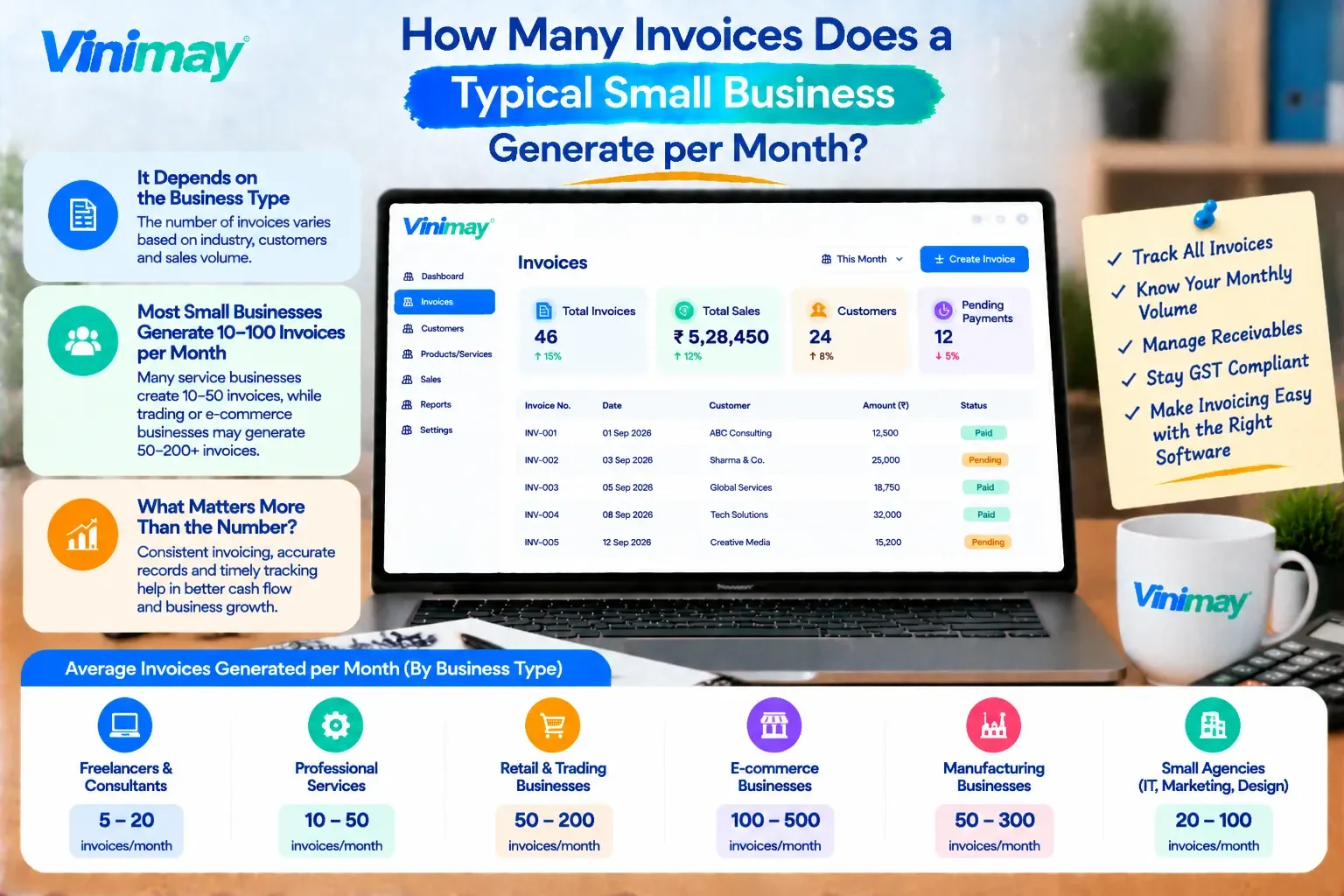
Rough Benchmarks by Business Type
These are rough, illustrative ranges rather than fixed benchmarks — actual figures vary by industry, region, and business model, so they're meant as a starting point for comparison, not a precise standard.
Why Your Own Number Matters More Than Any Benchmark
Your actual monthly invoice count is what determines whether a specific software plan's limits fit your needs
A benchmark from a different business type isn't a meaningful comparison for your own situation
Tracking your own volume over a few months gives a far more accurate picture than any general average
Your volume trend (growing, stable, seasonal) matters as much as the current number itself
How Vinimay Fits Your Invoice Volume
Supports GST-compliant invoicing suited to a range of volumes, from a handful of monthly invoices to higher-volume billing
Keeps invoicing connected to sales records and receivables, so tracking your own actual invoice volume over time is straightforward
Works for varying business types—service-based invoicing, retail-style frequent billing, or wholesale bulk transactions—through its confirmed feature set
Supports multiple company management for businesses whose combined invoice volume spans more than one entity or branch
Conclusion
There's no single meaningful "average" invoice count for small businesses — volume depends heavily on business type
Solo freelancers, retail shops, and wholesalers occupy very different, non-comparable ranges
Rough benchmarks by business type are more useful than an overall average, but still only a starting point
Tracking your own actual invoice volume over time is the most accurate way to judge your needs, including for choosing software
FAQs
How many invoices does a typical small business generate per month?
It varies enormously by business type — from a handful for a solo freelancer to hundreds for a busy retail shop, so no single average is genuinely meaningful.
Why can't I get one clear number for invoice volume?
Because "small business"spans hugely different transaction patterns — a freelancer billing a few large invoices and a shop billing many small ones aren't comparable on invoice count alone.
How many invoices does a freelancer typically send per month?
Often a handful — roughly 3 to 10 — since freelance work is usually billed per project, retainer, or milestone rather than per transaction.
How many invoices does a retail shop typically generate?
Often 50 to 300 or more per month, depending on customer footfall, since each sale typically generates its own invoice.
Does invoice count matter more than invoice value?
For choosing software plan limits, count matters most; for understanding cash flow, value matters more — both are useful for different decisions.
How can I find my own business's typical invoice volume?
Reviewing your actual invoice records over the past few months gives a far more accurate figure than any general benchmark.
Does invoice volume affect which billing software plan I should choose?
Yes, checking your actual monthly volume against a plan's invoice limits helps avoid hitting a cap unexpectedly or paying for more capacity than you need.
Do wholesalers generate fewer invoices than retail shops?
Often yes, since wholesale transactions are typically higher-value and less frequent, though this varies by specific business and order pattern.
Should invoice volume benchmarks influence how I price my services?
Not directly — invoice volume is about billing frequency, while pricing depends on separate factors like market rates and service value.
Is a growing invoice volume a good sign for a business?
Generally yes, if paired with accurate tracking and healthy receivables — but rapid growth in volume without proper systems can also signal a need to move past manual tracking
Related Topics
Published by admin
Our editorial and compliance specialists create practical guides, tax calculation rules, and operational strategies to empower Indian small business owners and accountants.