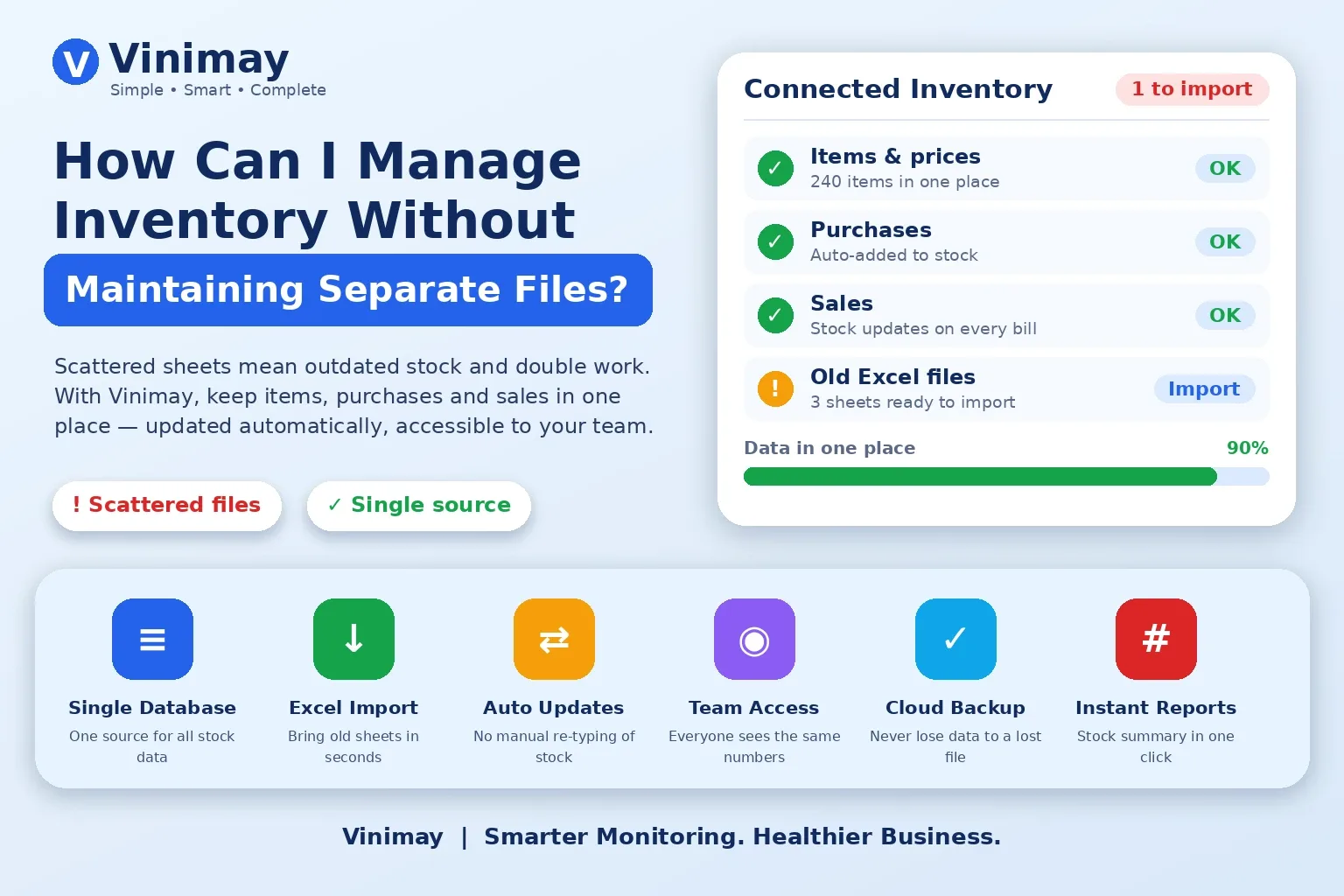
How Can I Manage Inventory Without Maintaining Separate Files
A business tracking inventory often ends up with one spreadsheet for purchases, another for sales, and a third for a running stock count, each updated somewhat independently. This split usually happens gradually and reasonably, purchases get logged when goods arrive, sales get logged during billing, and someone periodically tries to reconcile the two into a current stock figure. The problem isn't that any single file is wrong, it's that maintaining agreement between three separate files requires constant manual synchronization that's easy to fall behind on.
Consolidating this into one unified way of tracking inventory means a single product record reflects purchases, sales, and current stock together, rather than three separate documents that need to be cross-referenced to answer a simple question like "how much do I have left."
This article looks at why files tend to split apart in the first place, what that split actually costs, and a practical path toward consolidating existing separate files into one system.
What Maintaining Separate Files Actually Costs
Reconciliation time — someone has to periodically go through all three files and manually calculate whether they agree
Delayed accuracy — stock counts are only as current as the last time someone did that reconciliation, not truly real-time
Increased error risk — every manual transfer of a number from one file to another is a chance for a typo or omission
Confusion over which file is "correct" — if the sales file and the stock file disagree, it's not always obvious which one reflects reality
What "One Unified Record" Should Look Like Instead
Direct answer: A unified Services means each product has a single entry that updates automatically when a purchase or sale is recorded against it, rather than three separate files that need to be manually compared and reconciled.
A Practical Path to Consolidating Existing Files
Pick one product at a time rather than attempting to migrate the entire inventory at once
Do a physical count for that product to establish an accurate current baseline
Enter that baseline as the opening stock in the unified system
Stop updating the old separate files for that product going forward, entering all future purchases and sales only in the new system
Repeat for the next product, gradually moving the full catalog over rather than switching everything simultaneously
Keeping It From Splitting Apart Again
The consolidation only holds if new habits replace the old ones completely:
Every purchase and sale for a migrated product gets entered only in the unified system, with no parallel entry in an old file "just in case."
If a second person handles some transactions, they need to use the same unified system, not their own separate tracking method
Periodic physical counts still matter, but now they're checking one system against reality, not reconciling multiple files against each other
Conclusion
Managing inventory without separate files comes down to consolidating purchases, sales, and stock into one connected record instead of maintaining several documents that need constant manual reconciliation. A gradual, product-by-product migration, backed by accurate physical counts, moves a business away from this fragmented approach without the risk of a single, error-prone, all-at-once switch
FAQs
1. Why does inventory tracking tend to split across multiple files in the first place?
It usually happens gradually and for reasonable reasons; purchases get logged separately from sales because they happen at different times and often by different people, and a combined stock file gets added later to reconcile the two.
2. Is it risky to migrate all products to a unified system at once?
It can be, since verifying accurate opening stock for an entire catalog simultaneously is time-consuming and error-prone, migrating gradually, one product or category at a time, is generally more manageable.
3. What happens if I keep updating old files "just in case" after switching to a unified system?
This defeats the purpose of consolidation, since maintaining even one parallel file reintroduces the same reconciliation burden the switch was meant to eliminate.
4. How do I establish an accurate starting point when consolidating?
A physical count of actual stock, rather than relying on whatever the old separate files suggest, gives the most reliable baseline to enter as opening stock in the new unified system.
5. Does a unified inventory system eliminate the need for physical stock counts?
No, periodic physical counts remain important, but instead of reconciling multiple files against each other, they simply verify that the one unified system matches physical reality.
Related Topics
Published by Team Vinimay
Our editorial and compliance specialists create practical guides, tax calculation rules, and operational strategies to empower Indian small business owners and accountants.